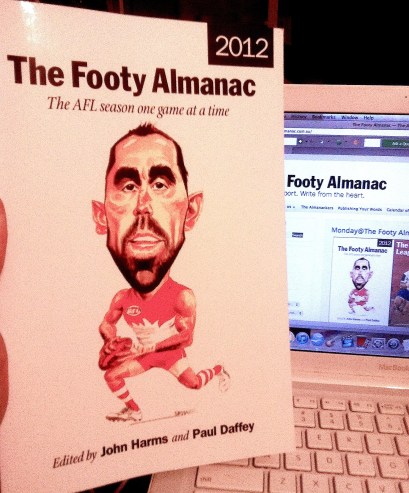
The festive season is upon us, and whilst the organised among my loyal readers have finished buying or making presents, there are those of you like me, who are only just beginning to think about starting such a task. Well this may help, as it has helped me. If you happen to be wondering what to get for your footy-obsessed family member or friend as they suffer the withdrawals the off-season brings, look no further for the answer is here. The 2012 Footy Almanac.
So what just is the Footy Almanac I hear you ask. Great question. In essence it is a yearly summary of the AFL competition, with all match reports written by people like you and me, lovers of football. No routine newspaper style ‘match reports’ which merely appear to cut and paste the teams and players names from week to week, in the almanac each match has it’s own unique narrative. You’ll laugh, you’ll cry and all that jazz. It’s a far deeper look at the game of Australian Football.
The great thing about the Almanac is that the match reports bring to life the dullest of fixtures in a way that Fox Footy’s obsession with off-season repetition cannot, because they focus not just on what happens on the ground, but also the historical implications, the pub talk, the walk to the ground, the characters in the outer. To me, it’s a more complete picture, lovingly put together by John Harms and Paul Daffey.
You can also become a member of the footy almanac website where you can share your football writing, or any other sport should you wish. Check it out, there’s some brilliant content on the site. If you’d like to order the Footy Almanac you can pick it up at good bookstores, probably some bad ones too, or you can purchase it off the almanac website.
Oh, and make sure you flick to the round 17 Richmond v North Melbourne match. Another glorious Richmond loss penned by yours truly.
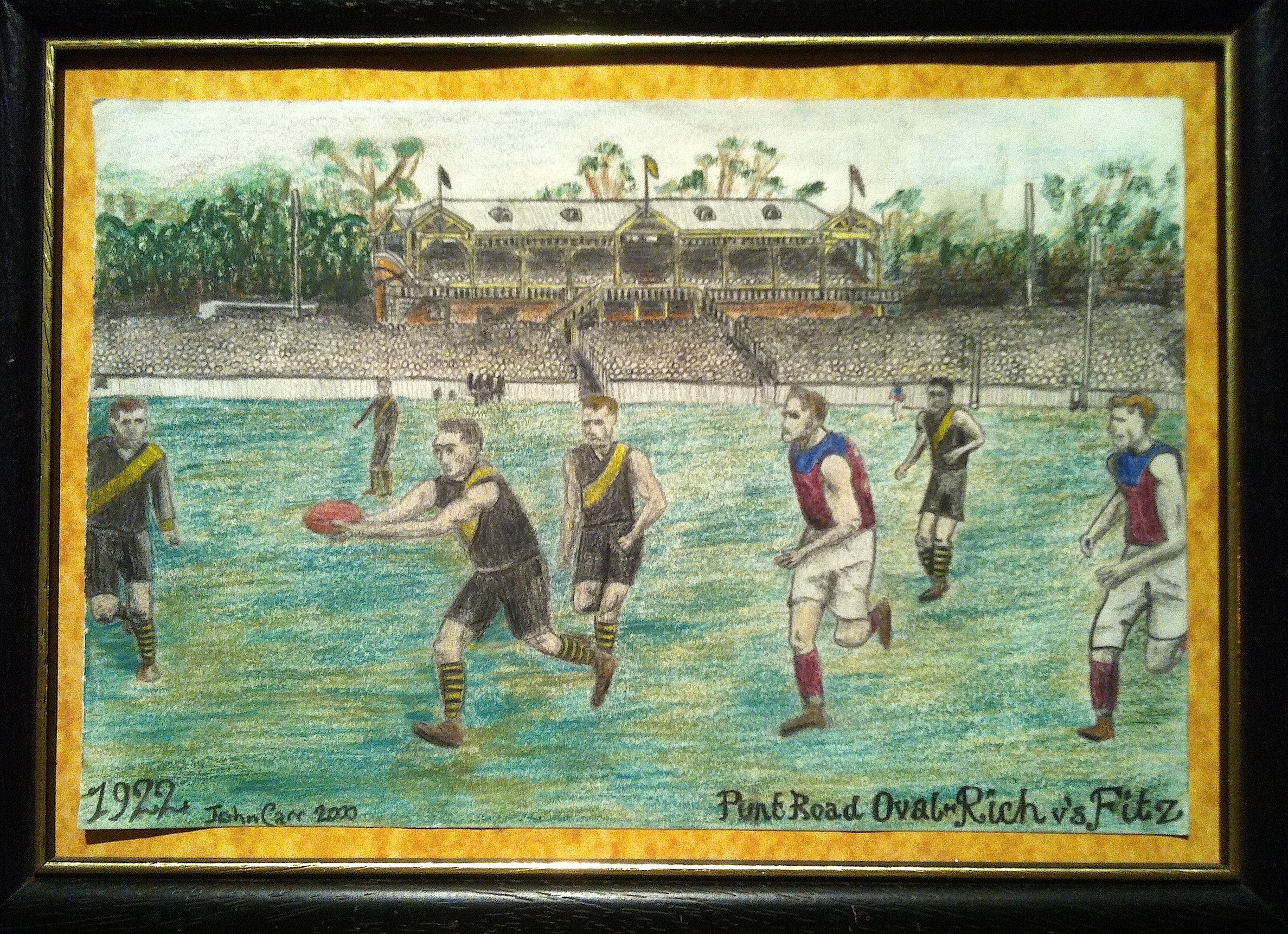
My five year old daughter the other night asked whether the olden days were in black and white. I think we may have all had that moment as children, our only links with the past being the old black and white photographs we peered at curiously. Well sifting through some old things at my parents the other day, I came across this drawing I did as a teen, and was reminded of my reasons for drawing it. I wanted to bring to life an old black and white photograph of a Richmond v Fitzroy match from 1922, with captain Dan Minogue taking a mark in outstretched arms.
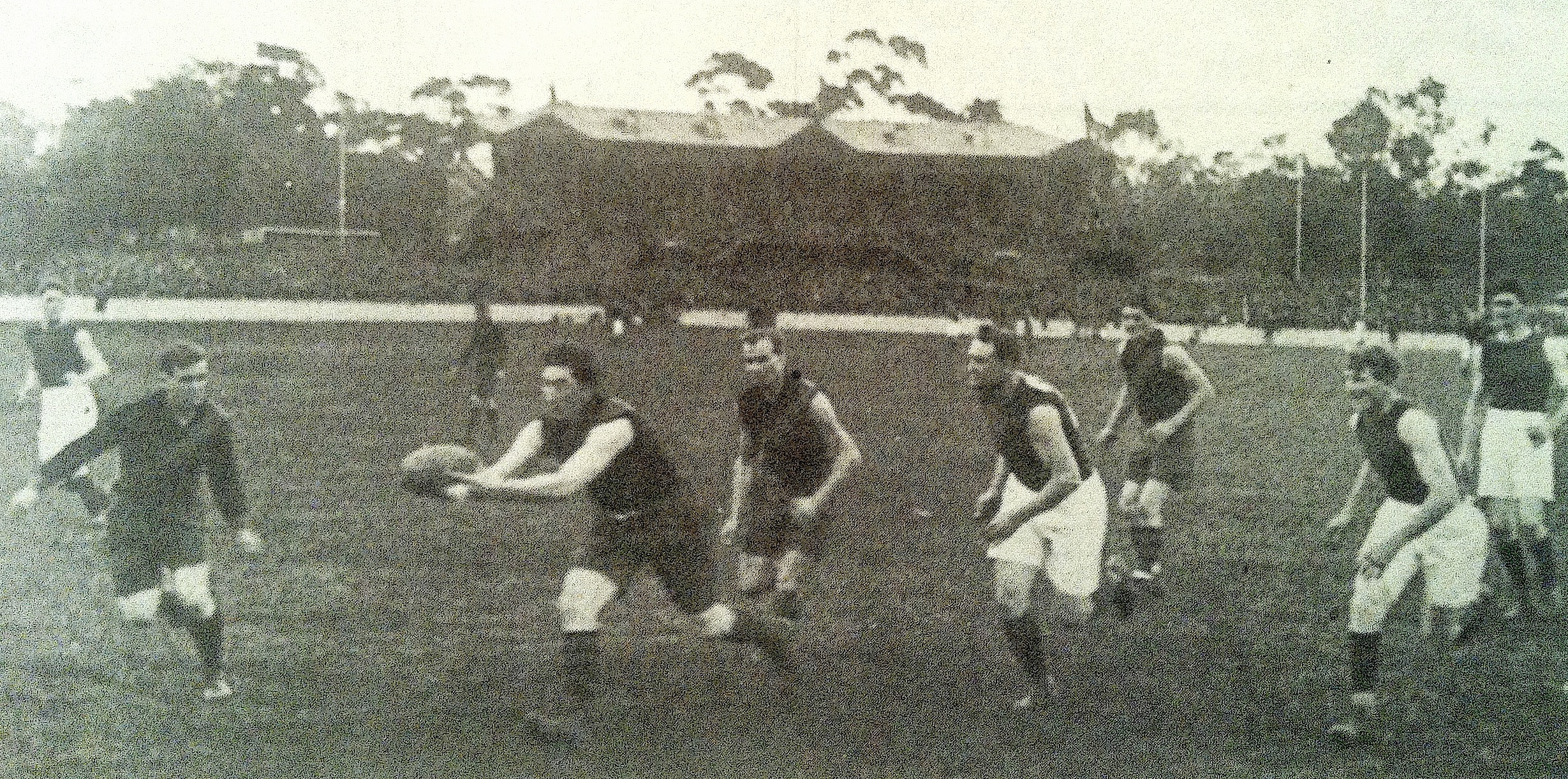
Whilst I’m not particularly pleased with the ‘trees of Yarra Park’ (I clearly had lost interest by this point, a common theme with myself and drawings) I made amends, in my mind at least, with the detail on the old grandstand, when my interest in the project was clearly at a peak. Below is the original snap, photographer unknown.
The result that day was Richmond 5.10.40 to Fitzroy 3.14.32, an aggregate of 8.24! Perhaps goalkicking accuracy isn’t so bad these days. Richmond having won the previous two VFL flags, and Fitzroy claiming their 7th later this year, it was fair to say the two clubs were a big deal at the time!
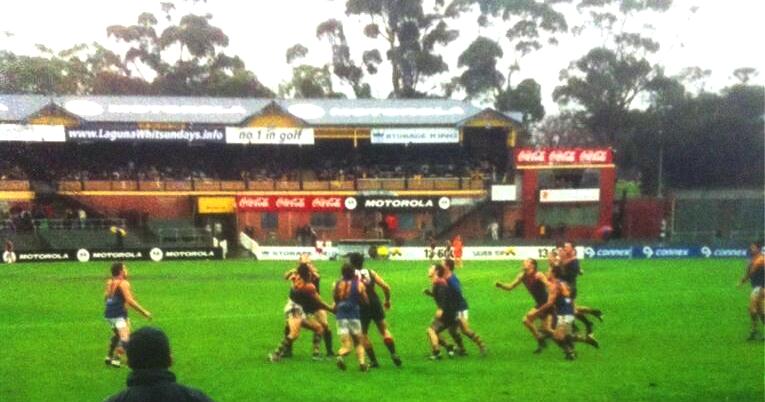
I took a photo from the same spot-Williamstown v Coburg, mid 2000's
Note: The grandstand…since renamed the Jack Dyer Stand, was opened in 1914, with a substantial addition in 1927. And Tiger fans…look out for my upcoming post on the Punt Road Oval! The more recent photo shows where the stand extenstion begins to the left.
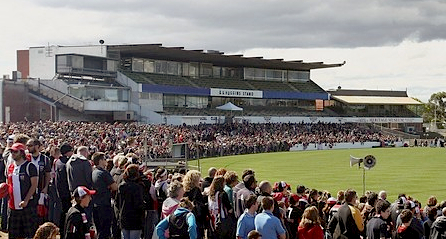
Moorabbin Oval: League venue: 1965-1992. League (VFL/AFL) matches: 254. Record Attendance: 51,370 St.Kilda v Collingwood, round 1,1965 (league debut)
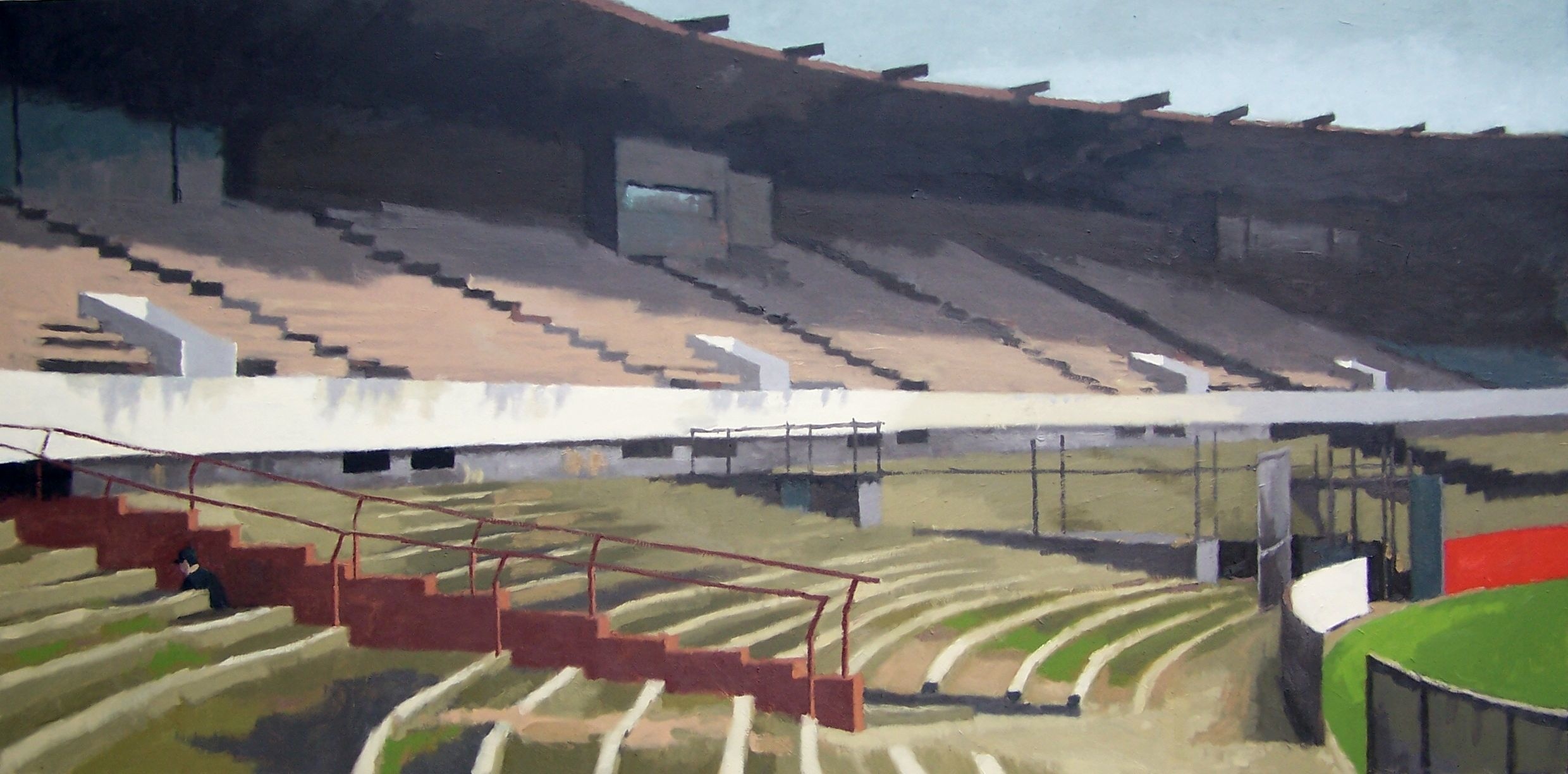
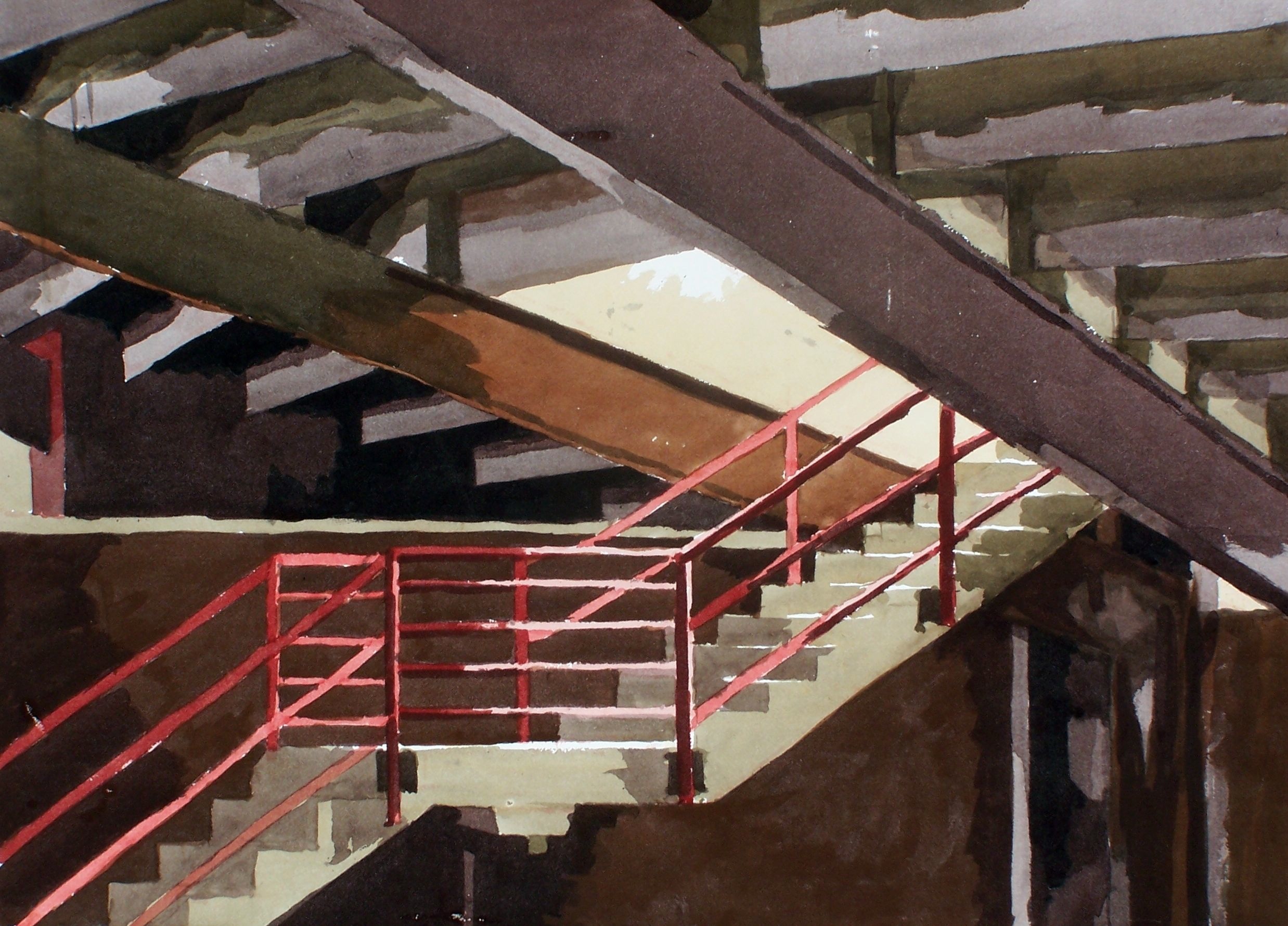
Painting of the decaying Moorabbin stands by David Hurwitz.
1965: a watershed year for the Victorian Football League. It can be argued that this year was the birth of the modern game. Barassi threw the long held ideal of loyalty into disarray, while three teams vacated their traditional homes in search of greener pastures. While North’s venture to VFA side Coburg’s ‘City Oval’ was short lived, Richmond’s move to the MCG propelled it to it’s most successful period, as did St.Kilda’s move from their home by the sea to Moorabbin, another VFA ground taken over by a league club, another glimpse into the future.
The Moorabbin Football Ground was previously home to VFA team the Moorabbin Kangaroos. Cutting a long story short, St.Kilda saw that the south east of Melbourne was in effect, unclaimed territory, and decided upon the shift. Though the move to Moorabbin brought with it heartache, all was quickly forgotten as St.Kilda made back-to-back-back grand finals, winning their one and only flag in 1966.
You can track St.Kilda F.C’s movement’s in the below diagram I put together.
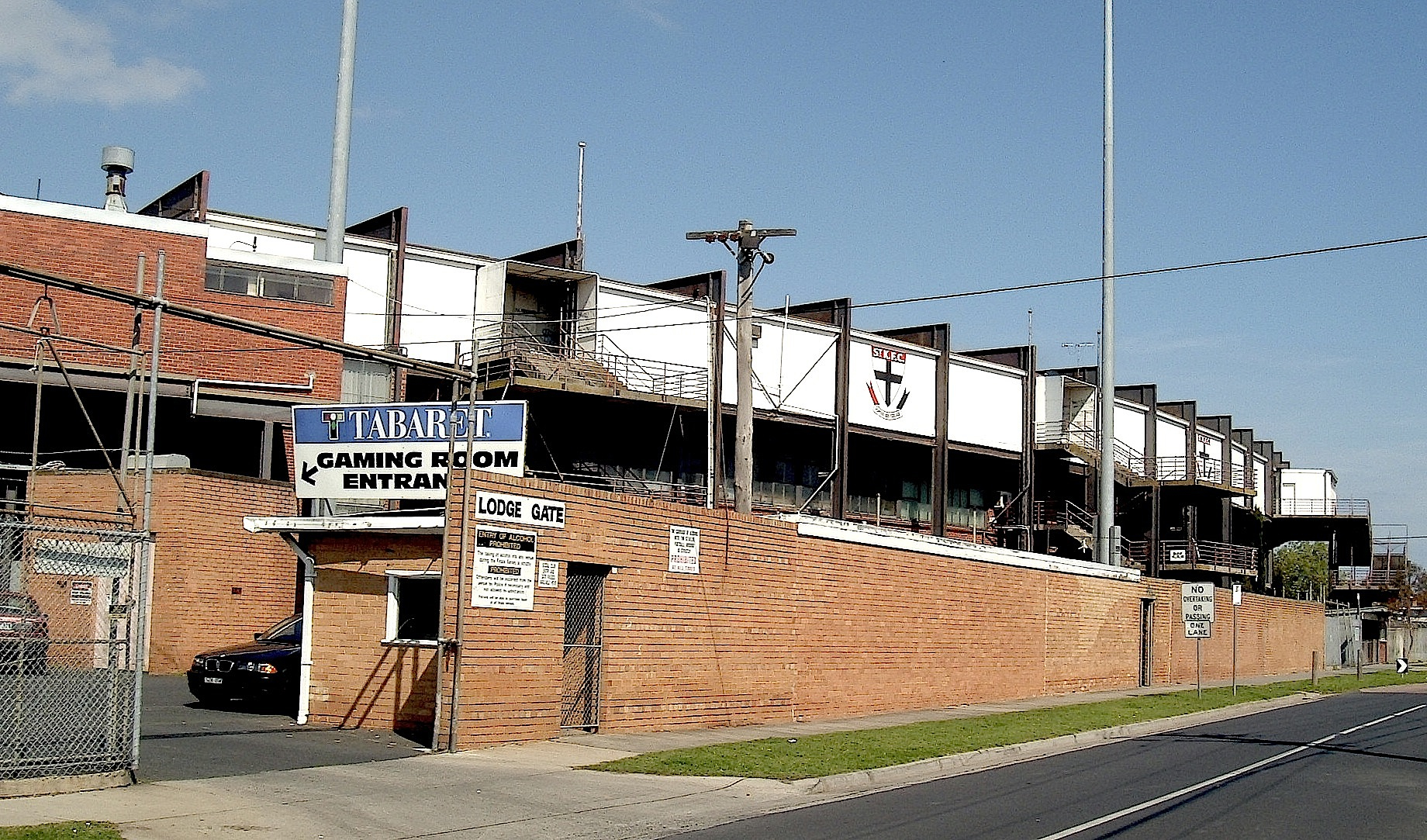
As you can see from the recently demolished stands at Moorabbin, the intention appears to have been to gradually morph St.Kilda into the Moorabbin Football Club, but this clearly never eventuated.
Whilst the ground’s league lifespan was short, less than 30 years, it truly found a place in the heart of St.Kilda fans. Though not quite to the level which Victoria Park has entered football folklore, Moorabbin has still spawned it’s fair share of paintings and literature, holding a certain dreamtime quality for fans of the red white and black.
On the left is another painting from David Hurwitz, painted in a very similar position to which I took the photo on the right! Great minds think alike I guess.
This post isn’t about the Animal Enclosure, the old Moorabbin nightclub or the muddy centre square. Heck, it’s not even about the Jeff Fehring goal from behind the centre! (However if you want a sneaky look, here it is!)
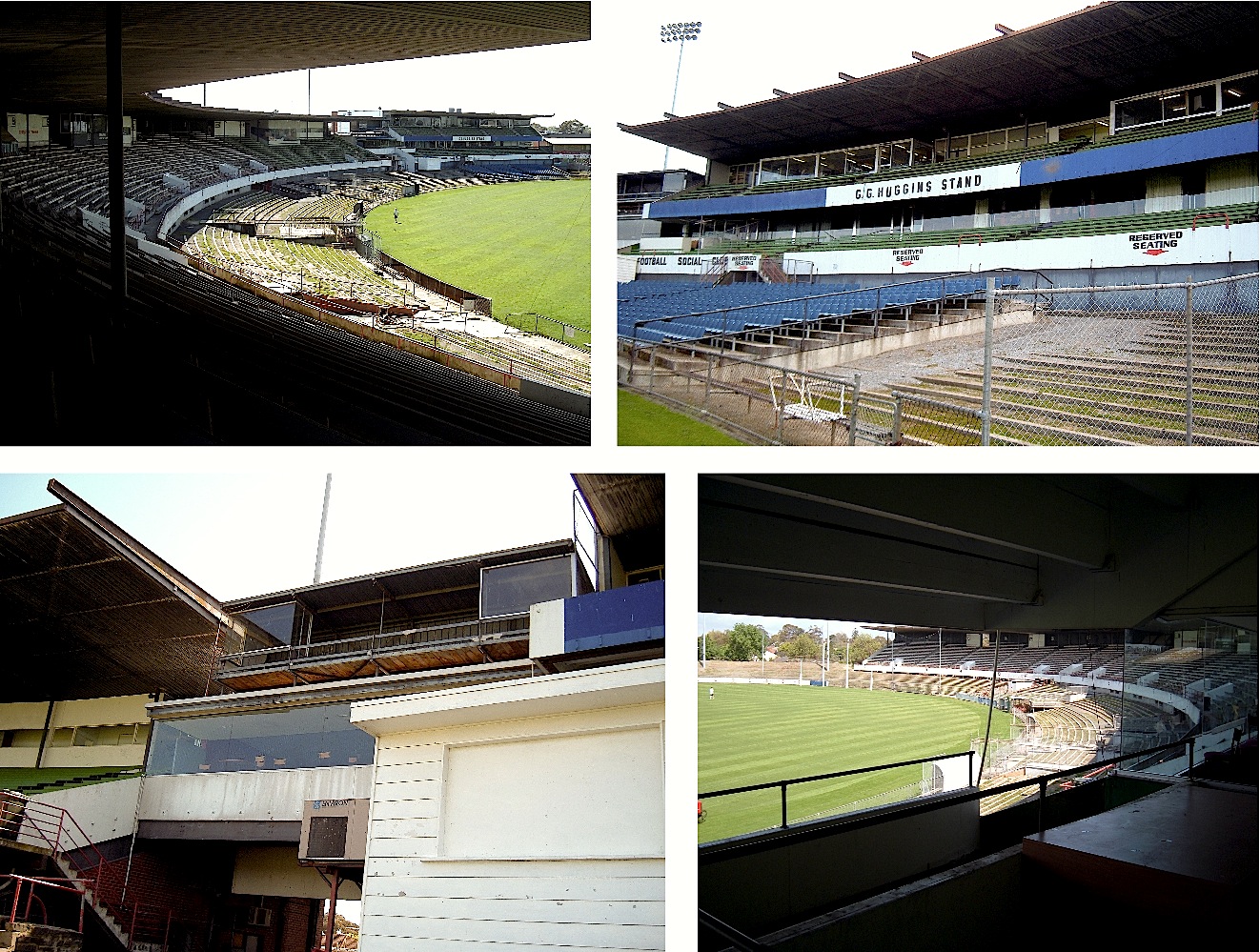
This is a collection of pictures I took of the ground in 2006, in a desperate bid to photographically archive all the old league grounds in Melbourne. As it turns out, much of what I captured has since been demolished, and many links to the past now gone. It seems a number of footy fans shared my vision, and some of their photos and paintings have helped shape this post.
My dad always said that Moorabbin seemed odd to him as it jutted out of the south-eastern suburbs of Melbourne; most other grounds were flanked by old hotels, old train stations and old terrace houses. Moorabbin was surrounded by the cream brick veneer housing of an ever-expanding city.
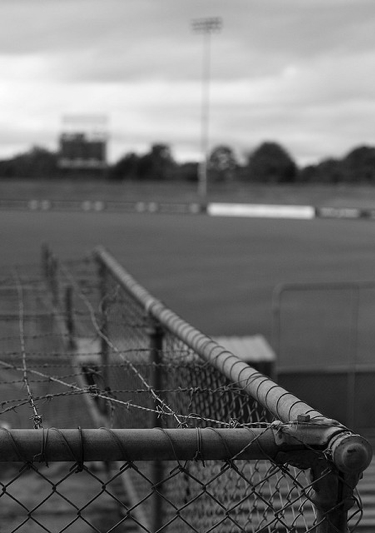
As I circled the ground before entering, I snapped one of the old entrance gates. On closer inspection, it became quite clear that it was occupied, and though I was keen to document all that I could, I decided to continue on.
And what this above photo makes me realise? That modern football stadia is severely lacking in barbed wire!
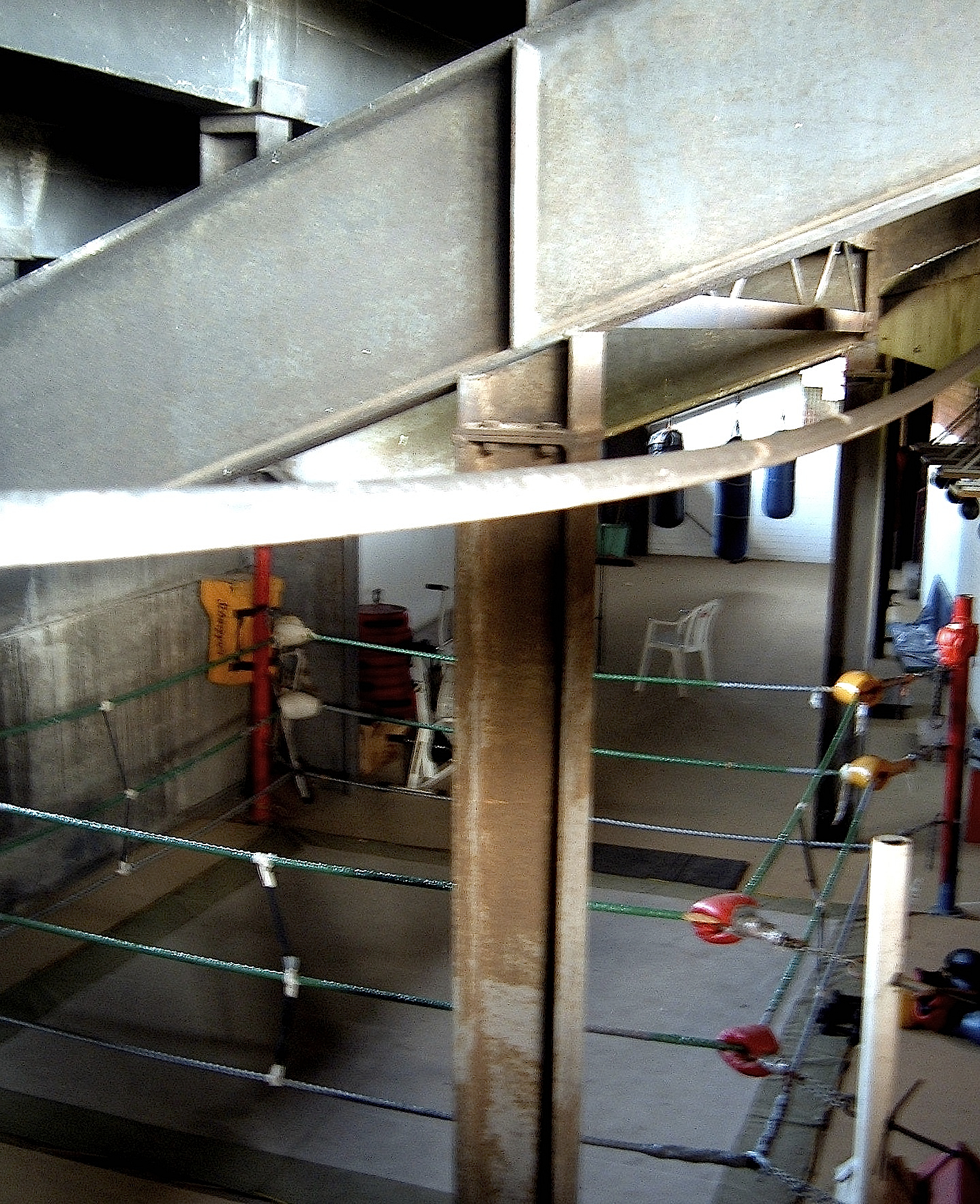
As I entered the ground from the Linton St side, I couldn’t help but catch a glimpse of St.Kilda’s gymnasium of the time. Even though this was six or so years ago, it was severely behind other clubs and their advanced setups. This was open to the elements!
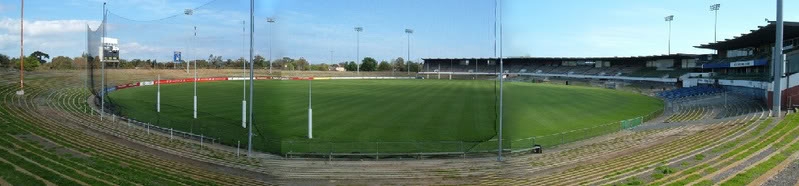
What struck me about Moorabbin was the size. The stand which stretched from the wing to behind the goals (below) was very large for a suburban ground, and the terraced outer was rather expansive. It begs the question of why the club actually moved to Waverley Park in 1993. Geelong’s Kardinia Park is nearly three quarters through a long-term redevelopment, the club reaping the benefits of being able to sell reserved-seat tickets to their matches. It is a shame that a ground such as Moorabbin has not shared the same fate.
The grandstand offered plenty of cover and very good views. However, the photo at the bottom left is what I love about the old footy grounds…if you needed a coaches box, you built it on top of the stand, creating a haphazard atmosphere which brought with it great character. A combination of weatherboard, tin, steel and brick!
Now to the outer. This is where the majority of footy fans have watched the action for the best part of 150 years. It’s now all but a relic of the past. Moorabbin’s expansive outer bore many a story, tears of joy and despair, the odd laugh and a round of fisticuffs or two. To illustrate, here’s how St.Kilda diehard Matthew Hardy’s remembered his first experience of the outer at Moorabbin from his wonderful (and highly recommended) book ‘Saturday Afternoon Fever‘
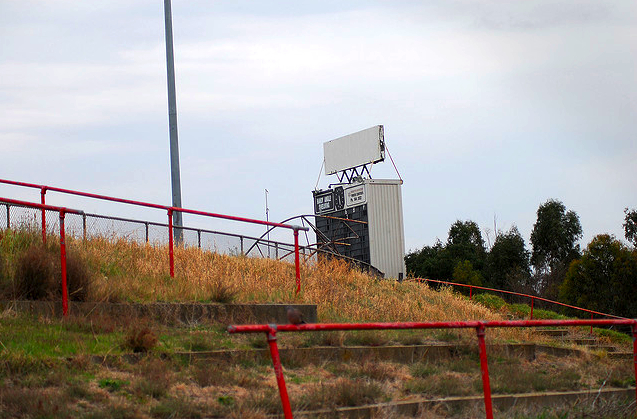
I love this shot taken by supporter and photographer Berk McGowan of the overgrown mound behind the outer, the scoreboard still erect and the iconic red iron work. It really captures both present and past. (Check out www.berkmcgowanphotography.com)
photo supplied by Berk McGowan Photography
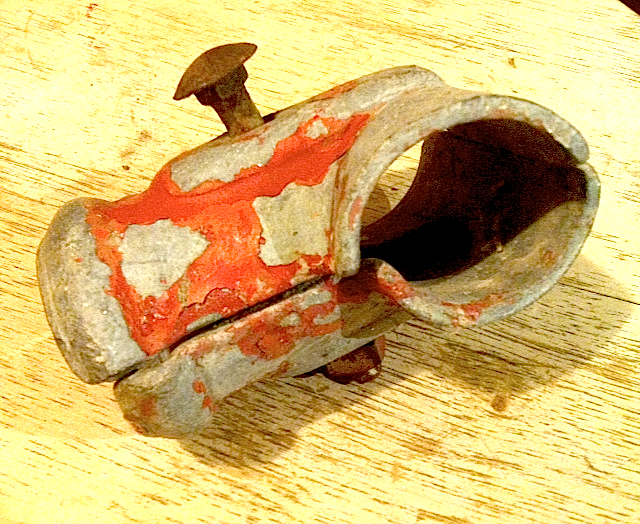
On my explorations, I found my own bit of Moorabbin to take home with me, 2 inch tubular fencing tee piece coupling, with red paint peeling. This was well captured again by Hurwitz’s painting on the left.
Here’s the outer side of the Moorabbin footy ground; the wooden seats on the fence for those early enough, looked down upon by the now demolished scoreboard and timeclock. In a great piece on the Moorabbin scoreboard, Vin Maskell looks at it’s history, and where portions of it are now scattered!
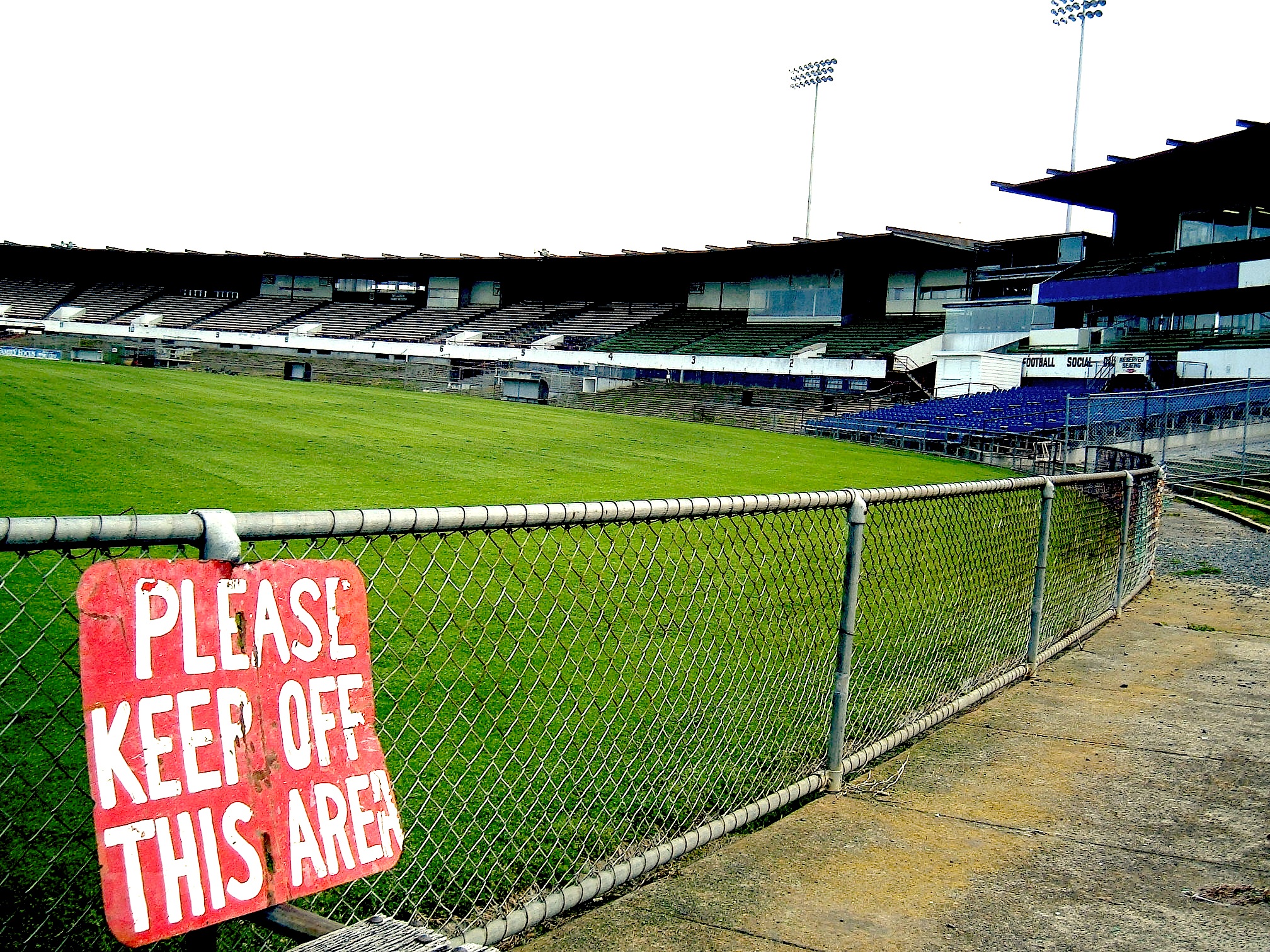
Old footy grounds were not just protected by barbed wire. Officious and over-zealous signage adorned many on old venue, and it’s hard to imagine it not been written by a gnarly old stallwart. Consider the following examples…the second is from the collection of Tim Best, a Saint fan who used to sell the footy record outside the ground!
And what post on Moorabbin would be complete without at least a view from one of the most notoriously vicious and parochial patches of terracing Australian Football has know, the old Animal Enclosure. The name says it all, it was not for the feint-hearted! Here’s a wonderful piece on the Animal closure by Paul Daffey.
Photograph by Tim Best. For more of his photographic take on Moorabbin Oval, click HERE.
While the Saints now train at the Seaford version of Linen House Oval (I liked how ‘Linen’ was so close to ‘Linton’) they still maintain a presence at Moorabbin. Only the Huggins stand remains, yet where terraces and stands once stood, there are now grassy embankments, maintaining the feel of how it once was. With light towers erected for baseball in the 1990’s, Football Victoria could do worse than considering it as a home for VFL football, however I can’t see this eventuating.
The Saints now play at the Docklands, which is far closer to their birthplace, St.Kilda, than Moorabbin, Waverley and Seaford combined. Yet a ‘home ground’ in Melbourne is nothing more than a token gesture these days, and nothing will match the days at the Junction and then Moorabbin. But that’s progress, progress which can be traced back to the Saints pioneering move to Moorabbin in the first place. Leaving wasn’t easy in 1992. There was much supporter angst, yet to no avail. Again consider the words of Matthew Hardy when it came to the last match at the ground in 1992.
And here’s a great clip from the last day at the ground.
g
So to sum up the Moorabbin Football Ground as a league venue, I will simply say this…
Artist & Pies fan David Hurwitz. Please contact him if you are interested in any of his remaining Moorabbin works. They’d make a sensational addition to the Saints fan collection. You can visit his website and contact David. http://www.davidhurwitz.com.au
All photographs by John Carr unless otherwise stated.
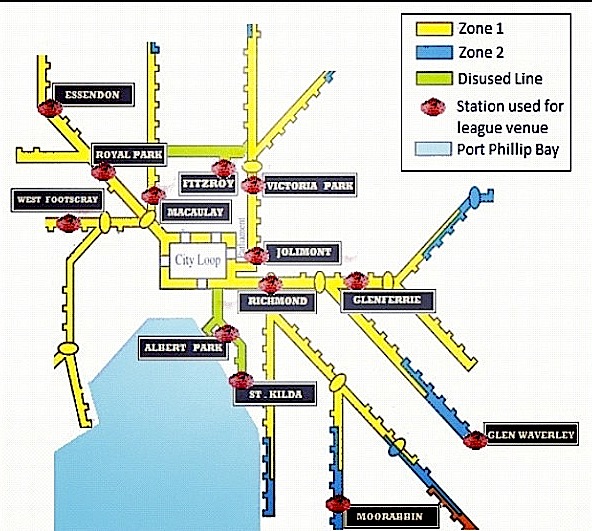
Unfortunately it is ‘un-embedable’ at this point, so a screen shot will have to. Below you can see what I’ve done, it’s a map of the rail network in Melbourne (adding in the defunct train lines in MSPaint) with a little footy on all the stations of the traditional Melbourne league venues. Great. But once you’re in the gloggy thing, click on the footy and you get taken to my post on that particular ground.
I haven’t gotten around all of the grounds as yet, so if you click on a station/footy and nothing happens, then just sit tight, I’m getting through them. There’s a Moorabbin one brewing as we speak!
Once I’ve finished my series on the old VFL grounds, it’s then to the VFA and beyond!
History. Records. Come Saturday afternoon at the MCG, the players won’t be giving these two words a thought in the world and rightly so. It is the now that they must live in. But alas, I am not playing in the AFL Grand Final, and therefore wish to delve into the past.
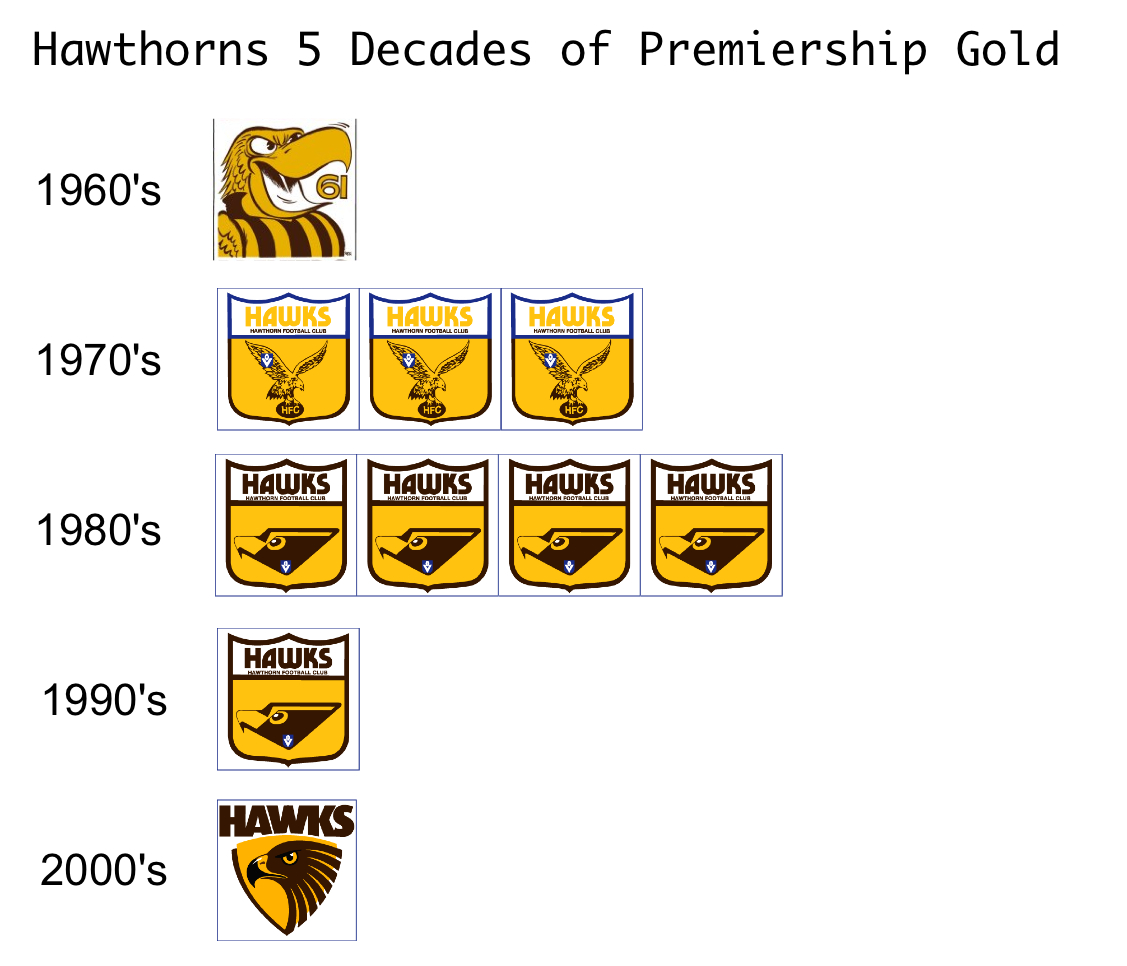
Should Hawthorn win the 2012 premiership, they will break a long held, little know record. It has been well documented that Hawthorn has won at least one premiership in every decade since the 1960’s, which equals Melbourne’s record of 5 straight decades with at least one premiership (1920’s-1960’s.) Should Hawthorn overcome the Bloods on Saturday, they will become the first VFL/AFL team to claim premierships in six consecutive decades, a truly remarkable feat of sustained success.
To illustrate, the three most successful clubs, Essendon, Carlton and Collingwood, have at best managed just four consecutive premiership yielding decades, giving an idea of just how successful the Hawthorn Football Club has become since John Kennedy took a hold of them and since they changed from Mustard Pots and Mayblooms into predatorial Hawks.
What makes it all the more astonishing is the meagre beginnings of the club. Formed in 1902, the club unsuccessfully progressed through the Metropolitan league, the VFA and into the VFL, all with a bare trophy cabinet. Once in the VFL, they spent the 1920’s-1950’s as a cellar dweller, and along with the other 1925 inclusions to the league, Footscray and North Melbourne, didn’t look like winning a premiership.
Footscray was the first of this trio to break through for a flag in 1954. But just seven years later in 1961, as both Hawthorn and Footscray met on the big day, it was the ‘underdog’ Hawthorn who were the sentimental favourites, winning their first flag and beginning an astonishing run of success.
But they come up against a formidable foe in Sydney, also once the easybeats of the league. In fact the Swans (continuation of the South Melbourne into the Sydney Football Club) have undergone a transformation not unlike Hawthorn’s in the 1960’s. After six fruitless decades, surpassed only by St.Kilda’s 1890’s-1950’s drought, the Swans shed their easybeat image, internally rebranding themselves as the Bloods, leading to premiership success in 2005.
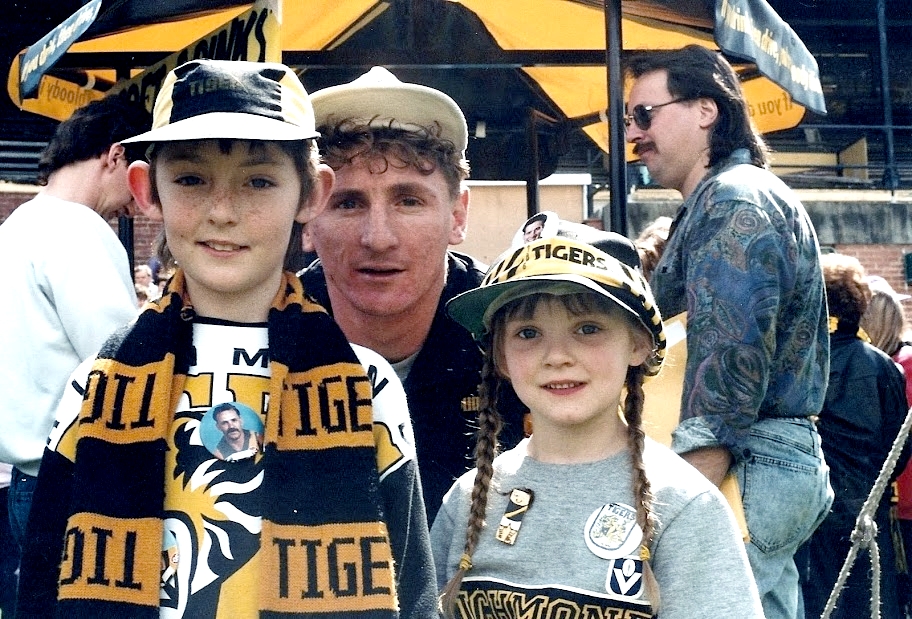
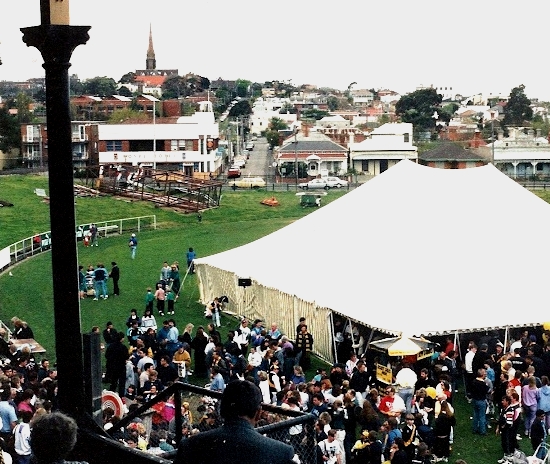
The year was 1991, and Craig Lambert had just taken out the Richmond best and fairest award. This is long before the current day glitz and glamour of club Best & Fariests, complete with live streaming on the club websites. This was pretty much a sausage sizzle under a tent with 100 or so people around.That’s me on the left, Lamby in the middle and my sister Mezz on the right. Contrary to the lies I told my sister, that is not David Cloke in the background!
So that’s me in my dorky early 90’s Richmond attire… I would’ve worn Tiger jocks had they been available. Note my sisters Trent Nicholls badge atop her hat, her favourite player at the time, while Flea Weightman’s badge is close to my heart. The following year saw me don Lamby’s number 4, and as I had a long sleeve jumper, this felt authentic. It was with sadness that another Tiger hero of mine left at the end of 1993, but I followed his career with interest, much as I did with Stuey Maxfield in Sydney.
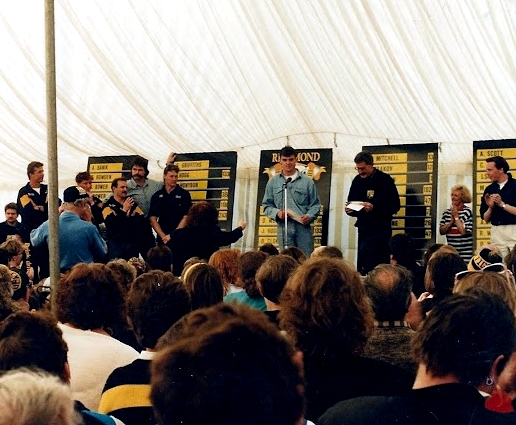
Best & Fairest 1991 style…Nev Crowe presents a double-denimed Scott Turner as Cameron Schwabb stands extreme left. Le far left players are Jeff Hogg, Lamby, Flea Weightman, old man Cloke and I think Craid Smith.
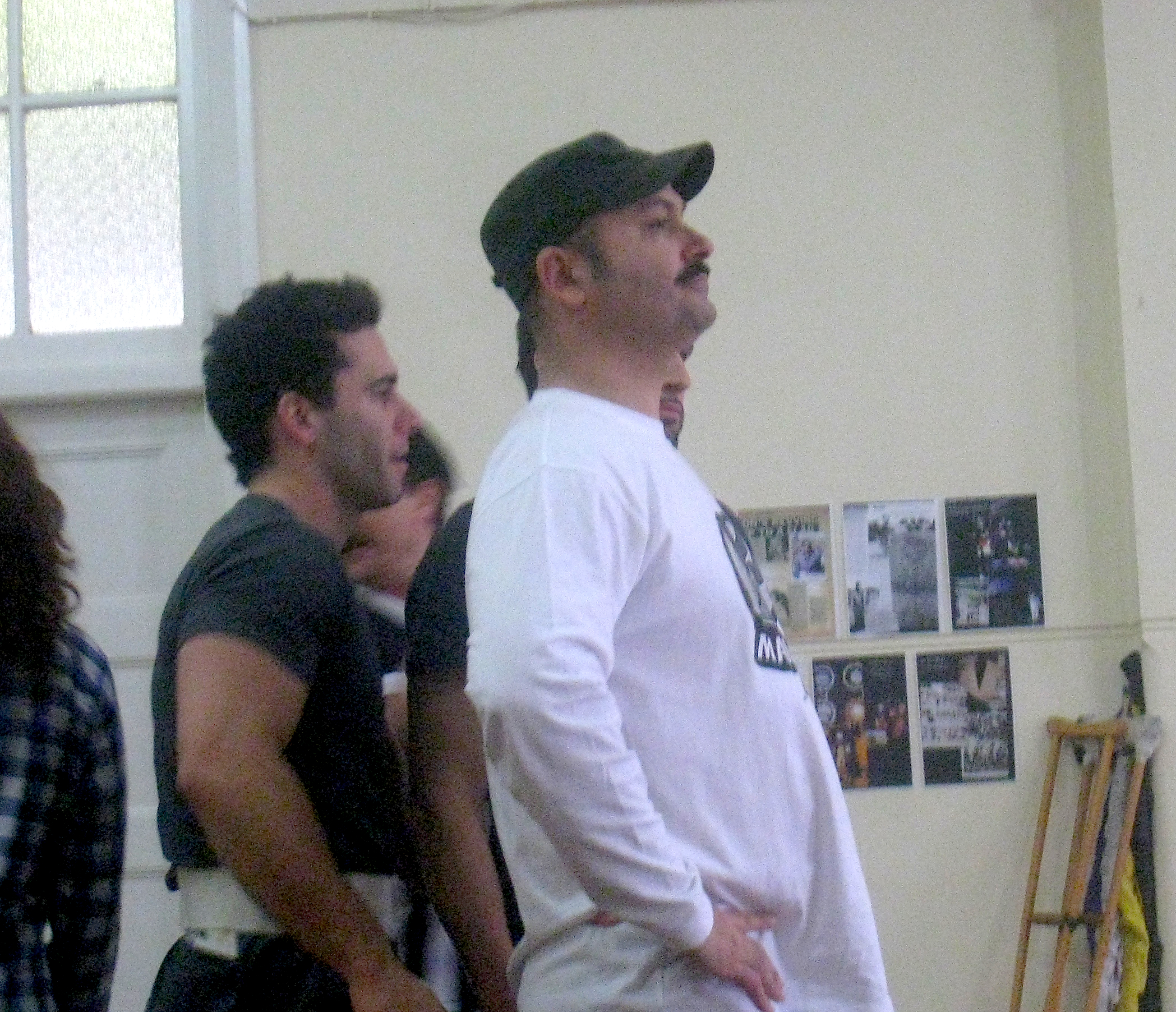
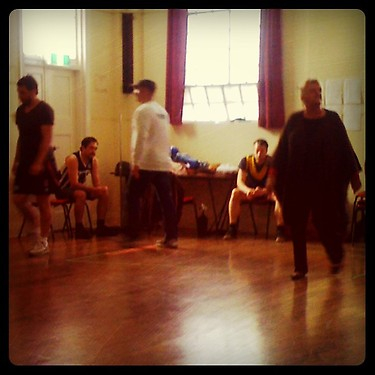
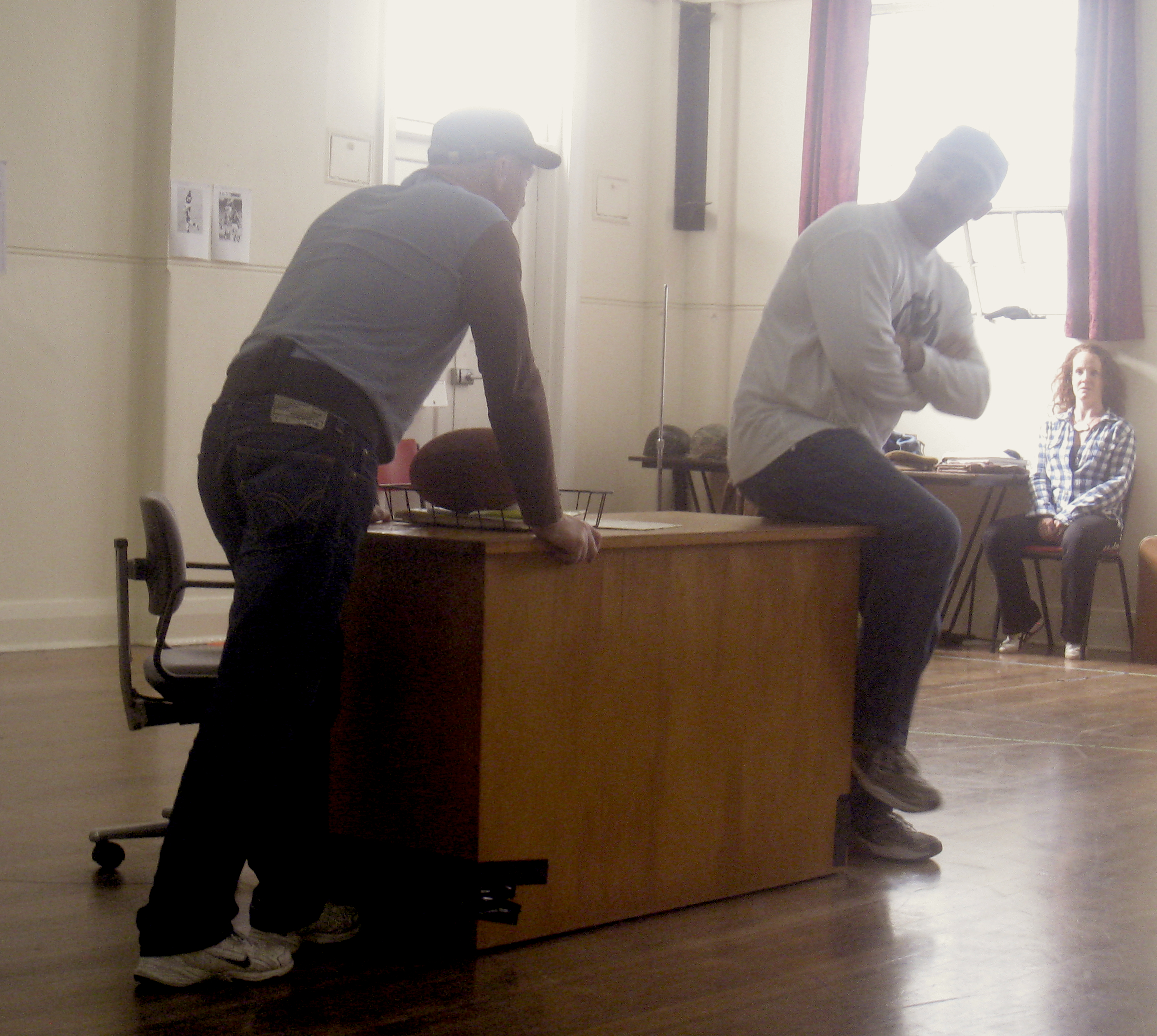
Ronald Dale Barassi. His name is intrinsically linked with Australian Football, as player, coach, media performer and visionary. And what better way to celebrate Barassi’s contribution to football and life in Victoria than in the form of the Stage Show! Barassi the Stage Show is nearly upon us, combining two of Melbourne’s great passions; footy and the arts. I was lucky enough to be invited for a sneak peak at rehearsals and a quick chat with some of the cast, but before I had even entered the building, I felt that this show would be a success. Why?
Well in a quiet backstreet of Collingwood, the majority of the cast was involved in a glorious game of kick-to-kick. This is what they do in their breaks. Parked cars were at risk of damage while the possibility of the footy lodging itself in a tree loomed large. It was beautiful.
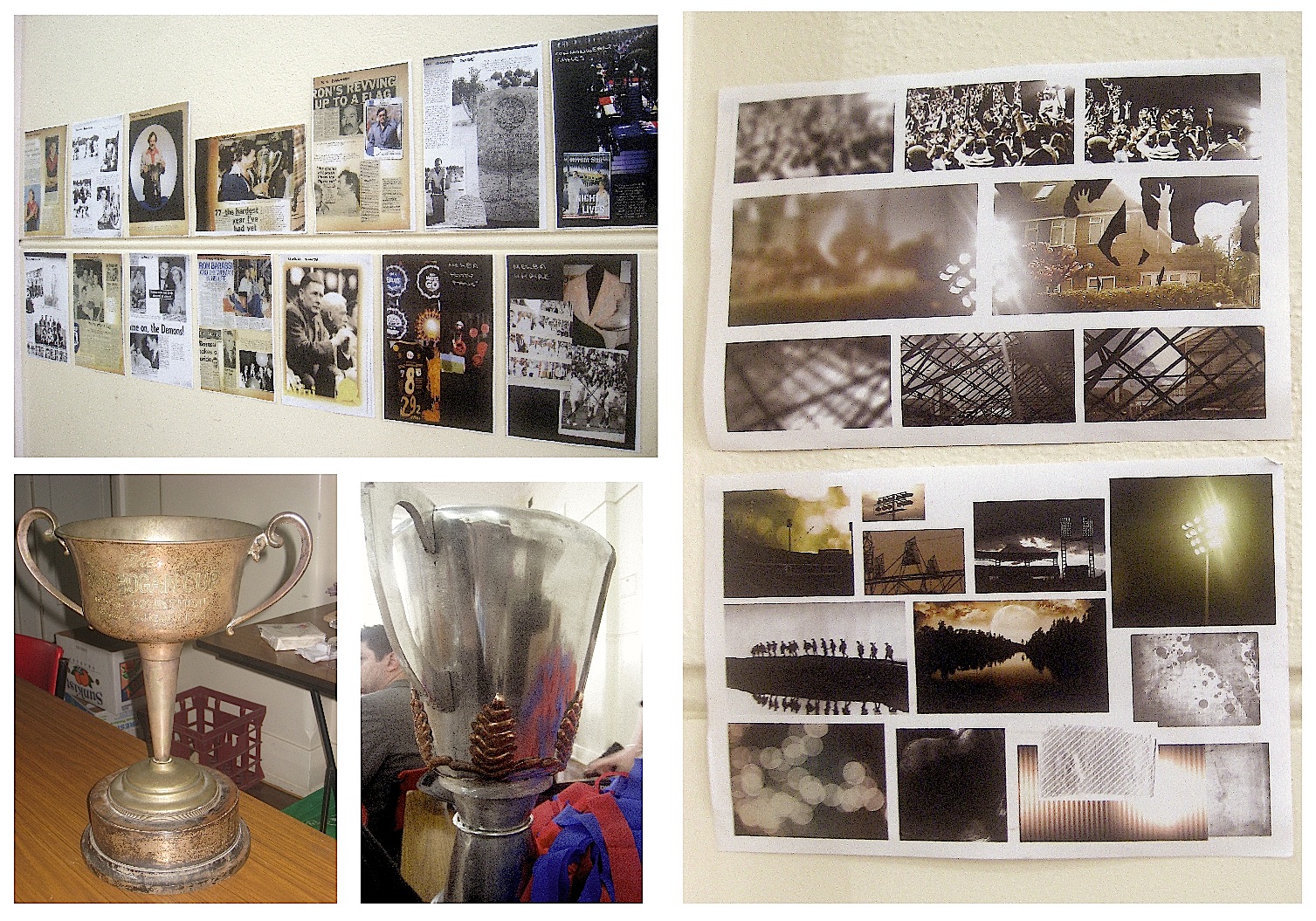
On entering the main rehearsal room it was as if being in a football museum, with old photos, Sherrins, Premiership cups (I think they were fake) and even newspaper clippings lining the walls. As a stickler for detail, I could see that much thought and research is going into putting this show together.
But just how do you bring the rough and tumble game of football to the stage? I didn’t have to wait long, as the fist scene we were treated to was an artistic impression of Jesaulenko’s famous mark from the 1970 grand final. Here’s the thing…it was done in slow motion! I won’t go through the mechanics of how, you can see for yourself in the video below.
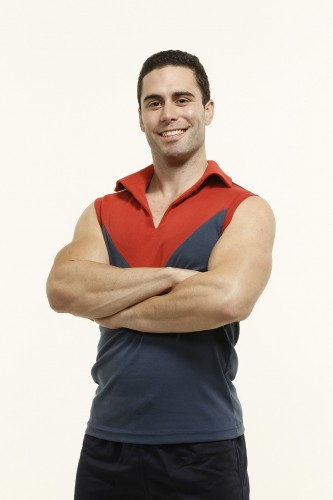
All of the best choreography in the land would be futile however without someone who could pull off the role of Ronald Barassi himself. Enter Chris Asimos and Steve Bastoni, playing ‘young’ and ‘older’ Barassi respectively. When meeting the young Barassi, Asimos, I was struck by his appearance. He has the Barassi mouth, the strong jaw line, while also pointing out that he was Greek and not Italian like Barassi’s heritage. Originally from Adelaide, Asimos noted that “you need to have a team to follow in Melbourne,” and as such he now follows the Dees.
Chris Asimos portrays a young Barassi. I like that his Melbourne jumper has a collar!
While I didn’t get to see the young Barassi in action, Bastoni too has the strong jaw line and presence to play Ron. The legend of Australian football is not the most eloquent of speakers. Even he once famously said after adressing a player that “you probably don’t even know what I’m talking about!.” But both the script and Bastoni combine to bring Barassi’s sharp and at times clumsy manner of speaking together in a most enjoyable way.
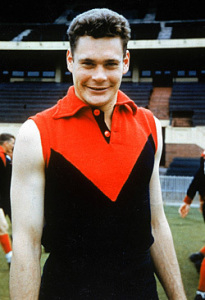
Ron Barassi, young and the old…er. Asimos on the left, Bastoni on the right.
An interesting aspect of the show is the teaming up of former high flying Melbourne star Russell Robertson, a performer in his own right whether taking a hanger in the square or behind his guitar, with the experienced Sean McGrath and Glenn Maynard. The inclusion of Robertson for his first acting role appears to be far from a token appearance of a footballer.
The three work as a team throughout, portraying a multitude of different characters relevant to the stage of Barrassi’s career being depicted. Remember, Ron was in footy from the 1950’s through to the 1990’s, so there is much ground to cover.
“This is all new to me so being with Sean and Glenn has been great, I’ve just soaked up as much as I can form them” said Robertson of working with McGrath and Maynard, himself familiar with footy. “It’s different to footy, that just takes up your whole life, you can’t drink, you have to watch what you eat… whereas these guys work hard but then go to the pub every night for a couple of beers!”
Ron The cast go through their paces, Jane Clifton with her enthralling narration while the ‘boys’ await their turn.
Having a professional footballer on board certainly has it’s benefits in a project such as this, and in a search for authenticity, Robertson has been able to give some ‘footballing direction. “Chris (Asimos) was too balletic and clean in his movements, I had to dirty him up a bit” Robertson said with a cheeky grin, well aware that he was a novice of the theatre but looking for a bit of playful leverage. “All I’ve really helped in has been movement…to make it more realistic.”
Maynard, who among other roles depicts indigenous star Syd Jackson, pointed out that it’s a show for everyone, “not just Melbourne supporters” added Robertson. Barassi once said that “loyalty was doing the right thing by the club you were with for the time you were there,” and as such spent time at 4 different clubs. However Barassi transcends club, he represents Australian football, and has been patriotic about spreading it around this land. “It’s a history of VFL/AFL football, everyone should see this play” Robertson concluded.
Richard Sutherland playing North administrator Albert Mantello, attempting to lure Barassi to coach the only club without a premiership.
Rehearsal hours are long, but with the show opening in little over a week and a noticeable increase in media coverage, there is a great sense of enthusiasm amongst the cast. Bastoni was sporting a Marngrook Footy Show top, no doubt a memento from his recent appearance on the show to plug ‘Barassi.’ It seems apt as the Margrook footy show mixes live musical performance with footy talk, much in the way footy will hit the stage with this production.
September in Melbourne is more than just finals time, it’s also a celebration of Australian football.There’s no better way than to make sure you catch ‘Barassi.’ Check out this quick video of how rehearsals are coming along.
For more information, please visit the comprehensive Barassi Play website. Ticketing and cast information can be found along with plenty of other interesting features.
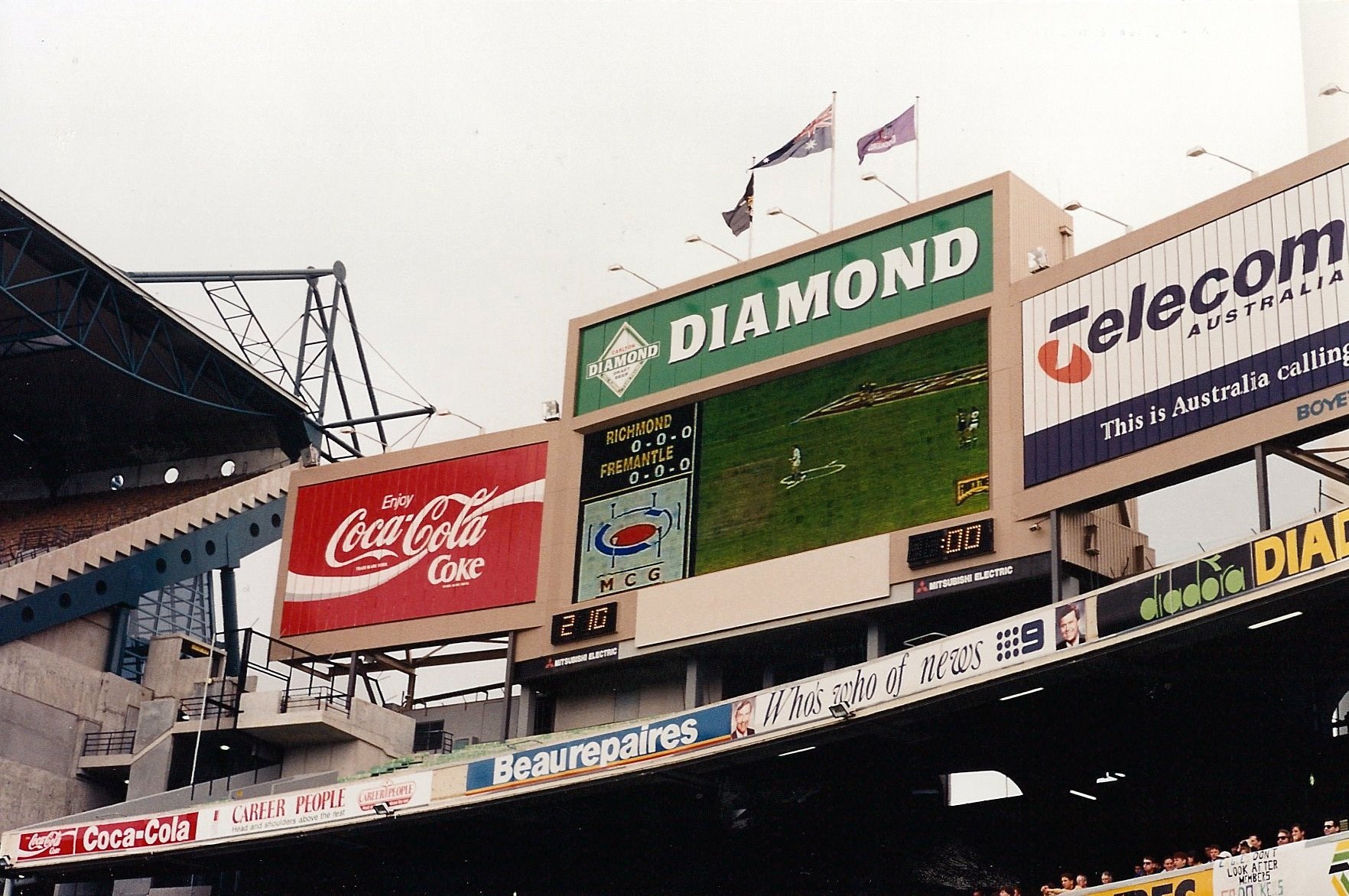
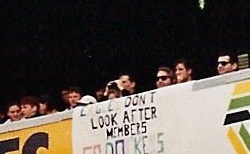
I just quickly want to post this picture from the family photo album as there are a few interesting little aspects to it. Firstly, this is just seconds before the Fremantle Football Club commenced playing in the Australian Football League, round 1, 1995. The time is 2:10…traditionally when matches used to begin! It’s anyone’s guess these days! We were there because Richmond were again used as the guinea pigs to welcome a new Western Australian club into the big time.
But thanks to my dad, we have some idea as to the Dockers mindset in relation to their powerful big brothers, West Coast, who had won two of the past three premierships. This little home-made sign hanging over the fence simply says…
“Eagles don’t look after members…Freo Dockers!”
A disgruntled Eagles fan perhaps? Sick of success? Or perhaps sick of being on a ten year waiting list to get a seat at a home match? Either way, this Freo fan or fans have failed miserably in one aspect…you can’t read yellow texta from a distance!
Richmond nervously held on for a 5 point win, with little indication that it would be the first of 7 successive victories. As a side, this is the old Western or Ponsford stand at the MCG, and the photo is dated by the ‘Telecom’ (not Telstra) and “Brian Nailor-Ray Martin…Who’s who of news” advertisements!
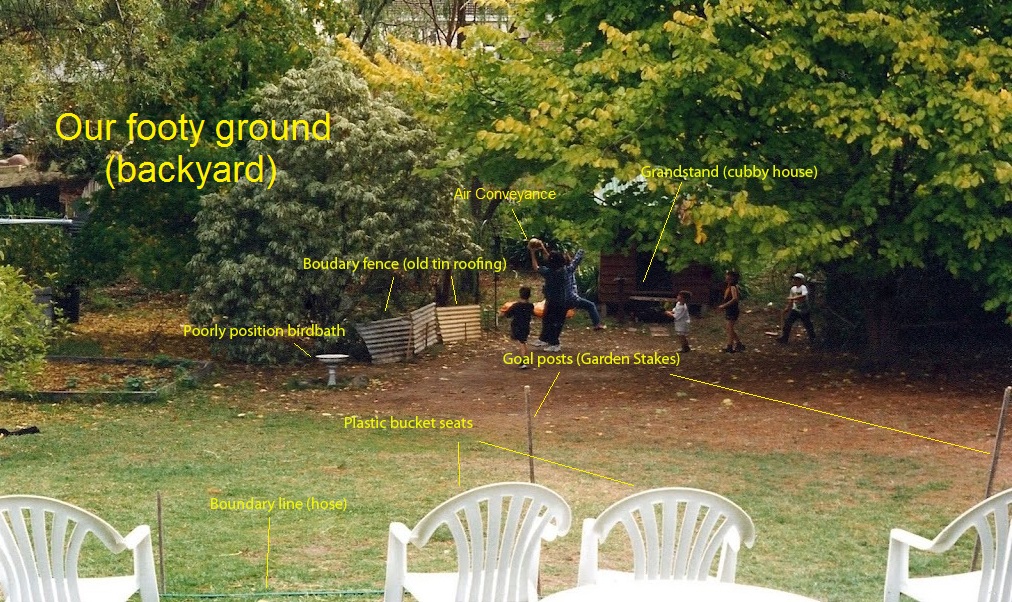
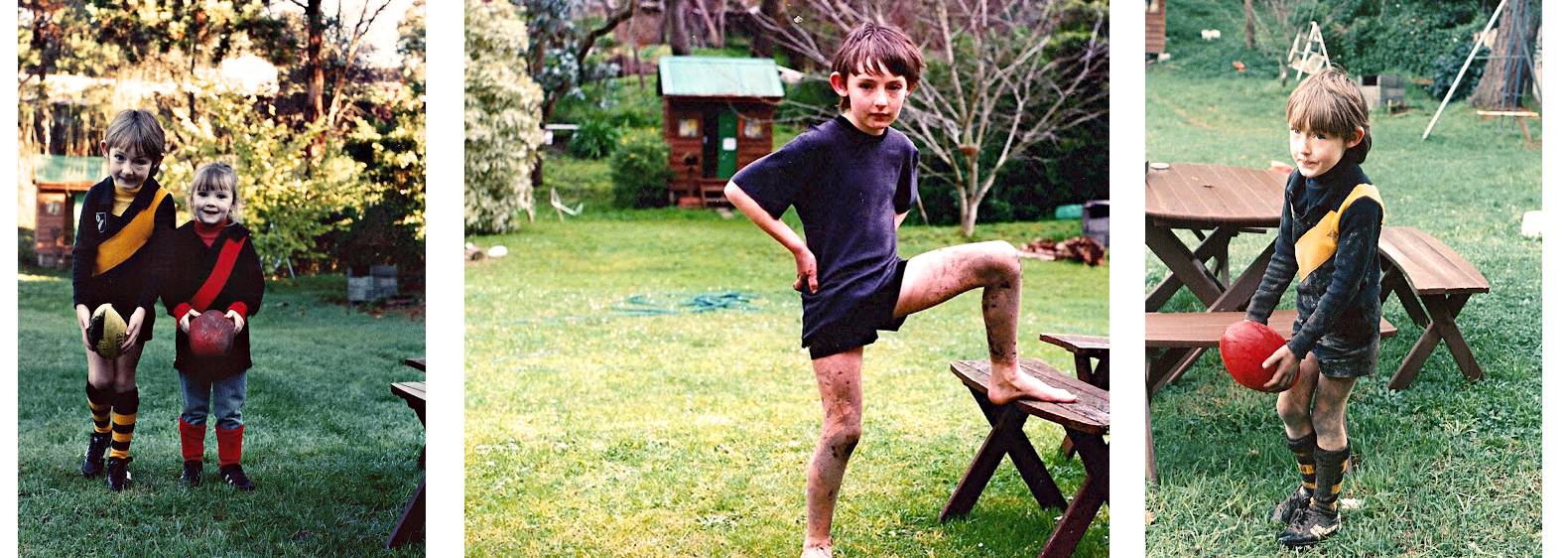
Yes, like a lot of you, my backyard was my footy ground as a kid. Poorly placed lemon trees, clothes lines and vegie gardens became obstacles to overcome, much like an opponent, although luckily we grew up on a rather big property in leafy Blackburn.
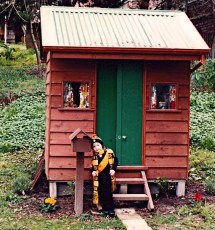
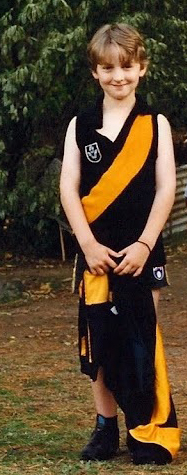
Here I am in front of the newly erected pavillion (1986)…surely one of the last wooden structures before the modern obsession with concrete and steel. The Tiger jumper you see there now fits my own daughter, although she’d like to morph my Dale Weightman’s ‘3’ into an ‘8, like Jackie.’
I loved playing footy in the backyard as a kid. I would act out each upcoming match, concocting the most bizarre of circumstances! Richmond, 23 goals in the first quarter against Essendon! Or trailing Carlton by a hundred points, the Tiges would come back and snatch it with a miracle goal after the siren! I did commentate a little to myself, but I was more into mimicking the crowd noise as the Tiges came storming back! The glory was never reflected come the weekend, but I’d be back the next week, dreaming up glorious scenarios for my Richmond.
It was often said to me as a kid that the muddier you got, the better you had played. I must have been a bit of a star then! Yep, that’s my sister Mezz and I. Mum did the unthinkable and tried to convert her to Essendon, but she had the sense to follow the family team, and the sash was soon a yellow one. I enjoyed playing footy with my lil’ sister, and I had her kicking really well, but her heart just wasn’t into playing. I had a dream to play for Richmond. That was sadly not a reality for her so why bother? What I needed was a mind for moulding. Thankfully, my footy mad baby brother came along.
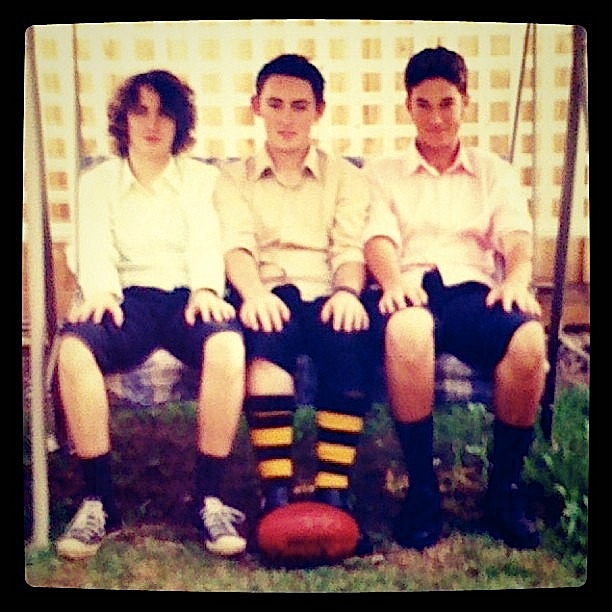
Inexplicably, though he’s wearing yellow and black here, he grew up a Footscray supporter. He does have a soft spot for the Tiges however, as I do for the ‘Scray, but going to Footscray v Richmond matches is a big no-no!
Far too old to get away with it, but that didn’t stop us!
There was a six year gap between us, but I wasn’t your typical ‘beat-up on you little brother’ type. I preferred an even competition, so would introduce handicaps for myself. I’d have to start on my knees, only kick on my left and the like, all the time searching for some semblance of realism. The backyard was my own league ground, and I tried to play it to scale. This meant kicking shorter, running slower…all in the search for reality. A visitor would come over, boot it over the fence, and essentially ruin our game.
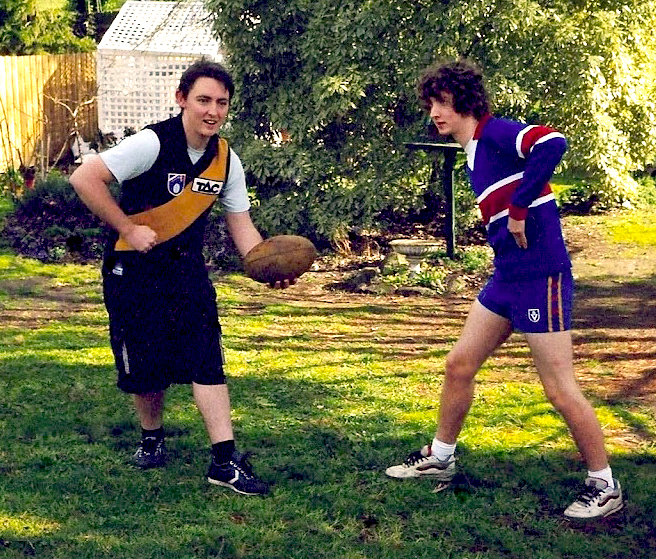
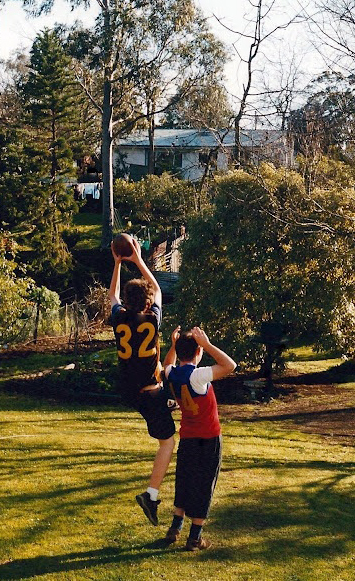
But my brother grew up. Pete now stands half a head above me. In my latter years at home, we were able to compete without handicaps…it was man verses man….ok…. boy verses nearly man. We had two main games. For one of them we’d stand 20 meters apart, one of us would kick the ball high into the middle and we essentially played a version of chicken. After a sore head or two however, we resorted to the game you can see in the surrounding pictures.
Shoulder to shoulder, one of us would kick the ball high into the air, avoiding the pine tree. If you had scored, the other person kicked it ‘up.’ If you marked the ball, you had a set shot. If it came to ground however, it was on for young and old. He was young, I was old. Numerous winter hours were spent here, playing until dark. We’d bump, swear, tackle and rub it in the face of the other. All still within the framework of playing ‘to scale’ in our backyard though. We knew we’d never ‘make it.’ This was it for us!
Three things about this photo. Firstly, I cannot work out if I am wearing long shorts or short longs, but they do lend a certain early 1900’s knickerbocker feel to the photo. Secondly, it’s clearly a staged photo as can be seen by the limp ‘effort’ i am putting in. Our game was not so much about high flying either, rather marking ‘tussles.’ And thridly, it reminds me of finals time. Spring leaping through the trees and the smell of cut grass. I can smell this photograph.
There’s something about us older brothers. Though Pete is well taller than me, I can still outmark him through sheer competitiveness. I imagine league players, with older brothers who never made the highest level, still unable to defeat their older siblings in backyard footy. It’s a different beast. Visualise Jason and Cameron Cloke dominating and making Travis, clearly the pick of the trio, cry in the backyard. David would be umpiring of course. He never misses a match.
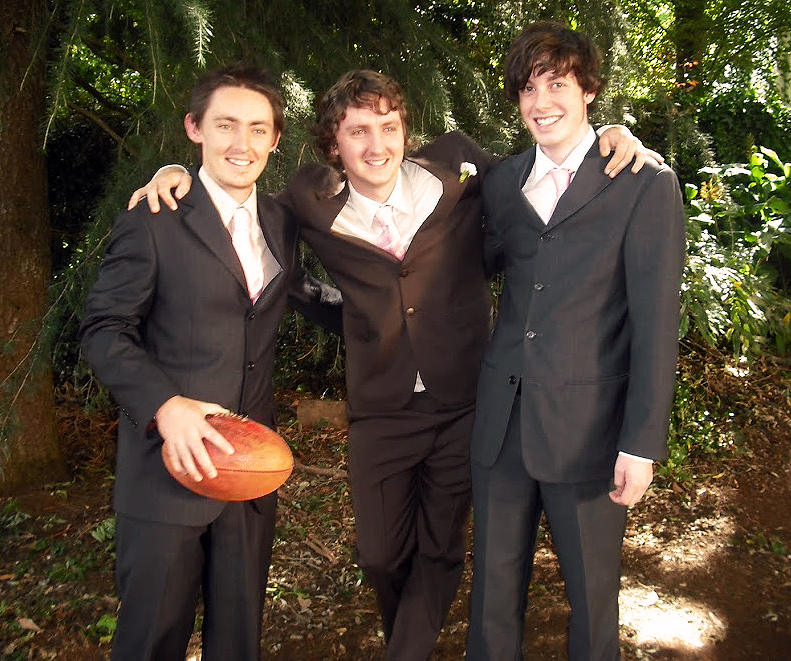
So whilst footy can sometimes be the only thing that ties siblings or parents together, that wasn’t the case with us. We had plenty in common and still do. But the footy is never far from being brought up. On both of our wedding days we even pulled out the footy, ironically in the backyard, to help settle the nerves. It’s something our respective partners are still coming to terms with!
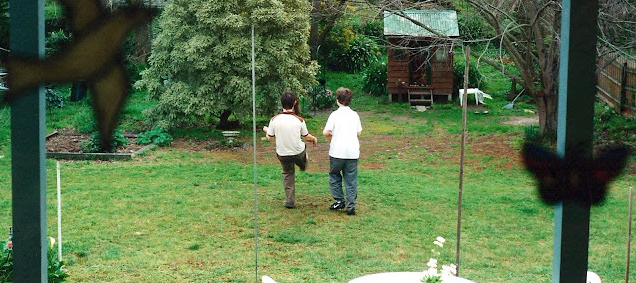
Playing footy in mum and dads backyard is not as easy as it used to be.There’s a new vegie garden on the half forward flank, and though the clothesline has been removed (about time!) the goal posts have since disappeared. There’s more breakable stuff around too…while the golden elm encroaches onto the playing field like never before. But we can still navigate our way past the cubby house, blind turn the bird bath and nail the goal from the clothesline pocket, all with our eyes shut!
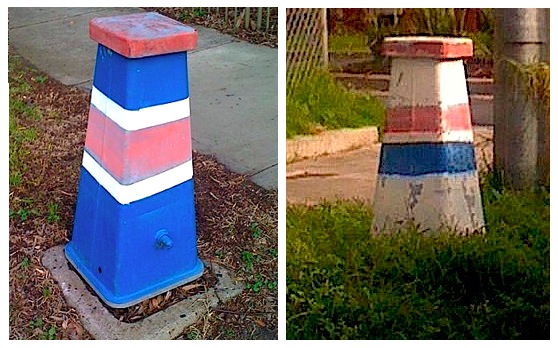
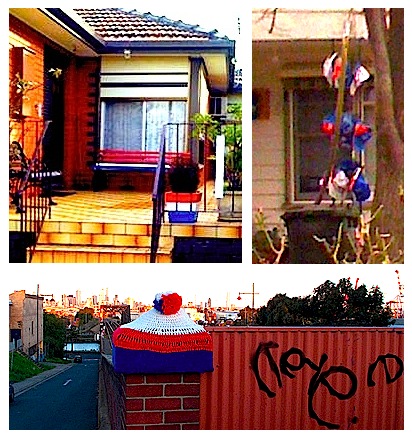
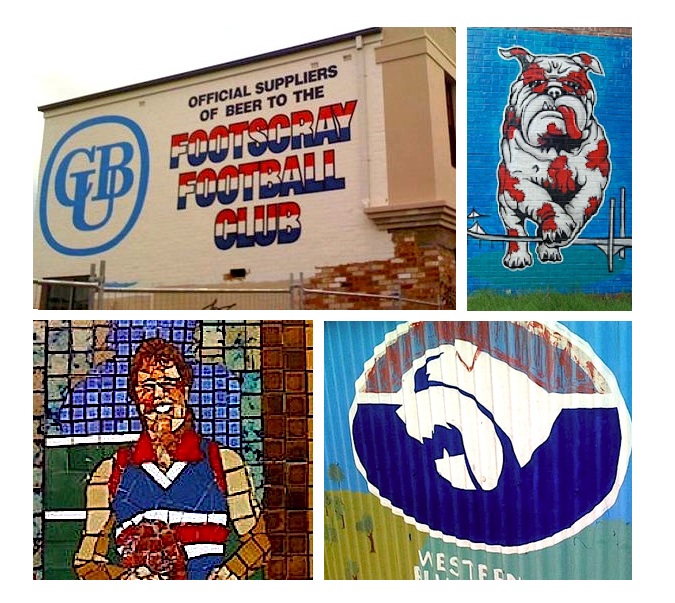
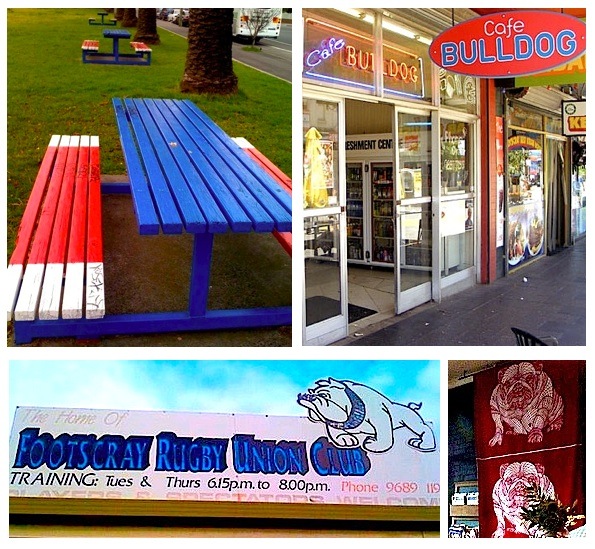
Living in Footscray, it’s hard to ignore the fact that as a Richmond supporter, I am in ‘enemy territory.’ (I’m actually quite partial to Footscray!) Unlike a lot of clubs, there is still a strong link between the suburb and the footy club. When I came across the below fire hydrants, I decided to do a little tour of the village in search of red, white and blue.
What impresses me is that the fire hydrants of Footscray encompass both home and clash strips!
Many houses are adorned with Footscray Footy Club paraphernalia, and when the Dogs are in the finals as they were recently the volume increases dramatically. Above are some of my favourites. From the subtle to the clever. The lower picture was found on Lara Cameron’s lovely blog http://kirinote.blogspot.com.au/2009/09/knitted.html
This is Doug Hawkins first of two appearances in this post, fitting given the connection he appeared to share with fans. He was one of them in a way. This is one small part on a wall outside Footscray City College, a large mosaic depiction of Footscray. Above Doug is some fantastic old advertising on the Rising Sun Hotel (now apartments…nearly), over the road from the Western Oval, while other street art around Footscray shows a great love for the dog. There’s even a Dancing Dog cafe!
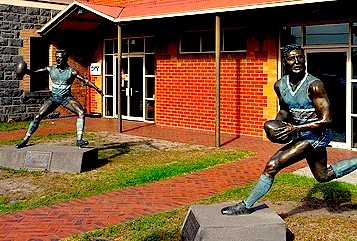
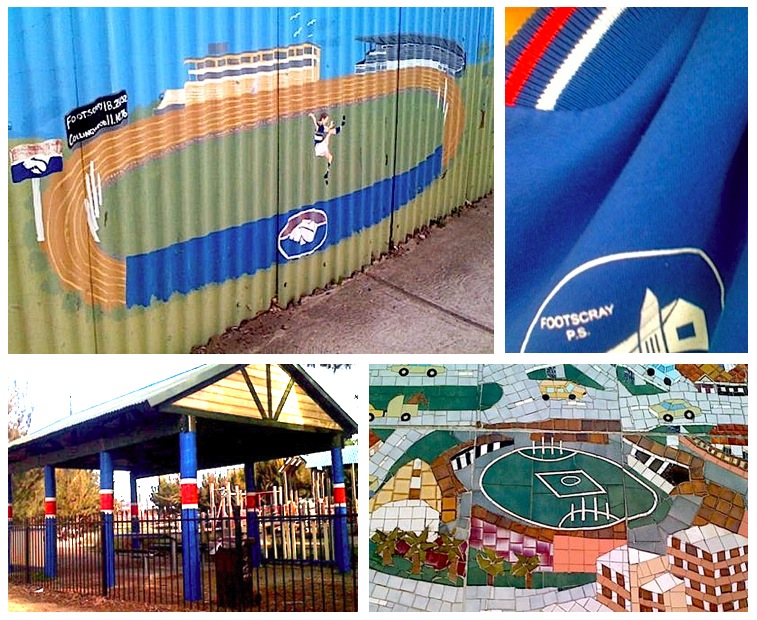
We’ll skip momentarily out of Footscray, yet stay firmly in the west. The Braybrook Hotel proudly houses these fantastic statues of two Braybrook boys in EJ Whitten and Hawkins, arguably Footscray Football Clubs biggest personalities and two of the very best. Surely there’s no need for security with these two out the front night after night?Below is another wall mural, this one running along the Barkley Street side of St.Monica’s Primary School. The scoreboard reads Footscray 18.24.132 to Collingwood 11.10.76. If only that were the case more often than not! We also see that Footscray Primary’s uniform is red, white and blue, and back to the mosaic wall for another take on the Western Oval, along with a Bulldogs inspired playground. ‘Cafe Bulldog’ in the Footscray Mall unashamedly sports the clubs logo and colours, as does the trendier Gusto cafe in West Footscray, albeit with a somewhat artfully put together Bulldog to watch over patrons. (bottom right pic from the wonderful Footscray Food Blog-read here about the Whitten Oval’s Pound cafe!)
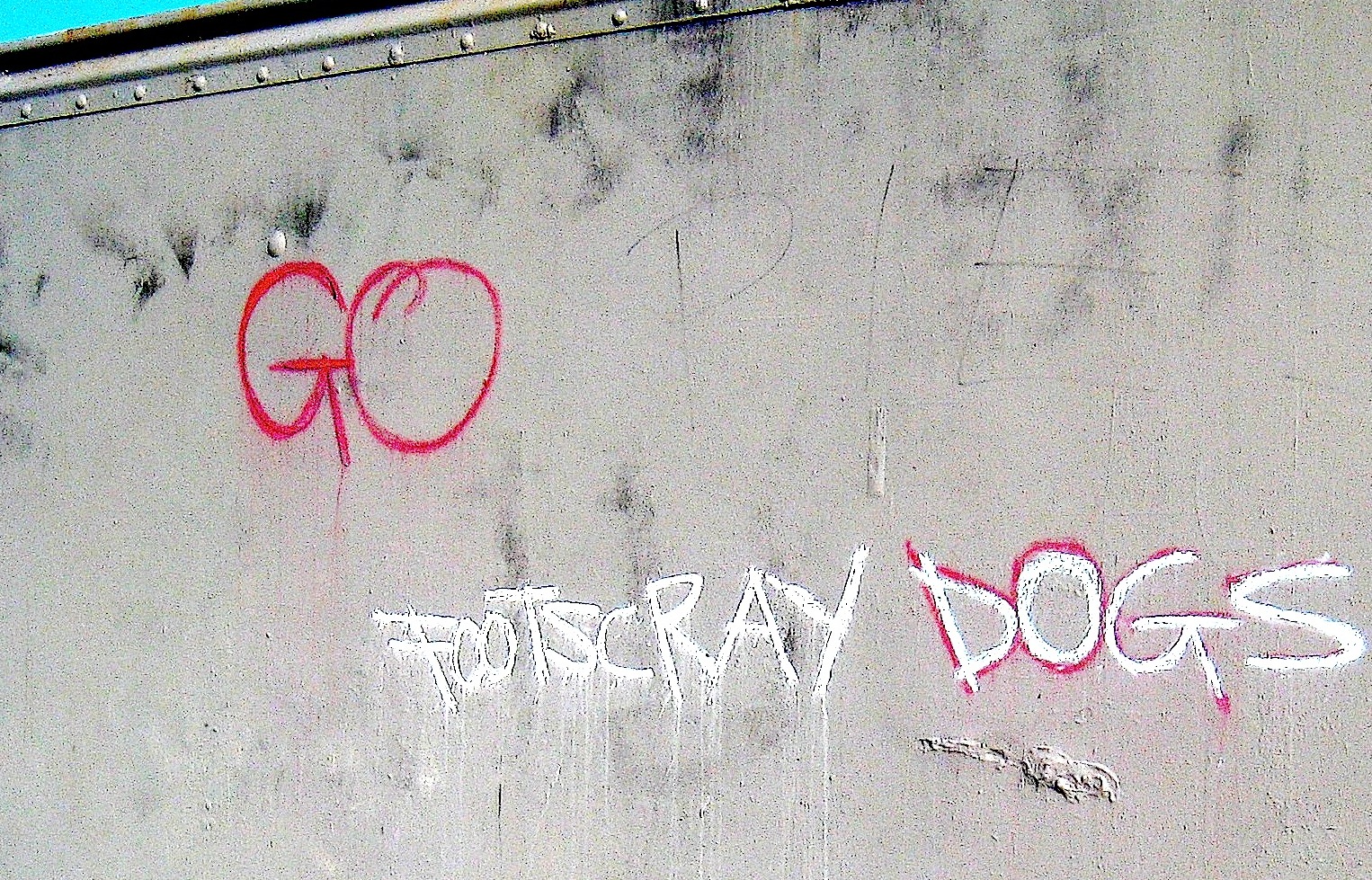
And lastly this bit of graffiti, pointed out to me by Vin Maskell of the fantastic scoreboard pressure blog, sums it all up for me. For no matter where you are, there’ll always be a Collingwood supporter showing a bit of cheek.







 The Holy Boot's Football Emporium