Nice Statistic – Hawthorn’s Premiership Gold

History. Records. Come Saturday afternoon at the MCG, the players won’t be giving these two words a thought in the world and rightly so. It is the now that they must live in. But alas, I am not playing in the AFL Grand Final, and therefore wish to delve into the past.

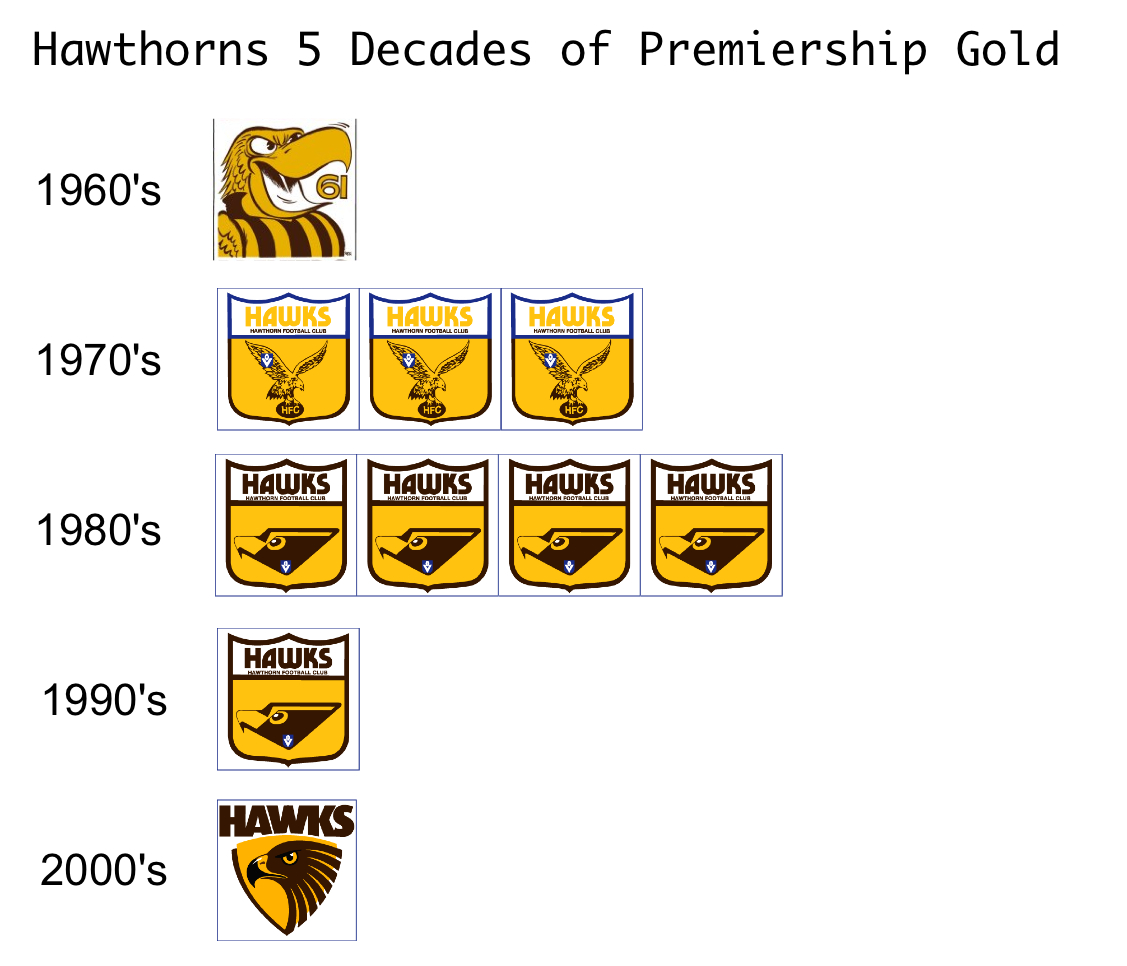
Should Hawthorn win the 2012 premiership, they will break a long held, little know record. It has been well documented that Hawthorn has won at least one premiership in every decade since the 1960’s, which equals Melbourne’s record of 5 straight decades with at least one premiership (1920’s-1960’s.) Should Hawthorn overcome the Bloods on Saturday, they will become the first VFL/AFL team to claim premierships in six consecutive decades, a truly remarkable feat of sustained success.


To illustrate, the three most successful clubs, Essendon, Carlton and Collingwood, have at best managed just four consecutive premiership yielding decades, giving an idea of just how successful the Hawthorn Football Club has become since John Kennedy took a hold of them and since they changed from Mustard Pots and Mayblooms into predatorial Hawks.

What makes it all the more astonishing is the meagre beginnings of the club. Formed in 1902, the club unsuccessfully progressed through the Metropolitan league, the VFA and into the VFL, all with a bare trophy cabinet. Once in the VFL, they spent the 1920’s-1950’s as a cellar dweller, and along with the other 1925 inclusions to the league, Footscray and North Melbourne, didn’t look like winning a premiership.

Footscray was the first of this trio to break through for a flag in 1954. But just seven years later in 1961, as both Hawthorn and Footscray met on the big day, it was the ‘underdog’ Hawthorn who were the sentimental favourites, winning their first flag and beginning an astonishing run of success.

But they come up against a formidable foe in Sydney, also once the easybeats of the league. In fact the Swans (continuation of the South Melbourne into the Sydney Football Club) have undergone a transformation not unlike Hawthorn’s in the 1960’s. After six fruitless decades, surpassed only by St.Kilda’s 1890’s-1950’s drought, the Swans shed their easybeat image, internally rebranding themselves as the Bloods, leading to premiership success in 2005.

She’ll be a grand old game come Saturday.

Thanks as always to http://www.footyjumpers.com/ for the Hawthorn logo images!

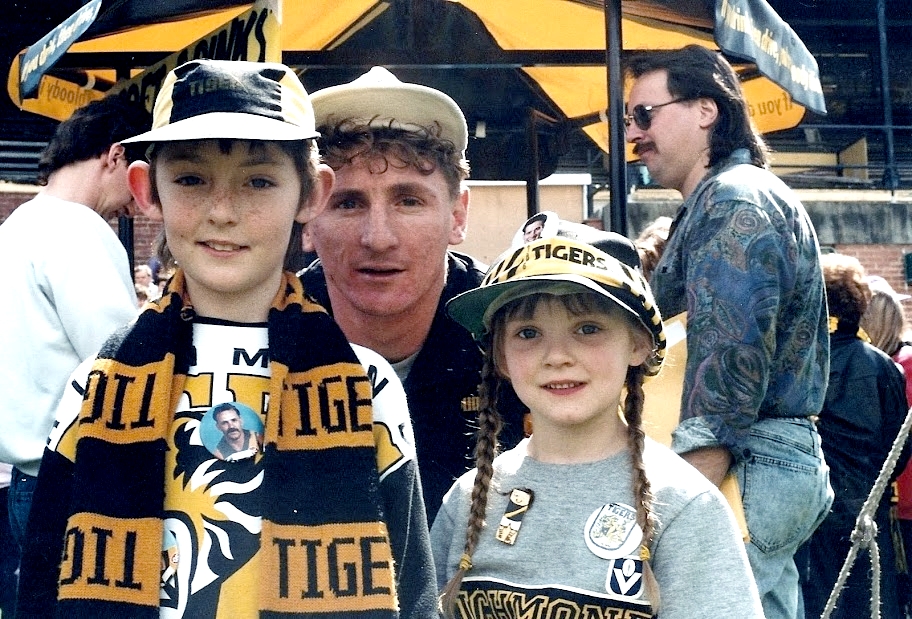
Happy Snap #18 Me, Lamby and Sis

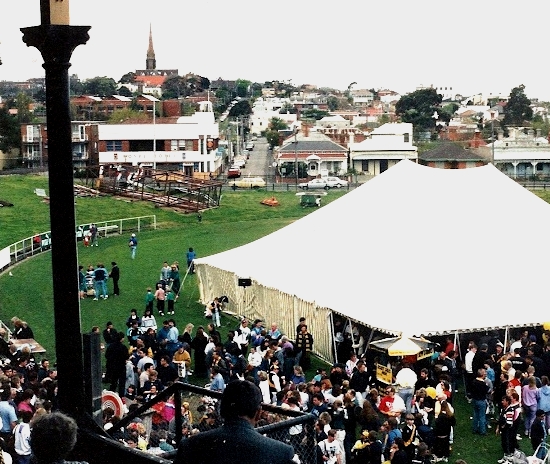
The year was 1991, and Craig Lambert had just taken out the Richmond best and fairest award. This is long before the current day glitz and glamour of club Best & Fariests, complete with live streaming on the club websites. This was pretty much a sausage sizzle under a tent with 100 or so people around.That’s me on the left, Lamby in the middle and my sister Mezz on the right. Contrary to the lies I told my sister, that is not David Cloke in the background!

So that’s me in my dorky early 90’s Richmond attire… I would’ve worn Tiger jocks had they been available. Note my sisters Trent Nicholls badge atop her hat, her favourite player at the time, while Flea Weightman’s badge is close to my heart. The following year saw me don Lamby’s number 4, and as I had a long sleeve jumper, this felt authentic. It was with sadness that another Tiger hero of mine left at the end of 1993, but I followed his career with interest, much as I did with Stuey Maxfield in Sydney.

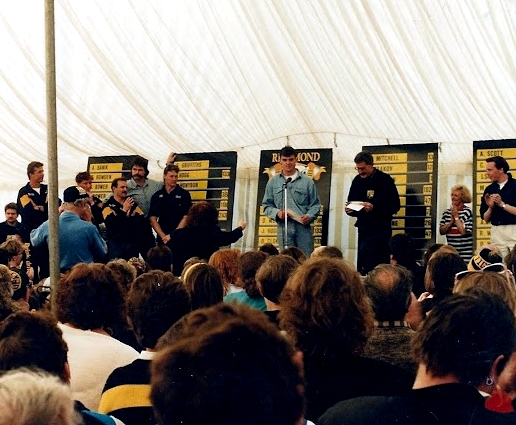
Best & Fairest 1991 style…Nev Crowe presents a double-denimed Scott Turner as Cameron Schwabb stands extreme left. Le far left players are Jeff Hogg, Lamby, Flea Weightman, old man Cloke and I think Craid Smith.

Nice Statistic #7 – Even stevens at Windy Hill #2!

In one of my first ever blog posts under my ‘nice statistic‘ section of this site, I looked at Essendon’s 2011 points for and against. Amazingly, after 22 games they had exactly the same score kicked against them as they kicked themselves- 2,217 for a percentage of exactly 100%.

Fast forward 12 months and what have the Bombers learned? Well, not much, but they can claim a small advancement. In fact a miniscule advancement. Season 2012 saw Essendon sore 2,091 points, conceding just 2090, a differential of just 1 point, their final percentage for the year coming to 100.05%.

image from – http://www.bigfooty.com/forum/threads/is-it-time-to-change-the-essendon-logo.521826/page-5

So Essendonians, don’t despair. Should this trend continue, the mighty Bombers will only have to wait 70-80 years to be in flag contention once more.

Thanks to Coodabeens talkback caller Stan from Stradbroke Island who alerted me to this fact! Click here for a free download of the Coodabeens weekly footy show, or tune into ABC 774 of a Saturday morning!

Around the Grounds – Victoria Park

Victoria Park: League venue: 1897-1999. League (VFL/AFL) matches: 880 (2 finals, 1901 1st Semi & 1904 1st Semi Finals). Record Attendance: 47,000 v South Melbourne in 1948.

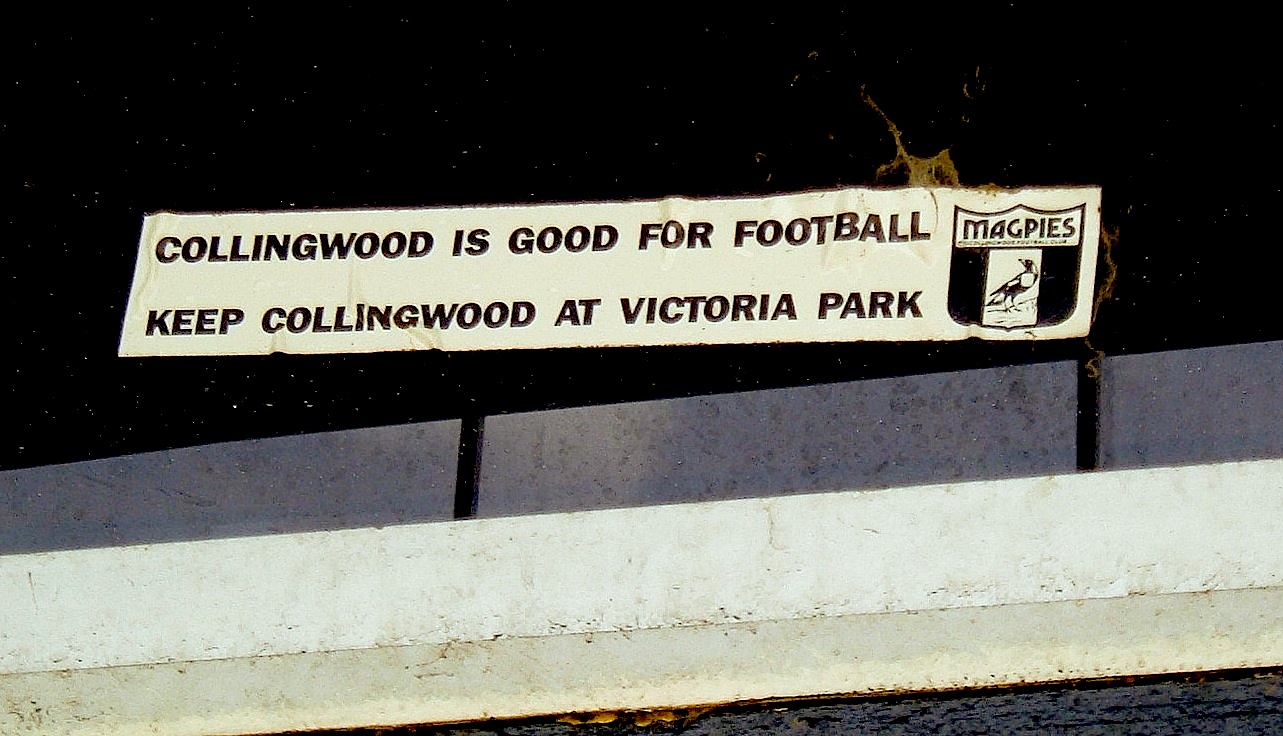
Collingwood’s Victoria Park. It’s iconic. It was more than just a home ground, it was a fortress, a statement of the club that played there. Not pretty but functional. Working class with no frills, yet plenty of character. It was the most feared ground for opposition players and fans alike, in a bygone day when a home ground advantage meant something more than your cheer squad getting a choice of which end to sit.

I never saw a league match at Vic Park. Dad wasn’t keen on taking me there for reasons which I don’t blame him, and by the time I could go to the footy on my own it was only used sporadically for games against Fremantle and the Crows. I’ve since been lucky enough to play a number of games on the old ground for the Western Storm in the Reclink competition.

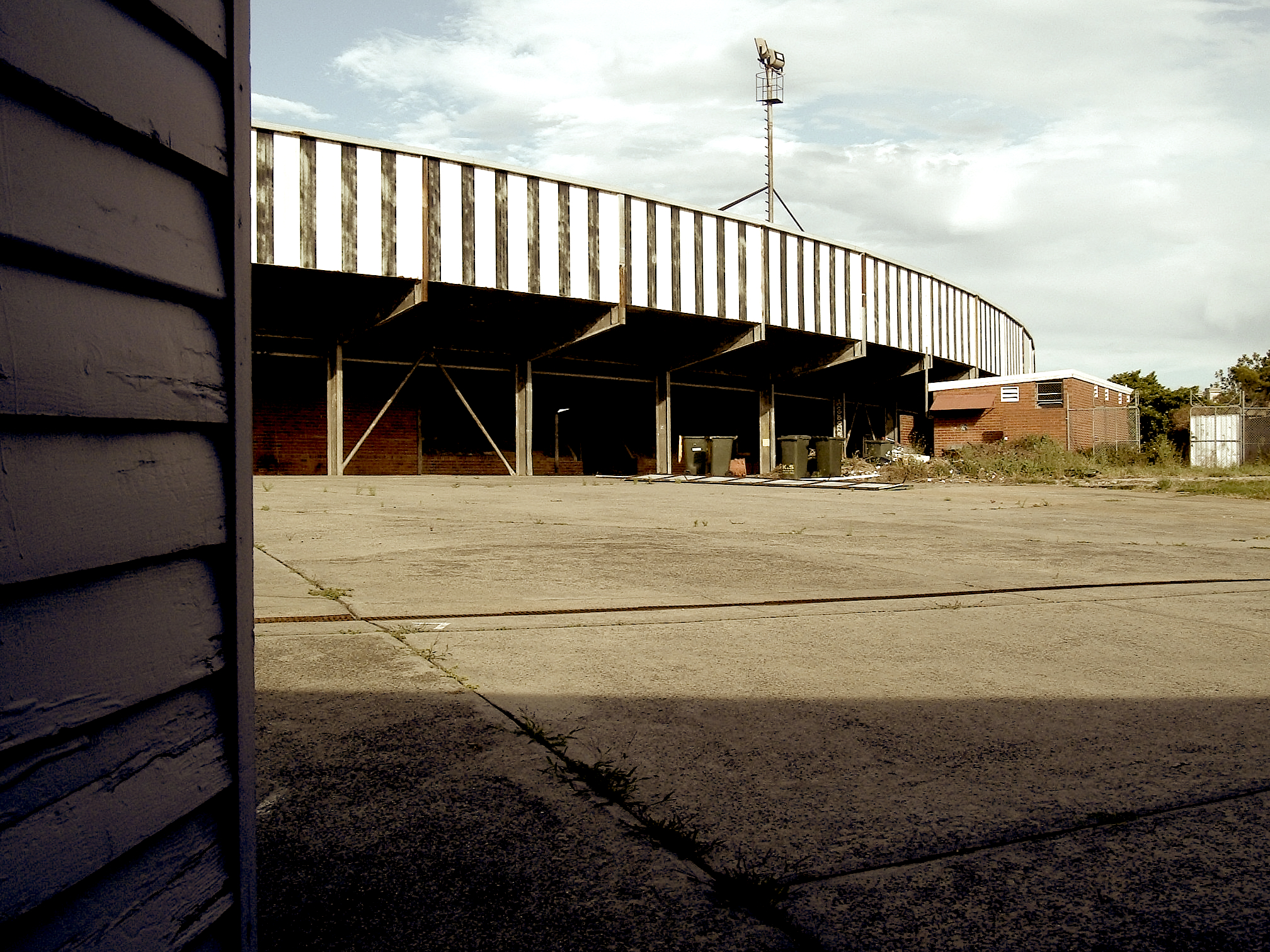
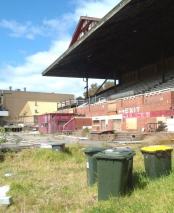
Shortly after the Pies had left the old ground for their shiny new Lexus Centre, it was in a state of decay. Used by the VFL umpires to train on, it’s future was uncertain. It seemed unfathomable to this writer that such a landmark was so easliy pushed aside. Sanity has since prevailed, but more on that later. I took a series of photos as I’m sure a few Collingwood supporters also did. The remenants of a leage ground (since refurbished) remained.

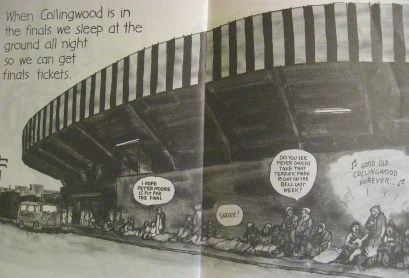
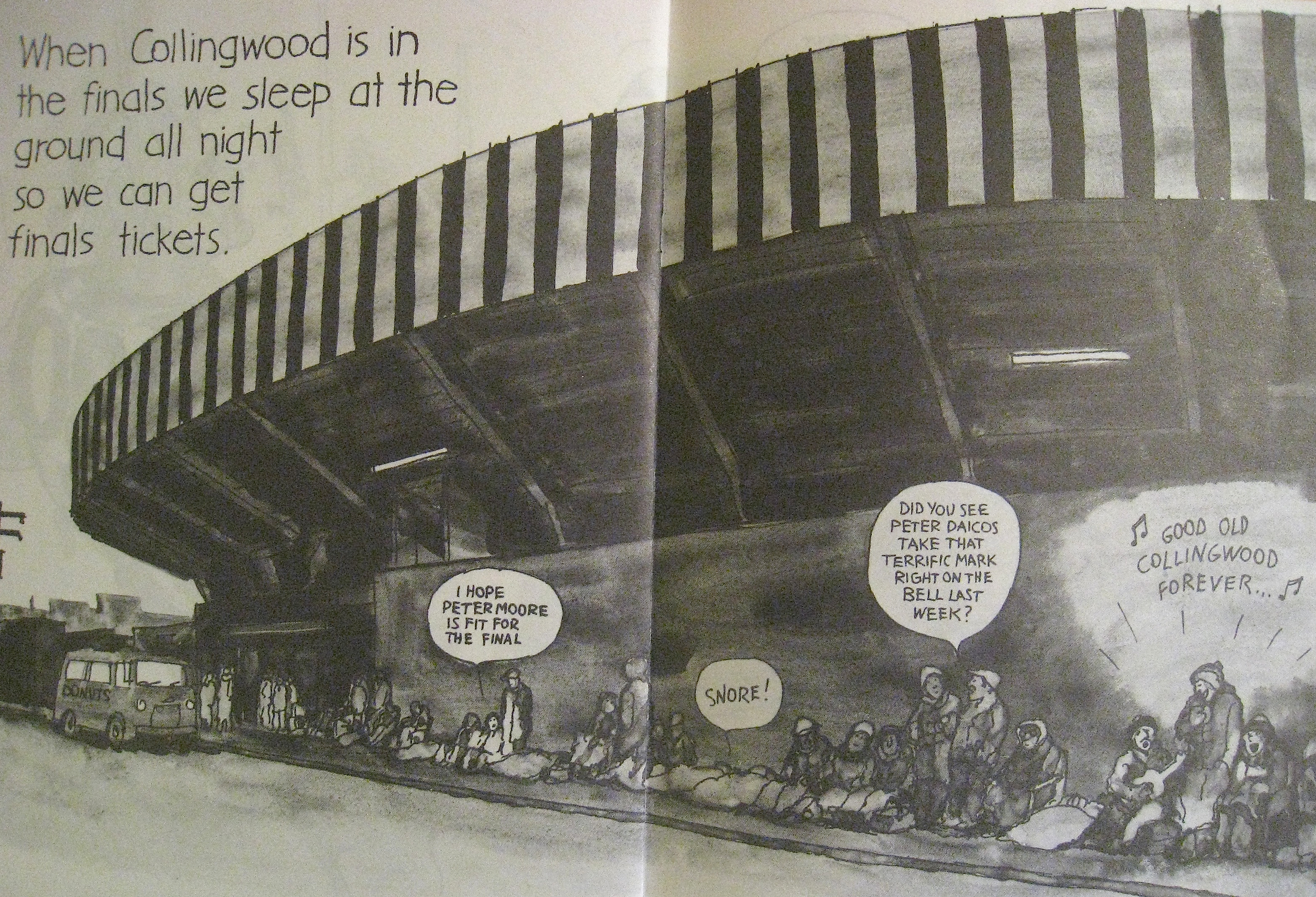
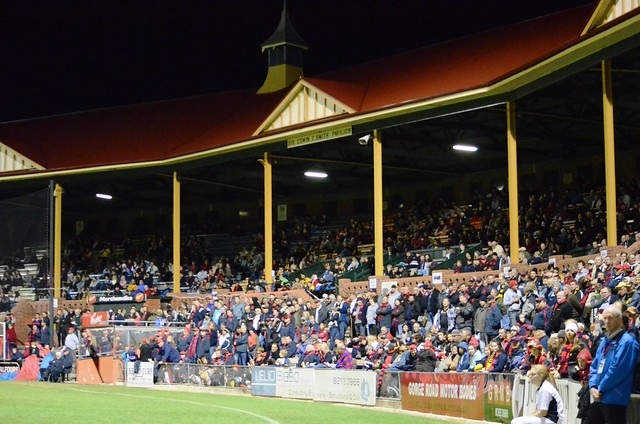
This is the view (above) of Vic Park that captured me as a child. Whilst dad didn’t take me to games here, he often took the chance to take us for a look around the old grounds. What I loved and still do was the overhang of the grandstand onto the street. Its imposing. I was also particularly fond of Lorraine Wilson’s childrens footy books. From her 1982 ‘Come on the Pies’ book, here is a fantastic illustration by Jack Newnham of the Sherrin stand, with all it’s overhang glorified.

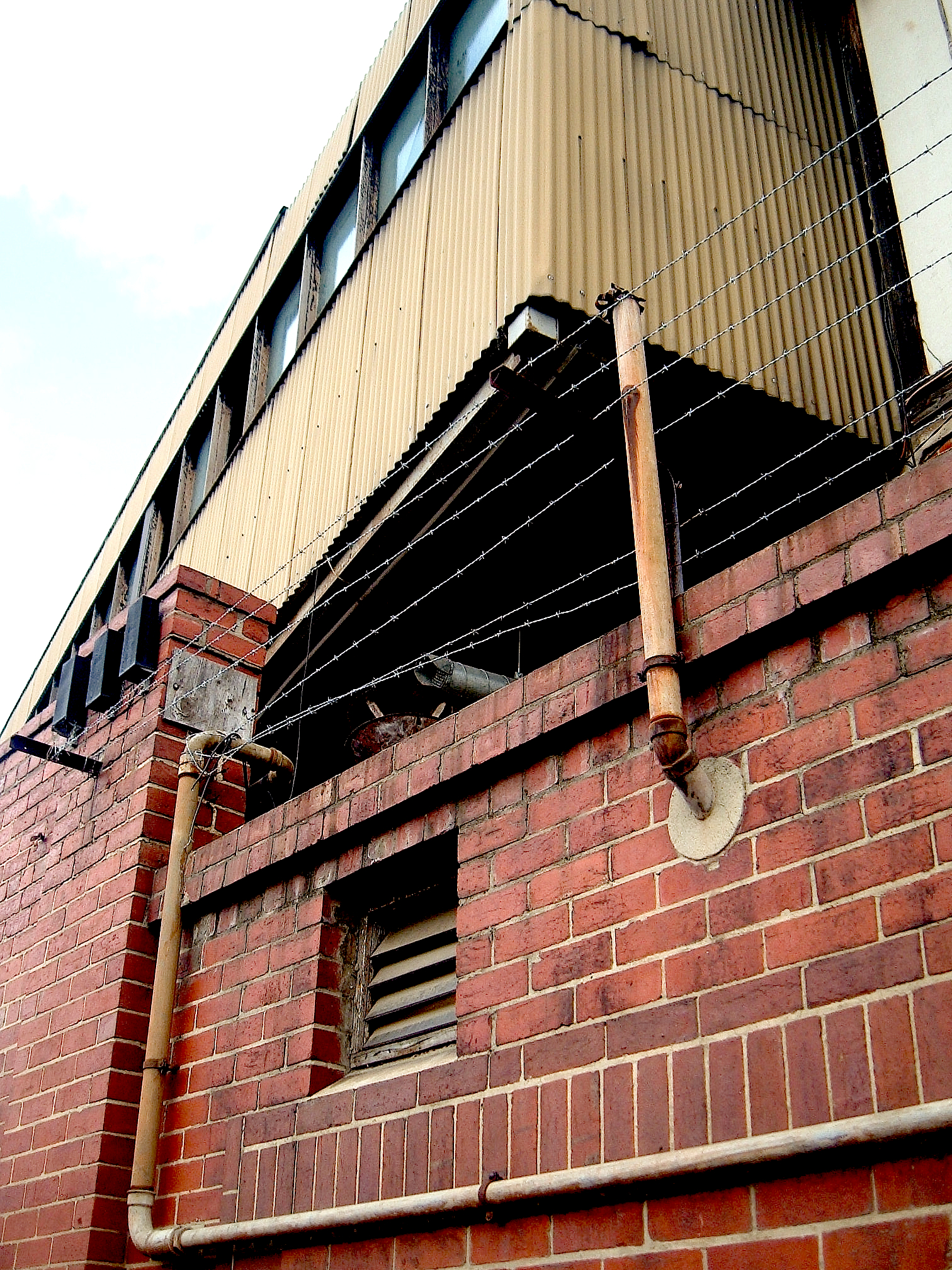
 The old wall, a long forgotten feature at many VFL and VFA gronds, was still standing when I took these photos, and sections of it still stand today. This was one of the last remaining walls of it’s type, with Punt Road, Williamstown and Fitzroy amongst the many to have bitten the dust. I love the ‘fortress’ that it, along with the barbed wire, provided. It’s a far cry from the modern day ‘concourse….’ I shudder when I hear that word.

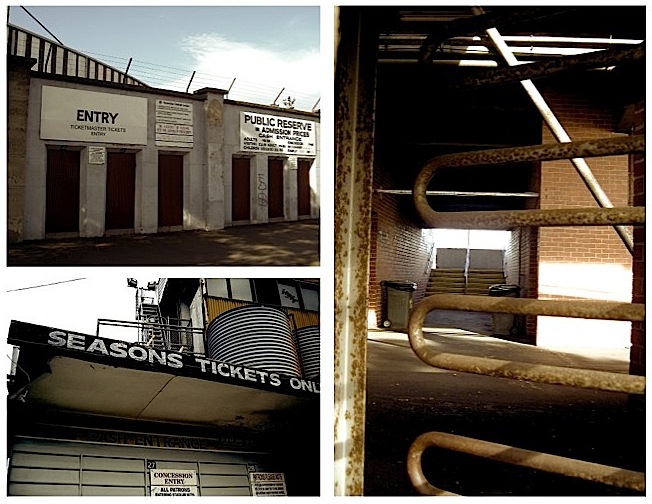
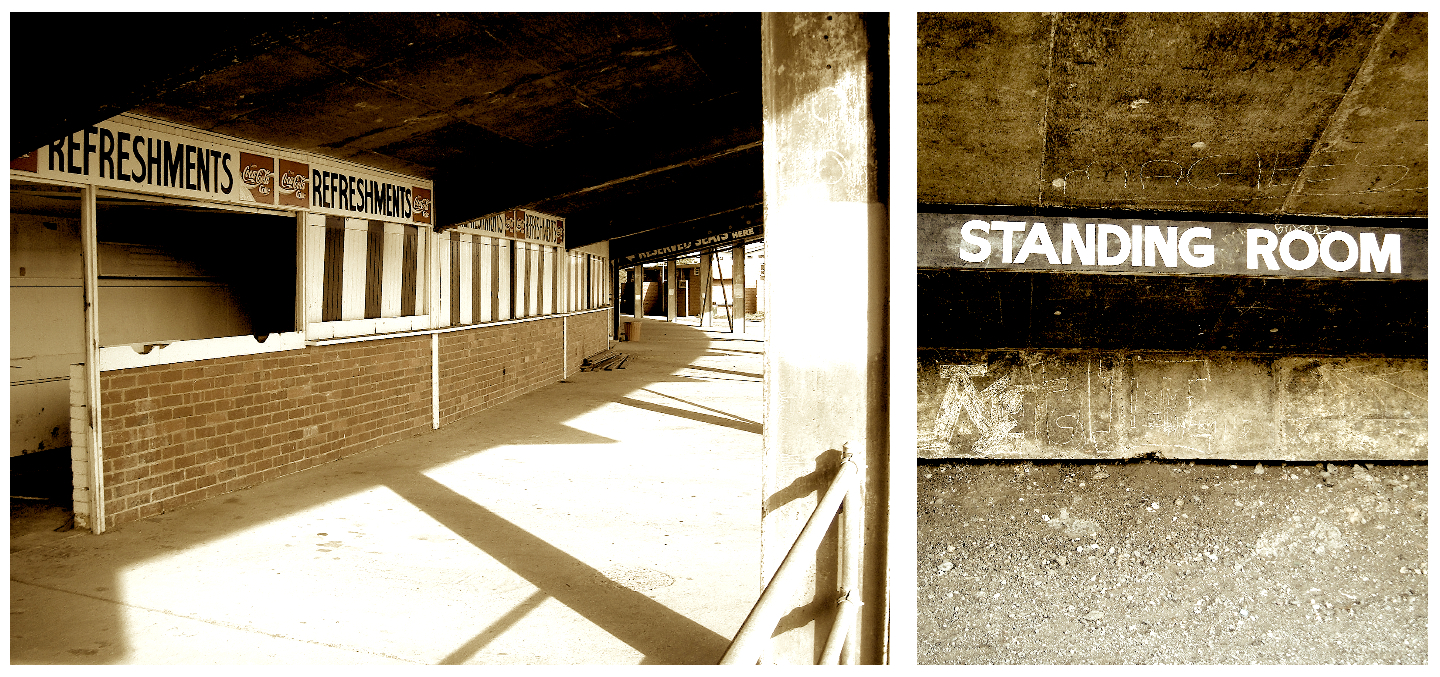
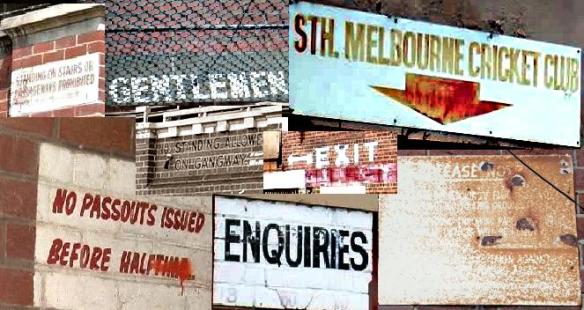
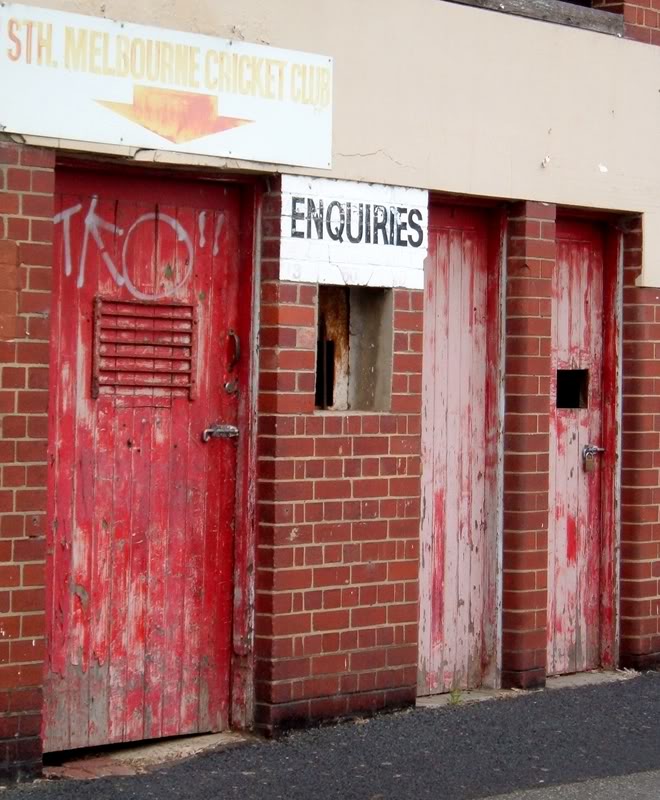
Here are some of the entry points to the ground. As it was used up until 1999, the signage was in good condition and fairly up to date. 

I think Vic Park may have been the first league ground to actually introduce a spacious concourse as seen below! This would fit with current stadia regulations surely, although perhaps there’s not enough modern art and fast food outlets? As I said, it wasn’t beautiful, but it did the job.

Once in the ground, there were nooks and cranny’s aplently to exlore. The two photos below were taken under the Rush stand. Collinwood made sure you never forgot where you were, taking any and every opportunity to stick up the black and white stripes. The Rush Stand was hardly a stand, more a terraced outer with a bit of shelter, and plenty of what the photo on the bottom right says…standing room!

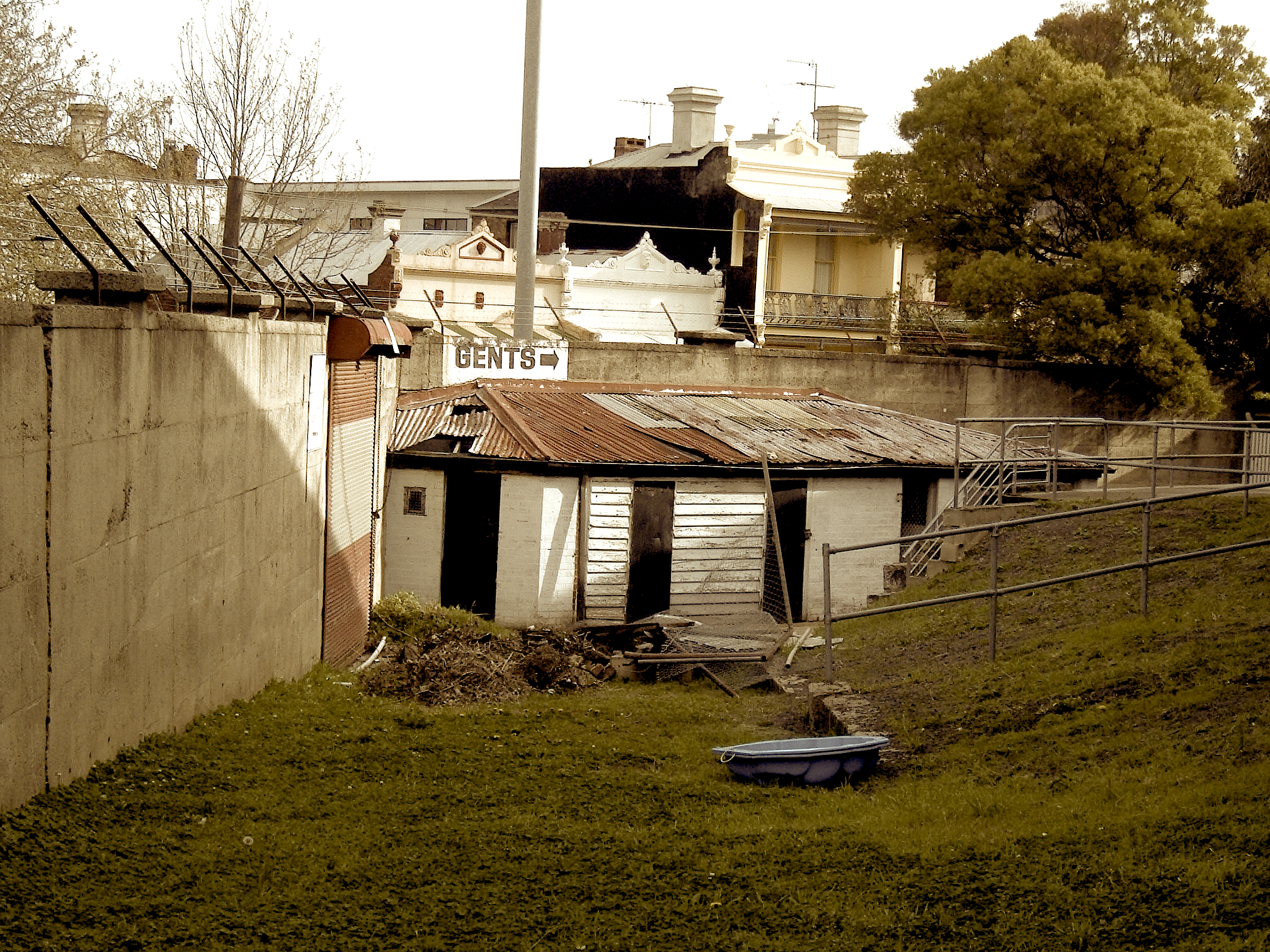
This is taken out the back of the Rush Stand as it joins with the hill behind the goals at the Yarra Falls end. I love the terrace houses you can see in the background, the same houses you can see in old photographs of the ground. The shot beside it shows the old scoreboard from behind, amidst the ghostly gums.


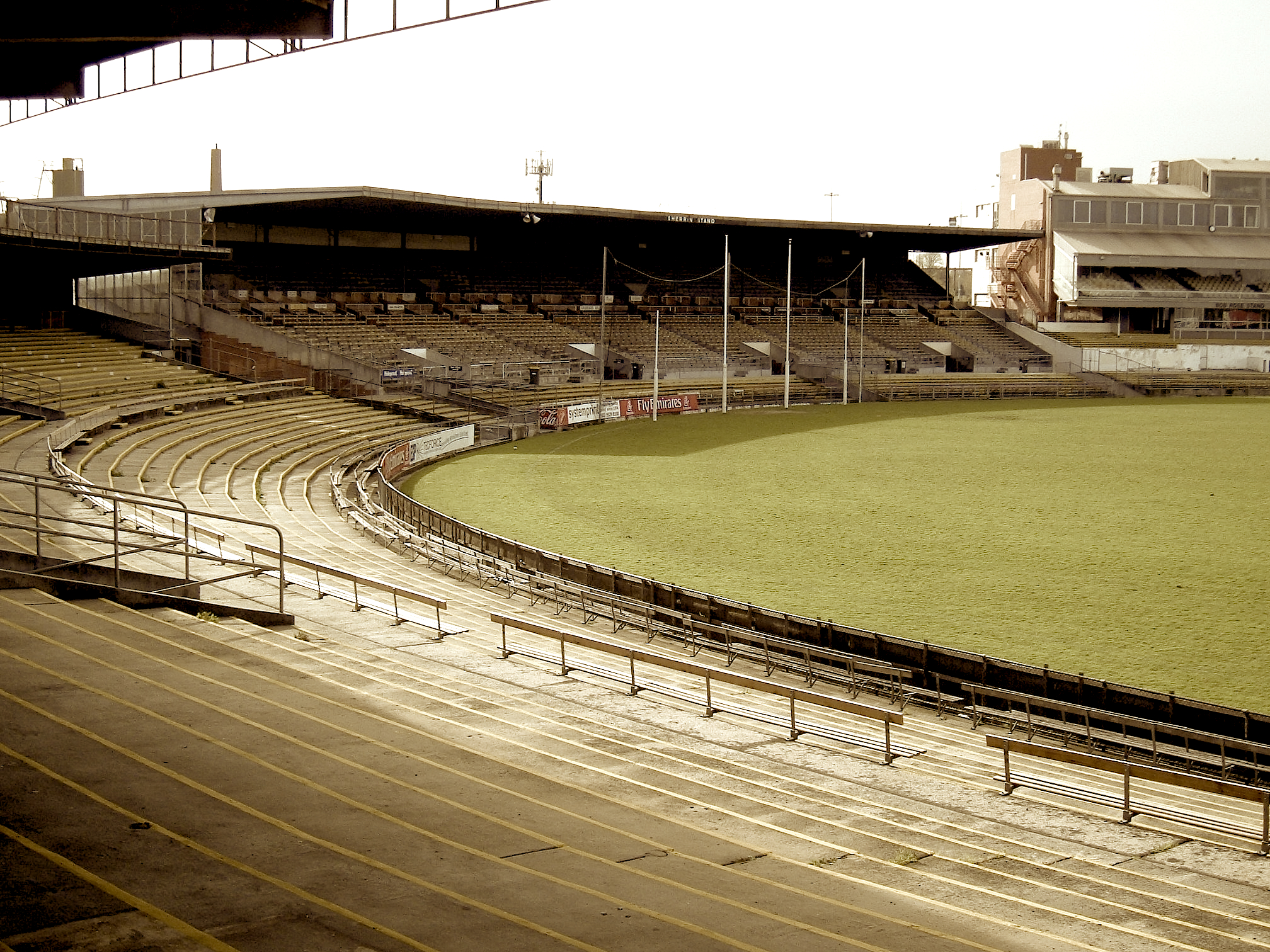
Entering any ground from the darkness below has me wide-eyed like a 10 year old. With the plethora of concrete, black and white, the sudden appearance of green really breaks the monotony. 

When I took these photos, Collingwood had just left, and with them had gone what seating the Rush stand had, along with the players names that adorned the Rush, Ryder and Sherrin Stands. The surface still looked in pretty decent condition.

 The precurser to the Sherrin Stand (above), the old Ladies Stand, is captured beautifully here by Ainsley Walters (below).

pic from http://www.neridahmcmullin.com/page/ainsley_walters.html

The old scoreboard, since demolished, stood atop one-eye hill. Many Pie fans wish that it had been refurbished, but it was deemed a health and safety hazard. It’s a shame to see these old scoreboards knocked down all over the place, but I guess that’s progress! To the right of that is a bit of broken seating from the Rush stand which I helped myself to. Seats numbers 75-77, they may have been your seats!

Below that is the since refurbished Ryder Stand, now complete with new VFL coaching facilities and wheelchair access, and to the left we see the old social club form behind. As a stark reminder of Collingwood’s seemingly abrupt leaving of Vic Park, this shot captures where the logo had been removed, only to see an older one it had been covering, if you look closely!

For a more comprehensive look at Victoria Park’s scoreboard and the modern artwork which now stands in its place, check out Vin Maskell’s blog Scoreboard Pressure. Click here for the old scoreboard and here for a piece on how the new sculpture was conceived.

Photo by Anderson Hunt
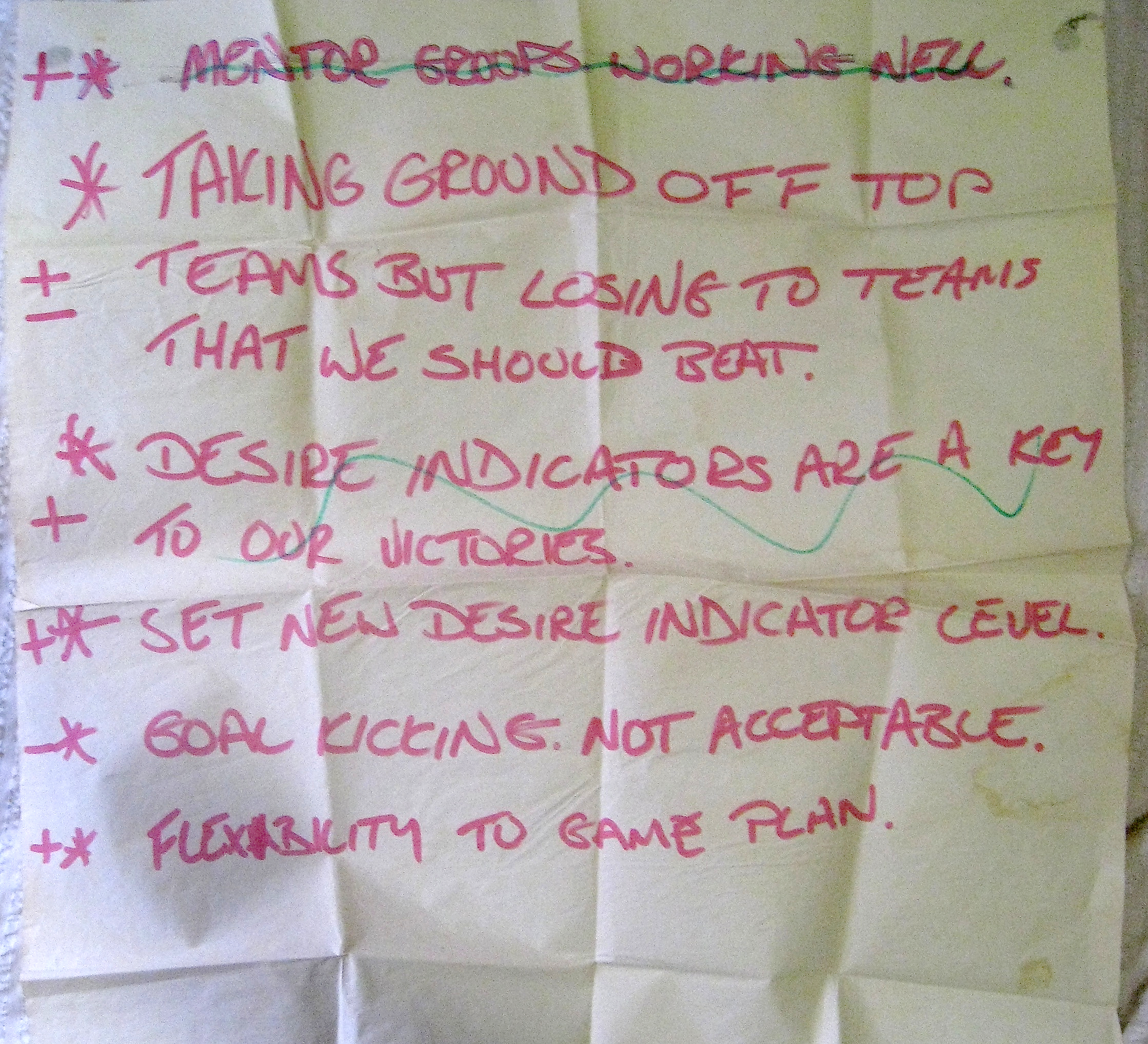
Whilst fossicking around Vic Park I also found a whole lot of rubbish carelessly ‘disposed’ of by the recently vacated Collingwood F.C. Among them were some notes from I guess a team meeting. I’m sure they’re more into interactive whiteboards and the like now, but some things remain the same.

DESIRE INDICATORS ARE A KEY TO OUR VICTORY…pretty much ‘have a crack!’

And what of Vic Park now? The Pies have returned in the form of their own ‘reserves’ or ‘VFL’ team, who now play home games at the ground. The Rush Stand has come down but the others remain, and the place has been done up nicely. For more on that check out Collingwood and footy nut Jeff Dowsing’s piece on the Footy Almanac website. To get you in the mood, below is some of his pictorial work with the refurbished ticket box, before and after.

No set of footy fans were as connected to their home ground as the Pies were to theirs, with websites, artwork and poetry now devoted to Victoria Park. Even though I follow Richmond, I’m disappointed that I never saw a league match played there, hostile as it may have been and no doubt a feather in the away fans cap should they have survived. The refurbishment is certainly respectful of the past, something I wish all Melbourne clubs would consider as their grounds are no longer useful playing venues. A leaf could be taken out of Collingwood’s book on this one.

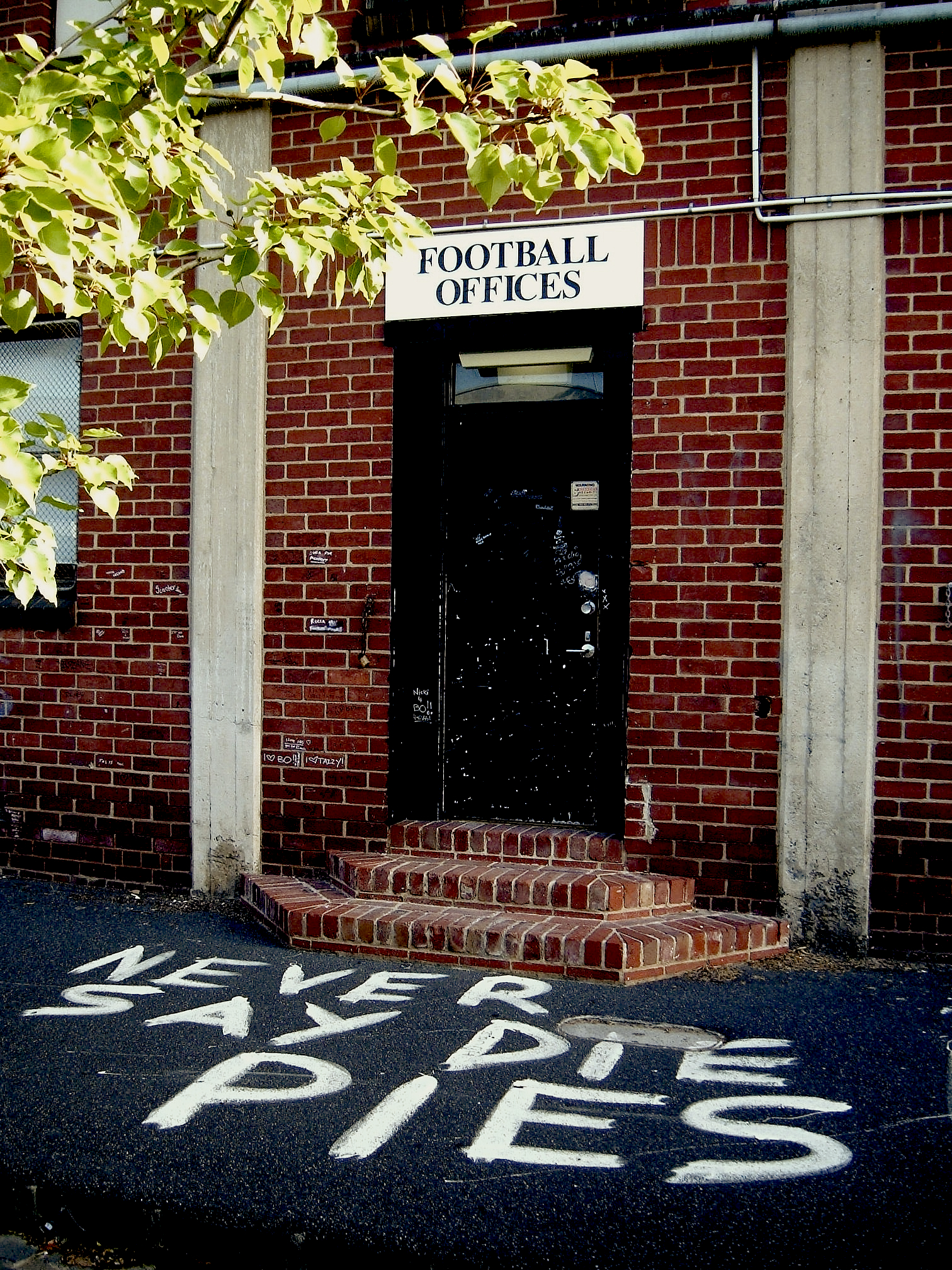
I’ll give the last word to a fanatical Magpie fan with a spray can…


Make sure you check out the comprehensive and fantastic Victoria Park website, full of stories, pictures, history, memories, video clips and more, all devoted to Collingwood’s spiritual home!

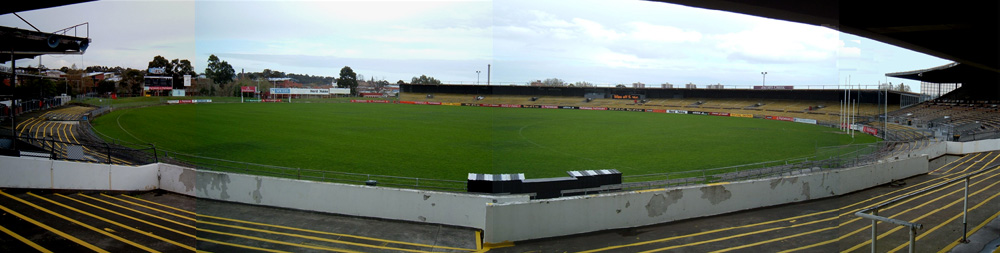
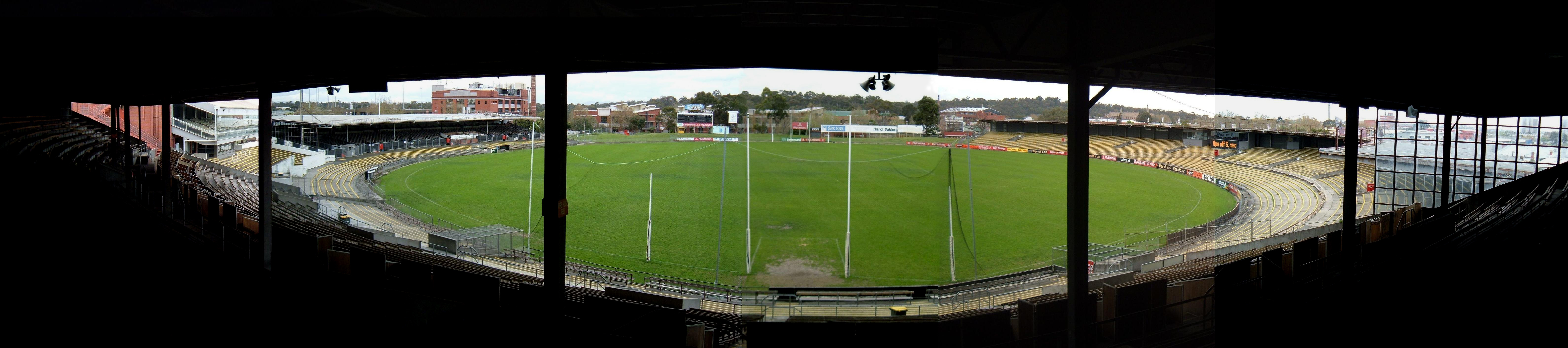
A couple of panorama’s I put together of Vic Park circa 2005. Above is from the social club, below from the Sherrin Stand.

Happy Snap #17 Dockers First Hurrah!

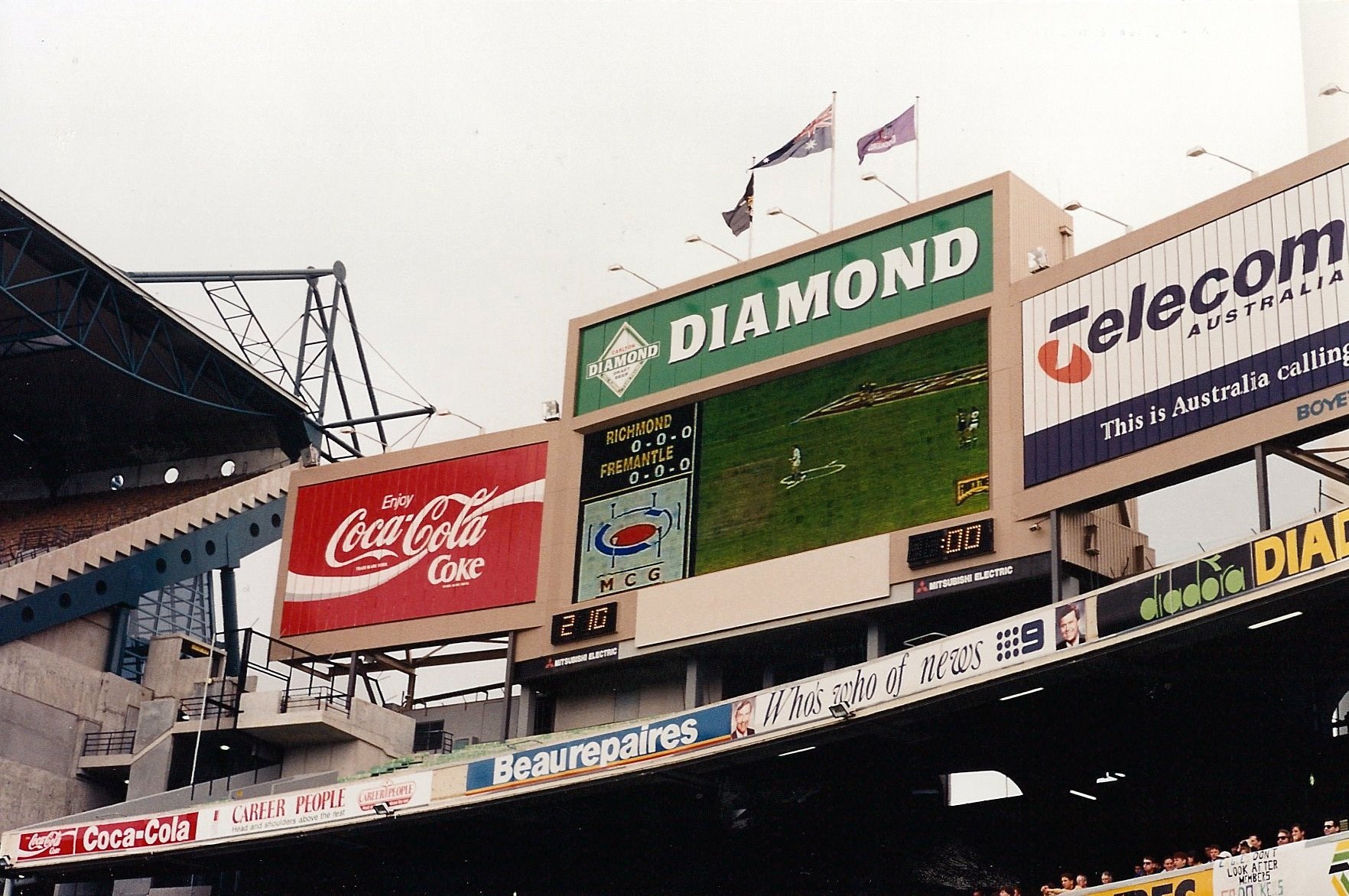
I just quickly want to post this picture from the family photo album as there are a few interesting little aspects to it. Firstly, this is just seconds before the Fremantle Football Club commenced playing in the Australian Football League, round 1, 1995. The time is 2:10…traditionally when matches used to begin! It’s anyone’s guess these days! We were there because Richmond were again used as the guinea pigs to welcome a new Western Australian club into the big time.

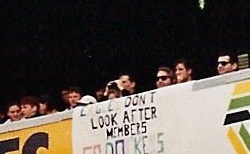
But thanks to my dad, we have some idea as to the Dockers mindset in relation to their powerful big brothers, West Coast, who had won two of the past three premierships. This little home-made sign hanging over the fence simply says…

“Eagles don’t look after members…Freo Dockers!”

A disgruntled Eagles fan perhaps? Sick of success? Or perhaps sick of being on a ten year waiting list to get a seat at a home match? Either way, this Freo fan or fans have failed miserably in one aspect…you can’t read yellow texta from a distance!

Richmond nervously held on for a 5 point win, with little indication that it would be the first of 7 successive victories. As a side, this is the old Western or Ponsford stand at the MCG, and the photo is dated by the ‘Telecom’ (not Telstra) and “Brian Nailor-Ray Martin…Who’s who of news” advertisements!

PS.Thanks to mum for her happy-snappery!

Backyard Gladiators

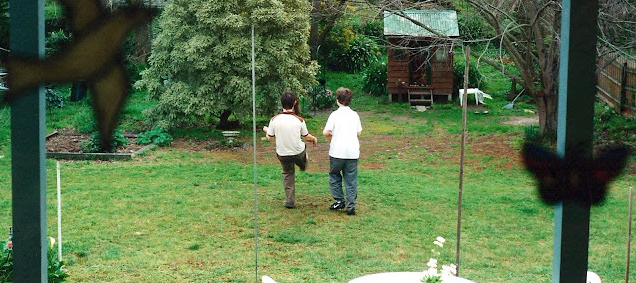
Yes, like a lot of you, my backyard was my footy ground as a kid. Poorly placed lemon trees, clothes lines and vegie gardens became obstacles to overcome, much like an opponent, although luckily we grew up on a rather big property in leafy Blackburn.


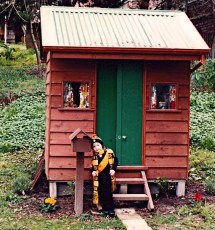
Here I am in front of the newly erected pavillion (1986)…surely one of the last wooden structures before the modern obsession with concrete and steel. The Tiger jumper you see there now fits my own daughter, although she’d like to morph my Dale Weightman’s ‘3’ into an ‘8, like Jackie.’

I loved playing footy in the backyard as a kid. I would act out each upcoming match, concocting the most bizarre of circumstances! Richmond, 23 goals in the first quarter against Essendon! Or trailing Carlton by a hundred points, the Tiges would come back and snatch it with a miracle goal after the siren! I did commentate a little to myself, but I was more into mimicking the crowd noise as the Tiges came storming back! The glory was never reflected come the weekend, but I’d be back the next week, dreaming up glorious scenarios for my Richmond.

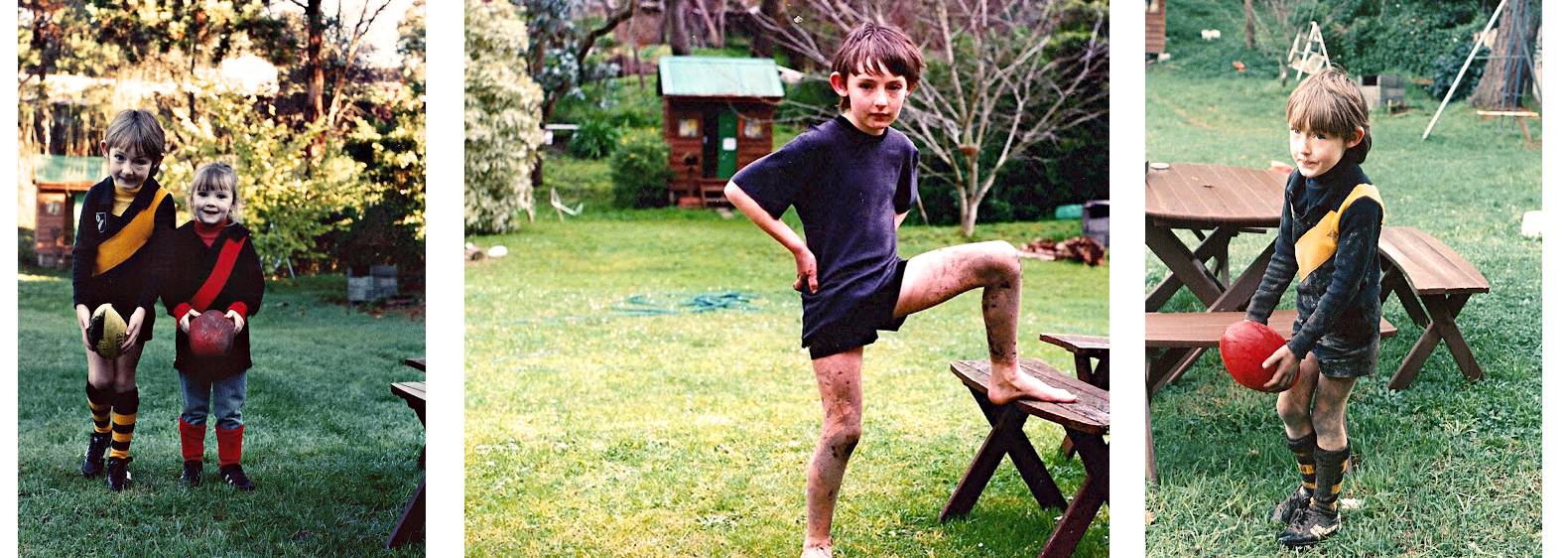
It was often said to me as a kid that the muddier you got, the better you had played. I must have been a bit of a star then! Yep, that’s my sister Mezz and I. Mum did the unthinkable and tried to convert her to Essendon, but she had the sense to follow the family team, and the sash was soon a yellow one. I enjoyed playing footy with my lil’ sister, and I had her kicking really well, but her heart just wasn’t into playing. I had a dream to play for Richmond. That was sadly not a reality for her so why bother? What I needed was a mind for moulding. Thankfully, my footy mad baby brother came along.

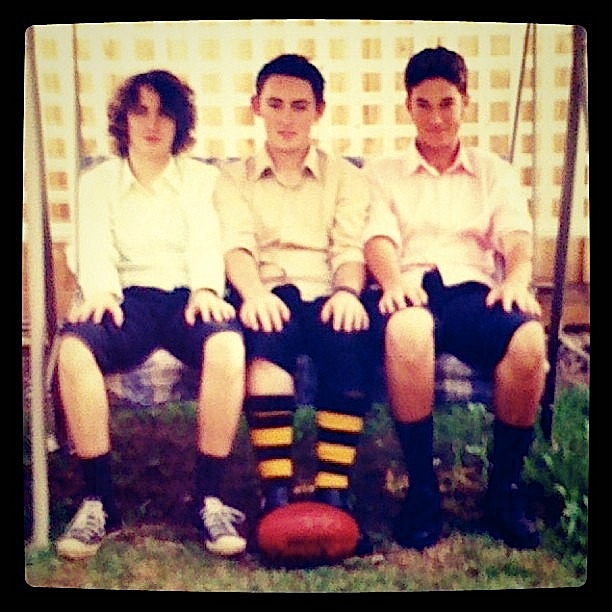
Inexplicably, though he’s wearing yellow and black here, he grew up a Footscray supporter. He does have a soft spot for the Tiges however, as I do for the ‘Scray, but going to Footscray v Richmond matches is a big no-no!

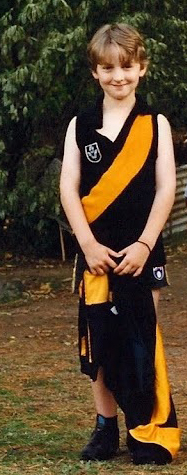
Far too old to get away with it, but that didn’t stop us!

There was a six year gap between us, but I wasn’t your typical ‘beat-up on you little brother’ type. I preferred an even competition, so would introduce handicaps for myself. I’d have to start on my knees, only kick on my left and the like, all the time searching for some semblance of realism. The backyard was my own league ground, and I tried to play it to scale. This meant kicking shorter, running slower…all in the search for reality. A visitor would come over, boot it over the fence, and essentially ruin our game.

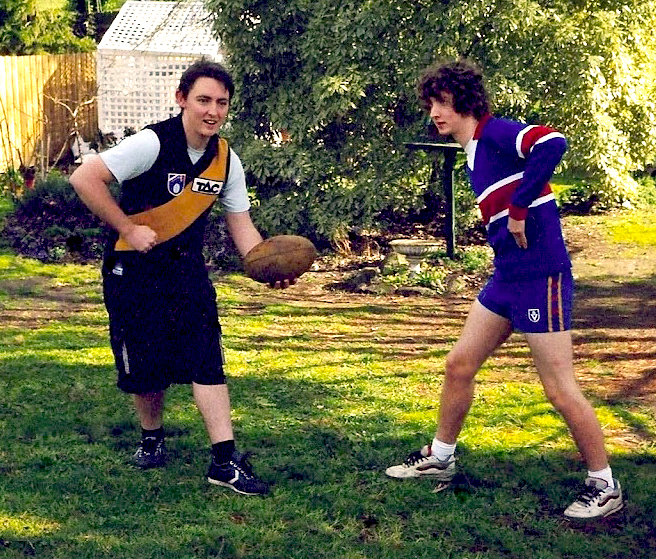
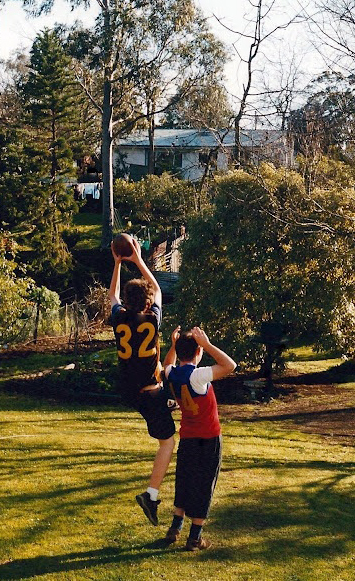
But my brother grew up. Pete now stands half a head above me. In my latter years at home, we were able to compete without handicaps…it was man verses man….ok…. boy verses nearly man. We had two main games. For one of them we’d stand 20 meters apart, one of us would kick the ball high into the middle and we essentially played a version of chicken. After a sore head or two however, we resorted to the game you can see in the surrounding pictures.

Shoulder to shoulder, one of us would kick the ball high into the air, avoiding the pine tree. If you had scored, the other person kicked it ‘up.’ If you marked the ball, you had a set shot. If it came to ground however, it was on for young and old. He was young, I was old. Numerous winter hours were spent here, playing until dark. We’d bump, swear, tackle and rub it in the face of the other. All still within the framework of playing ‘to scale’ in our backyard though. We knew we’d never ‘make it.’ This was it for us!

Three things about this photo. Firstly, I cannot work out if I am wearing long shorts or short longs, but they do lend a certain early 1900’s knickerbocker feel to the photo. Secondly, it’s clearly a staged photo as can be seen by the limp ‘effort’ i am putting in. Our game was not so much about high flying either, rather marking ‘tussles.’ And thridly, it reminds me of finals time. Spring leaping through the trees and the smell of cut grass. I can smell this photograph.

There’s something about us older brothers. Though Pete is well taller than me, I can still outmark him through sheer competitiveness. I imagine league players, with older brothers who never made the highest level, still unable to defeat their older siblings in backyard footy. It’s a different beast. Visualise Jason and Cameron Cloke dominating and making Travis, clearly the pick of the trio, cry in the backyard. David would be umpiring of course. He never misses a match.

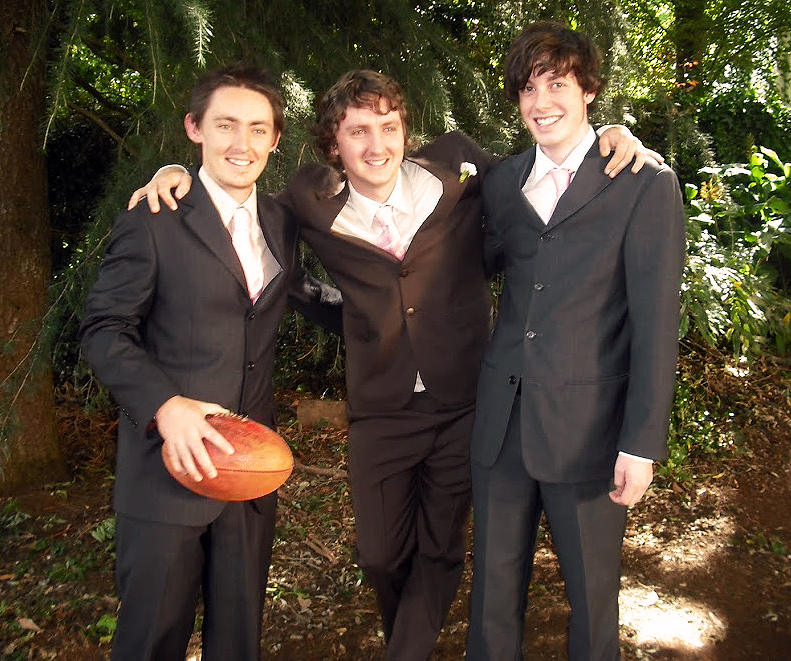
So whilst footy can sometimes be the only thing that ties siblings or parents together, that wasn’t the case with us. We had plenty in common and still do. But the footy is never far from being brought up. On both of our wedding days we even pulled out the footy, ironically in the backyard, to help settle the nerves. It’s something our respective partners are still coming to terms with!

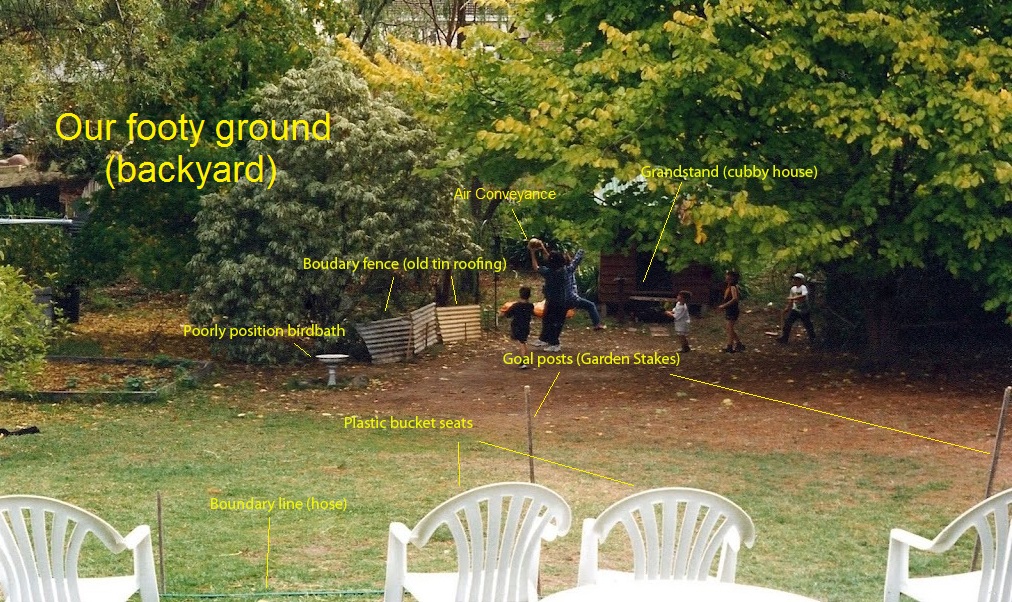
Playing footy in mum and dads backyard is not as easy as it used to be.There’s a new vegie garden on the half forward flank, and though the clothesline has been removed (about time!) the goal posts have since disappeared. There’s more breakable stuff around too…while the golden elm encroaches onto the playing field like never before. But we can still navigate our way past the cubby house, blind turn the bird bath and nail the goal from the clothesline pocket, all with our eyes shut!

A Town painted Red, White & Blue

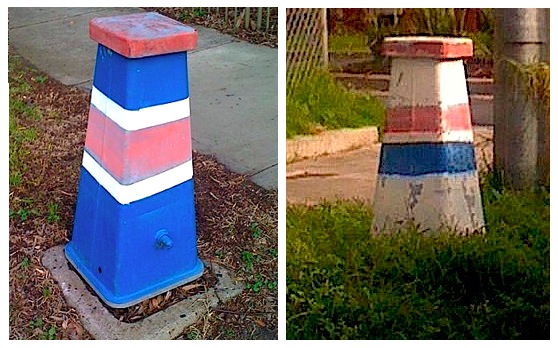
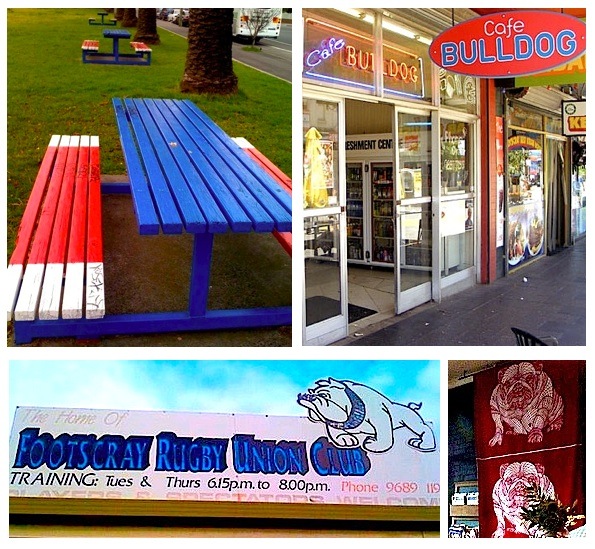
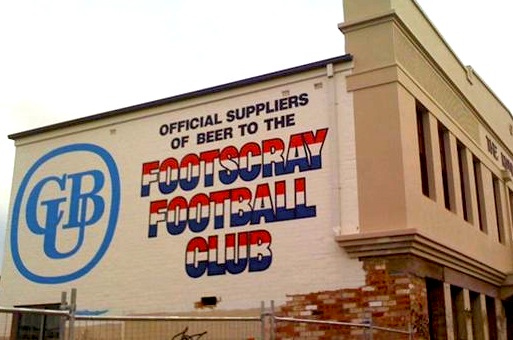
Living in Footscray, it’s hard to ignore the fact that as a Richmond supporter, I am in ‘enemy territory.’ (I’m actually quite partial to Footscray!) Unlike a lot of clubs, there is still a strong link between the suburb and the footy club. When I came across the below fire hydrants, I decided to do a little tour of the village in search of red, white and blue.

What impresses me is that the fire hydrants of Footscray encompass both home and clash strips!

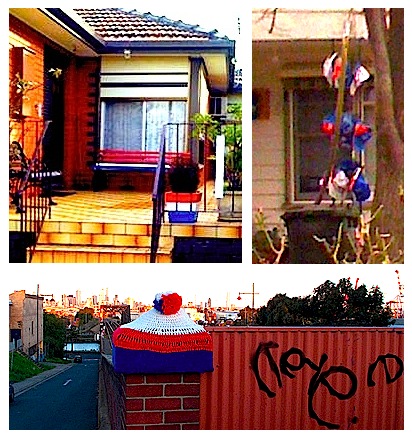
Many houses are adorned with Footscray Footy Club paraphernalia, and when the Dogs are in the finals as they were recently the volume increases dramatically. Above are some of my favourites. From the subtle to the clever. The lower picture was found on Lara Cameron’s lovely blog http://kirinote.blogspot.com.au/2009/09/knitted.html

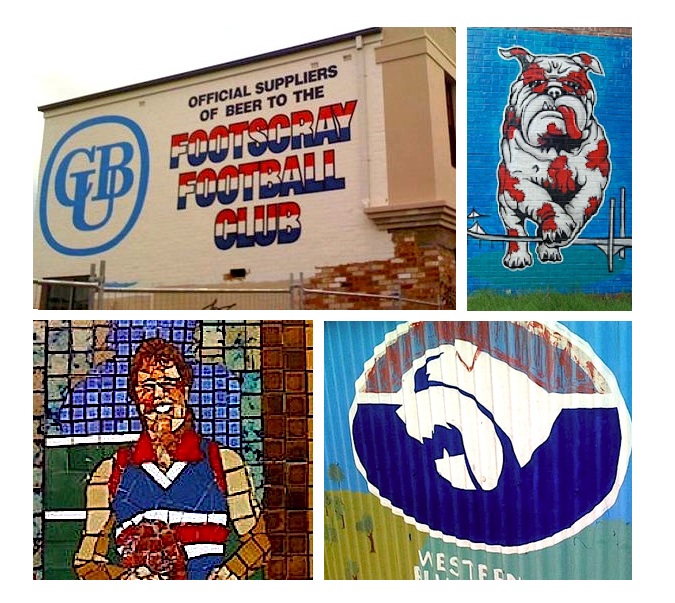
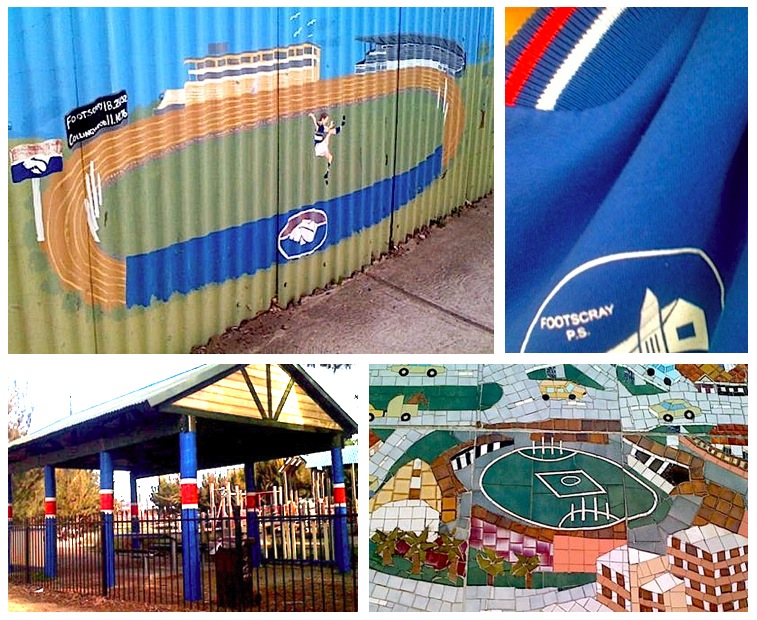
This is Doug Hawkins first of two appearances in this post, fitting given the connection he appeared to share with fans. He was one of them in a way. This is one small part on a wall outside Footscray City College, a large mosaic depiction of Footscray. Above Doug is some fantastic old advertising on the Rising Sun Hotel (now apartments…nearly), over the road from the Western Oval, while other street art around Footscray shows a great love for the dog. There’s even a Dancing Dog cafe!

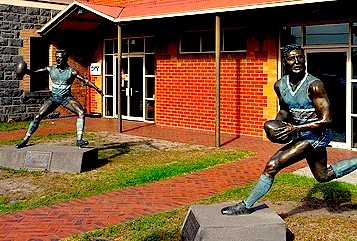
We’ll skip momentarily out of Footscray, yet stay firmly in the west. The Braybrook Hotel proudly houses these fantastic statues of two Braybrook boys in EJ Whitten and Hawkins, arguably Footscray Football Clubs biggest personalities and two of the very best. Surely there’s no need for security with these two out the front night after night?Below is another wall mural, this one running along the Barkley Street side of St.Monica’s Primary School. The scoreboard reads Footscray 18.24.132 to Collingwood 11.10.76. If only that were the case more often than not! We also see that Footscray Primary’s uniform is red, white and blue, and back to the mosaic wall for another take on the Western Oval, along with a Bulldogs inspired playground.
‘Cafe Bulldog’ in the Footscray Mall unashamedly sports the clubs logo and colours, as does the trendier Gusto cafe in West Footscray, albeit with a somewhat artfully put together Bulldog to watch over patrons. (bottom right pic from the wonderful Footscray Food Blog-read here about the Whitten Oval’s Pound cafe!)

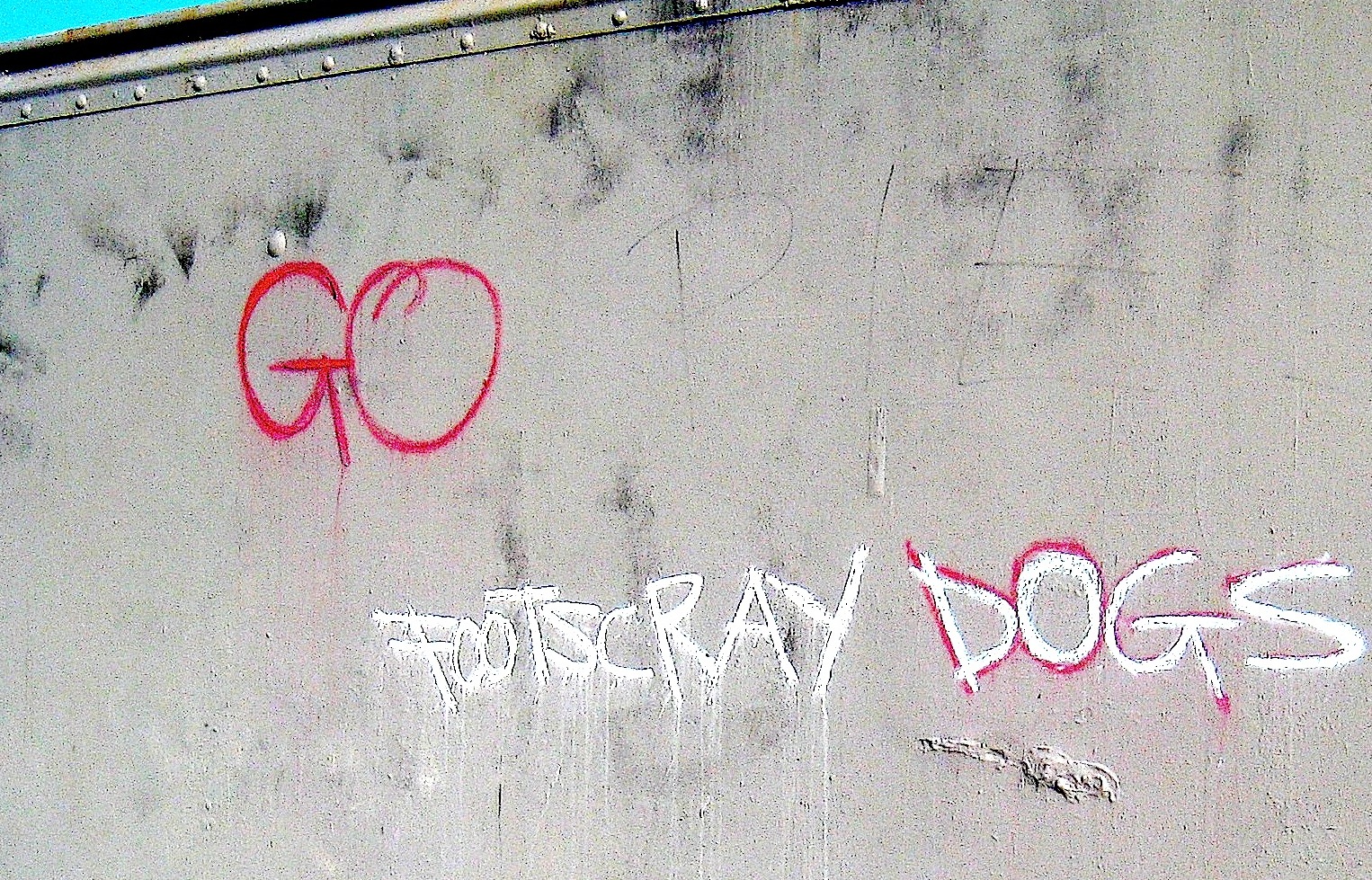
And lastly this bit of graffiti, pointed out to me by Vin Maskell of the fantastic scoreboard pressure blog, sums it all up for me. For no matter where you are, there’ll always be a Collingwood supporter showing a bit of cheek.

Home & Away #5 Lakeside Oval

Lakeside Oval: League venue: 1897-1981. League (VFL/AFL) matches: 704 (7 finals, including 1899 & 1901 Grand Finals). Record Attendance: 40,401, South Melb v St.Kilda, 1923


 This is part 5 in my series ‘Home & Away’, a look back at Melbourne’s old VFL grounds from a range of photos I took in the mid-2000’s. South Melbourne’s picturesque Lakeside Oval was last used as a league venue in the same year that I was brought into this world, 1981, as South Melbourne was bundled up north to become the Sydney Swans.  As such, I clearly never saw a Sherrin kicked in anger on the famous old ground. In fact I only once saw it as a footy ground before it became rectangularised, when dad took us to look around in the early 1990’s. I remember standing in the shadows of the old stand and dad being pleased that the tunnel in the outer terracing still existed. Not for long.

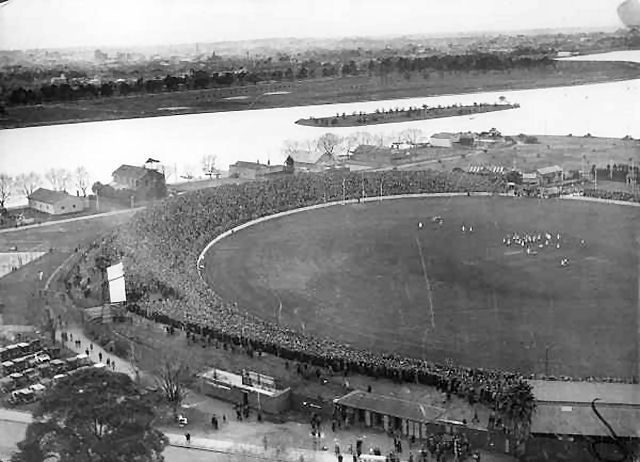
An very rare aerial shot of the Lake Oval dated between 1920-1940. Just over the back of the ground you can make out the newly planted palm trees which still standtoday. Image courtesy of http://www.austadiums.com/forum/viewtopic.php?f=1&t=1663

 I ventured down to the Lake Oval during grand final week of 2005, desperate to soak up something of the Swans past to  make relevant the impending ‘interstate’ grand final. I know that’s a very Victorian-centric mindset, but it’s what I needed to do to get myself up! Now there may have been just the old stand left, but I intended to explore it as far as was reasonable. But to set the scene, here is some old ‘Bloods’ passion which was bursting out!

The view down to Albert Park from Clarendon Street South Melbourne is still dominated by the 1926 old red brick stand. 

 Note the car in the bottom corner? Well that was an Albert Park worker who had come to paint over this battle cry. Have they no sense of theatre?

The oval, which is now home to Athletics Victoria, has been been spruced up somewhat. The soccer pictch remains, although a runnning track around it has made for an oval  shape returning to the venue, along with the name reverting to Lakeside Stadium, having been Bob Jane Stadium for a number of years. But as I took this photo, uncertainty surrounded the future of the grandstand, which was in a state of decay. The council and park were keen to help it on its way down, the Sydney Football Club not so. A compromise was finally reached, saving the stand.

The old stand hanging onto life, and an artists impression of what has since been turned into reality. While it is no longer a grandstand as such, it is far more a part of the oval than when it looked forlornly on at South Melbourne Hallas from the old forward pocket. (The wooden blue bench seats were snapped up from the Waverley Park fire sale!)

Clearly all that was left of South’s old home was the old grandstand. Luckily however there were still traces of days long gone, with various artifacts still remaining, some obvious, some well hidden. Below is a collection of bits and pieces which provides an interesting time capsual. Most if not all of these gems have since been removed with the redevelopment. Here are some fading images from yesteryear.

The old entrance gates and ticket boxes were obviously all locked up, though still proudly wore the fading licks of red South Melbourne paint. These doorways have been maintained in the new structure, far narrower than the modern day door!

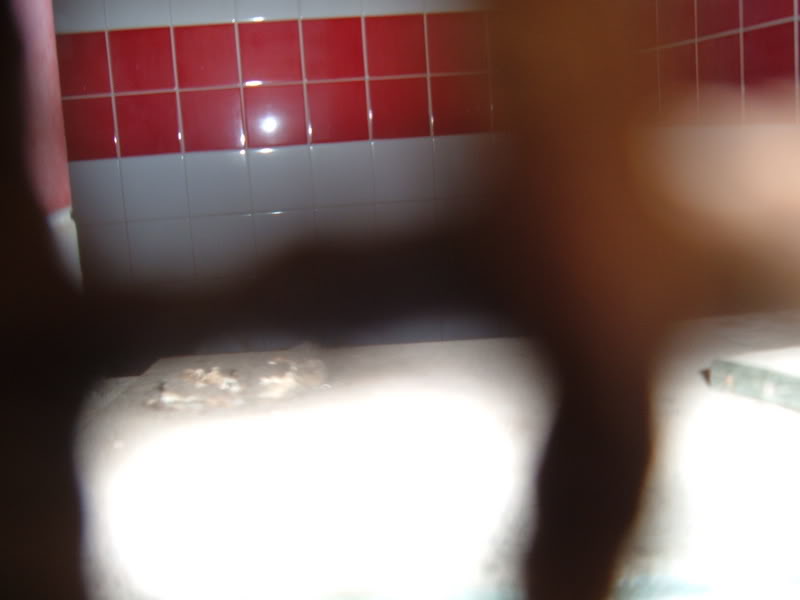
From the outside all you could see was a rusty grate and darkness. The flash of my camera revealed some lovely red and white tiling of what could only be the loos. And similarly, the photo below these was another ‘stick the camera under the dark door and see what comes out’ moment. The photo has been significantly brightened and demonstrates how unloved the stand had become.


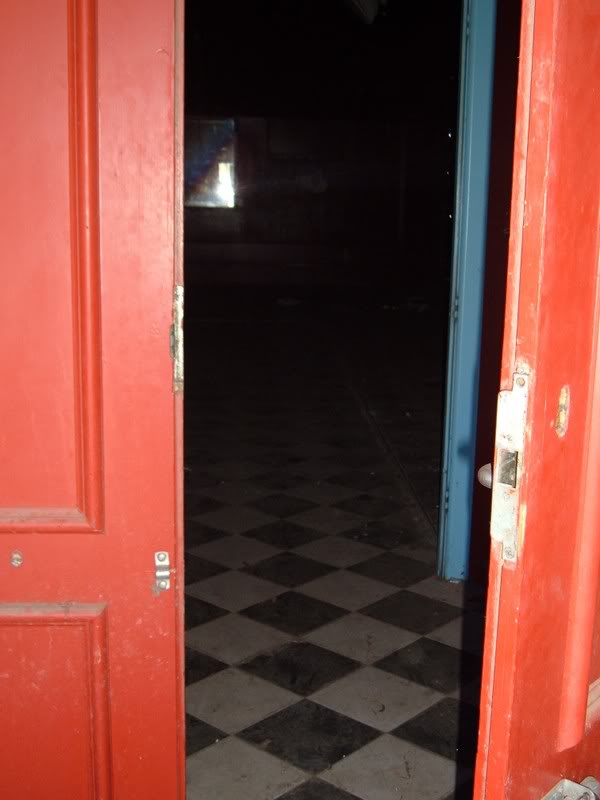
Then I plucked up some courage. There was an old door which appeared to be heavily locked. However as I fiddled around, I realised I could get it open. I simply could not tell what was in front of me it was that dark, so I quickly headed in and took a few shots with the flash. I had no idea of what or even who was in there, so I quickly departed to inspect my photos. What I found was the old nightclub ‘Redheads’, which operated well before my time but was apparantly quite the place to be!


The 1975 film ‘The Great McCarthy,’ which follows the fortunes of South Melbourne’s gun full-forward recruit from the bush, has some of the most vivid and complete shots of the old Lakeside Oval in what would turn out to be it’s final days. Here are some stills I took off the telly a while back. Also, check out the youtube clip below, where someone has bothered to take all of the best ‘lake oval’ shots and put them into one clip from said movie.

It would be remiss of me not to mention the Night Premiership or Consolation Cup played at South’s Lake Oval between 1956 and 1971. Being the only ground with floodlights, the VFL decided that the teams who missed out on the final four would play off for the ‘best of the rest’ tag under lights! My dad remembers the jubilation he felt in 1962 as Richmond ‘actually won something!’ This was the precurser to what is now the preseason competition, which has become nothing more than an annoyance to fans. But night footy in the 1950’s, though there was the odd dark pocket or four, must have been exciting for Melbournians post-war. Heck… 36,000 turned up for Carlton and North in 1965!

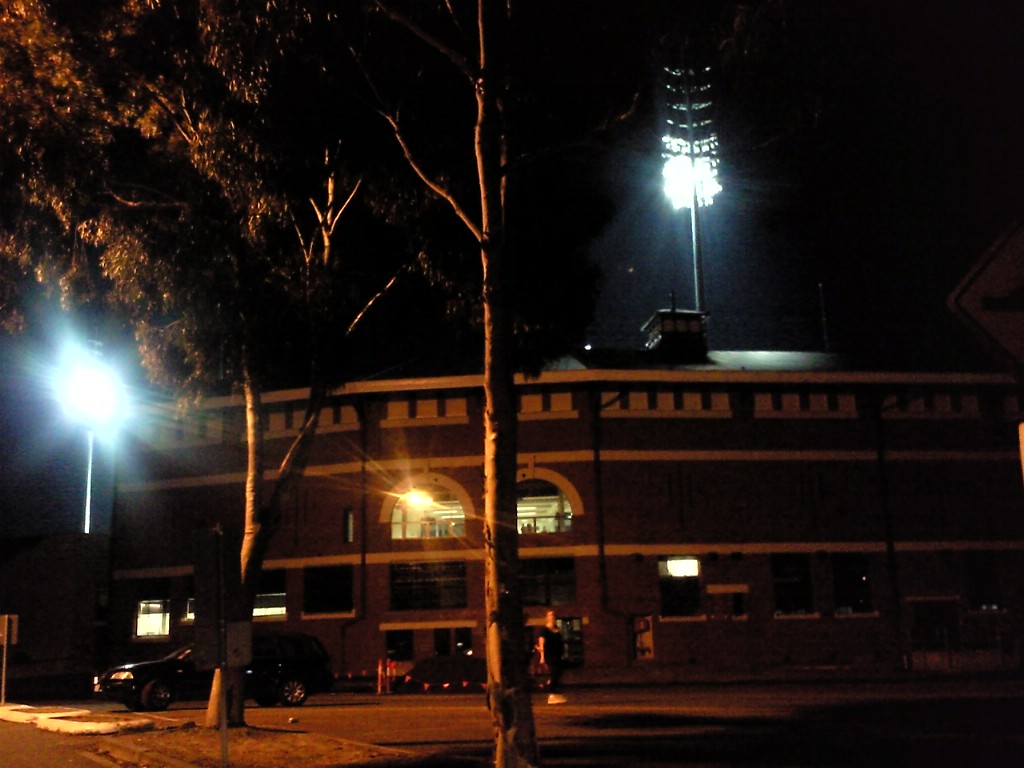
As I drove past recently, the lights (not original) were on at the conclusion of an athletics meet. I quickly snapped this pic to try and somewhat commemorate the old night series at the ground.
Finally, there are some other stands and grouns which share a connection with Lakeside Oval. While SANFL club Norwood’s grandstand is not identical, it is the closest stand that I have come across to South’s old 1926 red brick number. It is essentially the same design, there are just a few ‘frilly’ bits which differ.


image from http://farm8.staticflickr.com/7086/7144620767_b32f2438d1_z.jpg

And just last weekend the family and I took a trip to Maryborough, and decided to drop in on the picturesque Princes Park Oval, complete with resplendent old stand. What interested me however was a plaque which mentioned that this stand was based on South Melbournre’s 1886 stand, precurser to Souths ‘current’ stand, before it burnt down in the 1920’s. What we also noticed were the surrounding street names….Clarendon, Napier, Raglan, Albert, Palmerston, Park…all names of well known South Melburne streets. Whether a coincidence or not, it certainly felt like a little bit of old Emerald Hill as we cruised down Clarendon Street Maryborough.

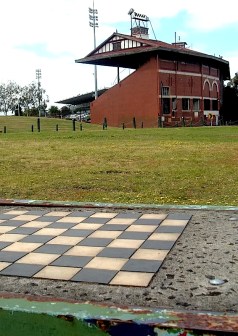
It’s often said that the coaches box can represent a game of chess, but at the old Lake Oval, you left your chess game at the entrance gate!

Make sure you check out Billy Millers wonderful videos on all the old VFL grounds.

http://www.bellestorie.com/aroundthegrounds/lakeside/video/lakesideoval_0.html

And a lovely little timelapse of the old footy come soccer ground becoming Victoria’s premier athletics track

http://youtu.be/ueC2tEygRnE

With a little help from my friends…

Football Grounds of Melbourne, Caruso, Fiddian and Main.
http://www.austadiums.com/
http://stats.rleague.com/afl/venues/lake_oval.html
http://www.majorprojects.vic.gov.au/

Adelaide v The Eagles


West Coast and Adelaide are often lumped together. Both teams represent their state’s local leagues, the WAFL and the SANFL, and are considered the ‘big brother’ of their respective cross town rivals, Fremantle and Port Adelaide. Both also enjoyed early success, prising away two flags each from a bitter Victorian landscape during the 1990’s.

Why is it then that I consider Adelaide a bona fide footy club, and the Eagles still as a franchise, a bit plastic? I was only 6 when they entered the competition so I’ve grown up with them, but there’s something not quite right for me.

So what’s in a name?

Let’s start with Adelaide. It is what it is, it represents the town of….Adelaide! The previous incarnation of the Adelaide Football Club disbanded in 1893 and is in no way connected to the current day club, which meant that upon entrance to the AFL in 1991, their was no hesitation in simply calling the club Adelaide.

West Coast on the other hand is to me a vague choice of name to represent a Perth based club. In their defence, the name Perth Football Club was already taken, the Perth Demons being a member of the WAFL. However, the ‘West Coast’ of Australia represents a landmass four to five times larger larger the United Kingdom, and as all landmasses possess a west coast, to me the name is generic and far from inspiring.

Think I’m being harsh? Consider the words of respected footy commentator and proud West Australian Dennis Cometti. He describes the “dumb name” as “American crapola!” The usually affable Cometti continued “It’s a real blight on the competition.”
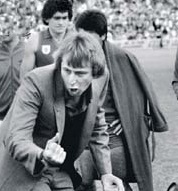
Cometti coaching WAFL side West Perth, who he also played with. Image from- http://www.theage.com.au/ffximage/2005/08/26/cometti.jpg

Part of Cometti’s reasoning is a lack of a geographical focus. “I have struck many people who I have met overseas who follow Australian rules who ask me where West Coast is located. They ask me how far from Melbourne is it.” The Perth Eagles is Cometti’s preferred choice.

While the name ‘Perth’ was out of reach, perhaps something such as ‘Greater Perth’ could have worked. That’s what marketing and branding people are out there for. ‘West Coast’ seems a poor choice.

Nicknames and Monikers

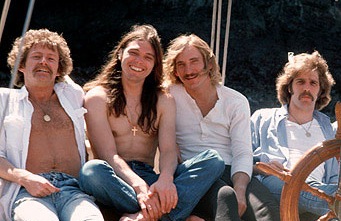
The Eagles. Easy listening pop-rock music, from the West Coast of the USA. That’s right, ‘West Coast Eagles’ conjures up images of harmonic pop melodies, sweetly sung by hairy, good natured ‘boy next door’ types. It hardly sounds befitting of a hard and tough football team, which is what West Coast have been for the majority of their existence.
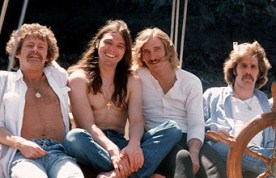

The Eagles from the US West Coast. Perhaps Eagle Ben Cousins modelled his open shirt look from the bloke on the left? Image from-http://images.paraorkut.com/img/artists/images/t/the_eagles-1137.jpg

But what should a team from Perth have been called? Like the Perth name was taken, so was the obvious W.A football name of Swans; snatched by South Melbourne after an influx of West Australian recruits many years ago. The state team was also known as the ‘Sandgropers,’ a colloquial term for West Australians. However ‘Greater Perth Gropers’ would struggle to secure the sponsorship dollars needed to run a football club. I don’t have the answer, but ‘West Coast’ with ‘Eagles’ is too American.

Compare this with Adelaide’s moniker, the Crows. This is no throw-away nickname, instead it is steeped in more history than most. South Australia’s state football team has been long known as the Croweaters, a unique name which started out as a term of ridicule. It can be traced back to 1851, seven years before the recognised ‘beginnings’ of our national game began fragmenting themselves together.

As the South Australians rushed to the Victorian gold fields they began to run low on food, so out of necessity, “killed, cooked and ate some crows.” Arriving at the gold fields in a “very hard up state” and after relating their experiences, they were soon dubbed the ‘croweaters.’ The name stuck.

So whilst ‘Crow-eaters’ and ‘Crows’ confusingly brings up thoughts of cannibalism, this too adds to their footy club culture, as all the old clubs have the ability to ‘eat their own’ in times of trouble.

The Jumper

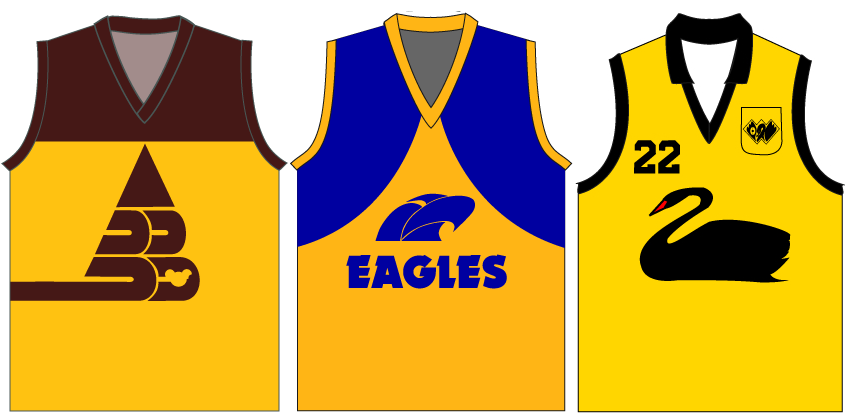
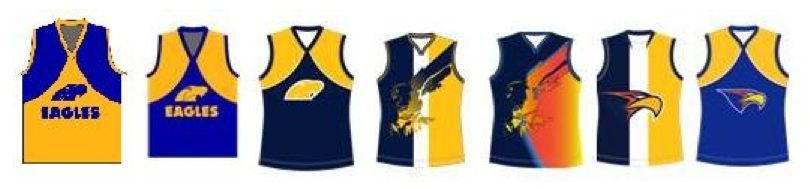
We now turn our attention the two teams guernsey designs. This is important to me. If the jumper is right, I can turn a blind eye to other aspects. When West Coast and the Brisbane Bears entered the VFL competition in 1987, they brought with them two jumpers which challenged the definition of a ‘footy jumper.’
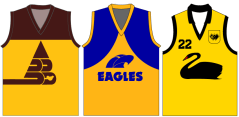
The original 1987 Brisbane and West Coast jumpers, along with the WA state jumper. Upon putting these together I noticed that perhaps a picture of a bird in the middle of the guernsey was possibly a shout out to tradition.

The first thing to notice is that there was far more yellow than had been used in the VFL to that point . But for me this worked, as yellow seemed a colour representative of far warmer climates than the Melbourne competition they were joining. West Australia’s state team had a predominately yellow jumper, and this provided a nice link.

Anthony Costa, whose site http://www.costasportslogos.com/ looks at sporting logos, branding and uniforms amongst other things, also prefers the “gold jumper, which for me is the club’s most distinctive onfield look. There’s a lot of blue and dark sombre colours in the AFL… reckon this jumper would really light things up.”

West Coast reversed the colours in 1988, the colour blue becoming the more dominant, though many shades of blue have since been used. I found and continue to find the Eagles jumper a tad fiddley, with both the writing and the picture being rather non-descript when viewed from any distance past ten metres, though the word Eagles is long gone. The guernsey has never felt settled and is often tinkered with. I am still unclear which is their ‘official’ jumper. 
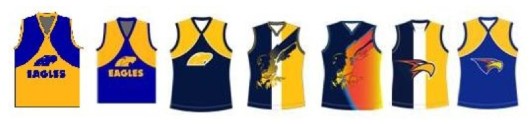
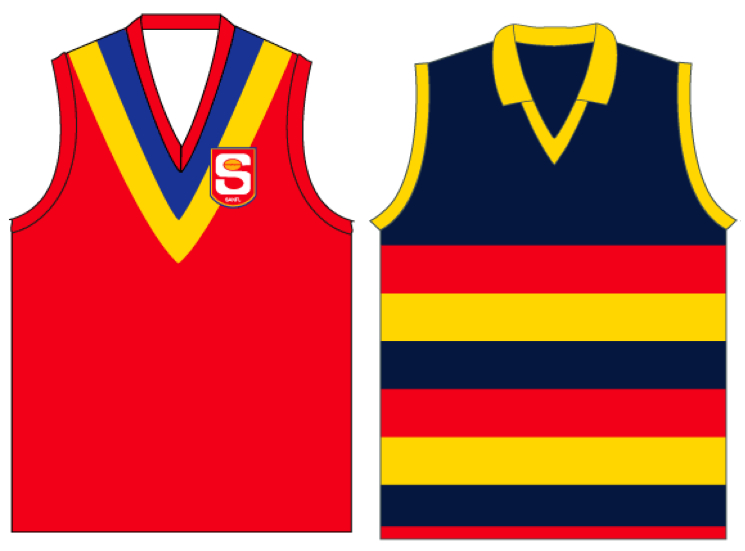
Adelaide on the other hand have ticked ‘all the boxes’ as the clichéd footy saying goes. Their colours, red, blue and yellow are those of their states football team. Their design is simple and striking, like a Geelong jumper on an acid trip.
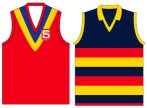
South Australia’s jumper left, Adelaide jumper right.

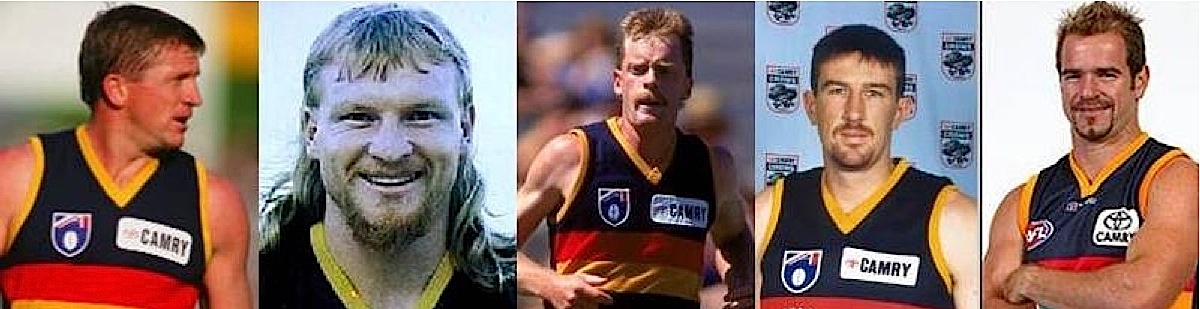
A look through Adelaide’s home jumpers from 1991 to today shows the most minor of tinkering, which would indicate that they have got it right. No fancy pictures, words or designs, which incidentally are impossible to see as a player is chasing the pigskin in the distance. Just simple, bold colours and patterns.

To illustrate my point, the past few years have seen Port Adelaide, Fremantle and Footscray all simplify their jumpers, removing all imagery, to near-universal praise. Port Adelaide’s current jumper was even designed by a 7 year old fan. Consider all the money wasted on professional advice from marketing and design companies!

Club Song

This is my final point. As a a musician, I can’t help but see this as integral to the fabric and culture of a club. I’ll kick this section off with a tweet I came across after West Coast’s recent thrilling victory over Hawthorn.

Simple statement. True statement. West Coast’s ‘modern’ rock-pop themesong severely lacks the punch and heart thumping pride found in old fashioned brass band music. It sounds corny, but it’s amazing what can happen when you mix a tuba, trombone and banjo with a barbershop quartet on heat! The rock beat which sits behind West Coast’s song also sucks the number dry of emotion and feeling.

*click* West Coast’s themesong (Warning! Contains mediocre footy song!)

While Adelaide’s song is far from the best in the league, again you get the sense that they have aimed for the type of song which blokes can sing together post-match, a cappella. They have the right idea, I’m just not sure about the execution. But it has the desired effect as the Adelaide players congregate post-victory. I think I can even hear the Coodabeens South Aussie representative Greg Champion’s voice in there!

*click* Adelaide’s themesong (Warning! Contains MIDI instruments)

Final thoughts

When it comes to club image, marketing and all that jargon, the Crows have just kept it simple and rooted in the past. And just think, anything fancy wouldn’t have matched the heads of McDermott, Weideman, Maynard, Rhenn or Riccoutiou!
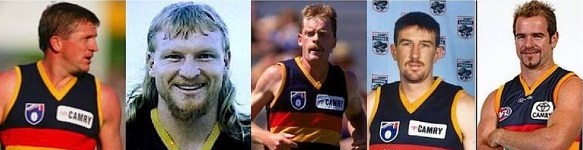
West Coast on other hand were and are a slick, professional outfit. Business like and clean cut, seemingly an emotionless machine. Much of that could have been due to coach Mick Malthouse’s approach and demeanor at the time. But just think of McKenna, Worsfold, Pyke and co…. they would have looked just as comfortable on the footy field as they would have in business suits.

Sure, West Coast had the rough heads of Gastev and Ishchenko run around, while the Crows had glamour boy Modra and the clean-cut Tyson Edwards, but these are the exceptions rather than the rule.

Perhaps the ‘American’ West Coast image suits this club? Perhaps it was what the Eagles founders saw as their aim? But I don’t think so. Think of Worsfold’s toughness, the skill of Matera, Dean Kemp and Guy McKenna’s courage, Ashley McIntosh throwing his light frame around with little regard for himself. What of the toughness of the pint-sized Daniel Kerr, the gut-running of Cousins and Judd, the fear Beau Waters instils in opponents. A team renowned for their miserly defence and toughness.

West Coast Eagle fans, you deserve better. Your club’s image does not match the reality of your club, whilst the Crows, love them or hate them, would appear to have done things well.

What’s your take? I would love to hear from Eagles and Crow fans alike!

With a little help from my friends…

-Click here for more of Anthony Costa’s thoughts on the West Coast logo

-All jumper images were found at footyjumper.com. For a comprehensive look at VFL-AFL and state jumpers, this website will not leave you disappointed! http://www.footyjumpers.com/

Cometti’s comments were courtesy of http://www.perthnow.com.au/sport/west-coast-name-is-dumb/story-e6frg1wu-1111113132067

And the Crow-eaters history lesson was found here- http://www.slsa.sa.gov.au/manning/sa/misc/crema.htm#croweaters
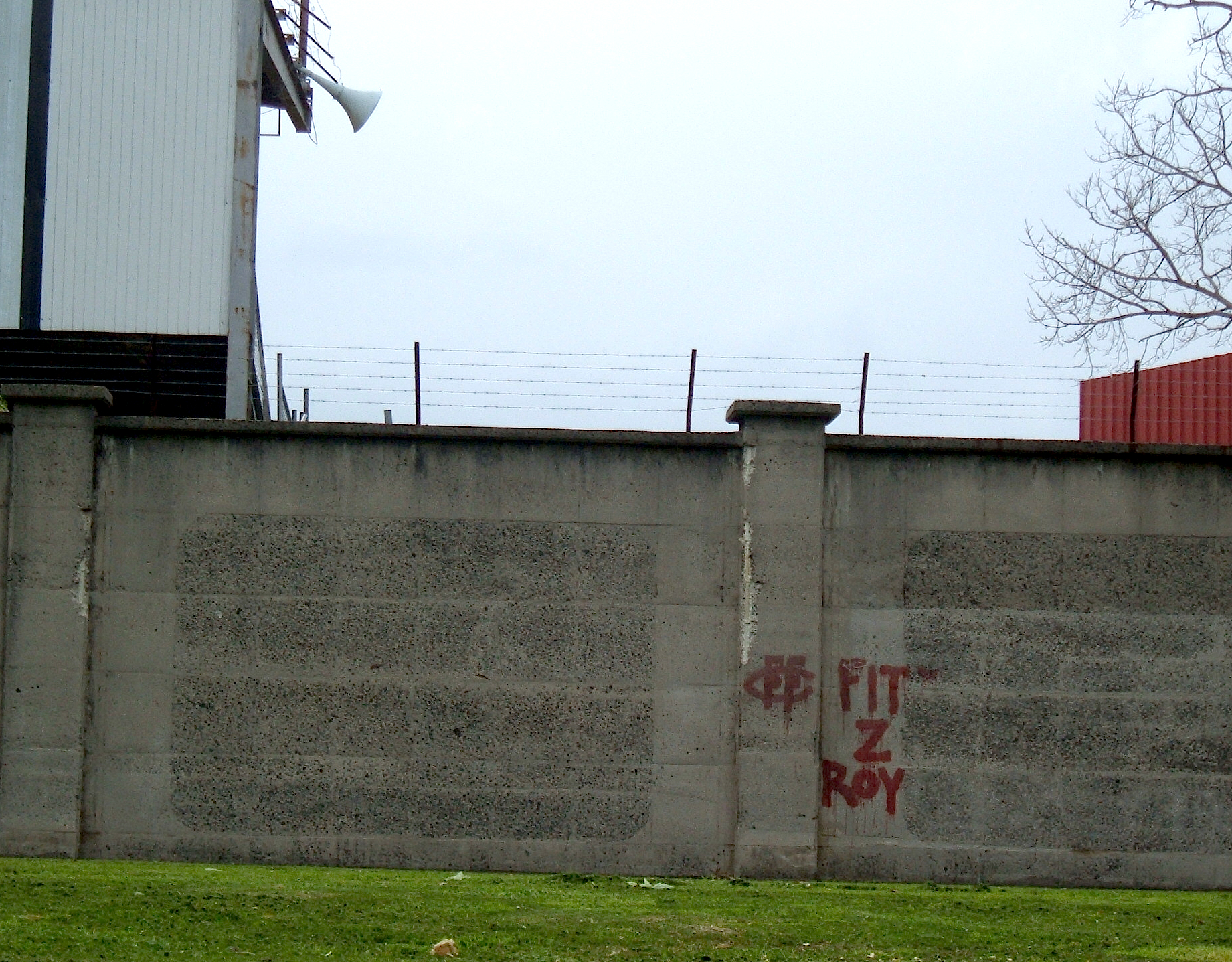
Happy Snap #13 Fit-Z-roy

I snapped this lovely little bit of graffiti on Collingwood’s Vic Park wall back in the mid 2000’s, the Roy Boys long gone and Victoria Park in a state of decay. Most of the wall is gone, and tag most certainly gone, yet Vic Park has been spruced up somewhat and I plan to feature it in a post soon. The photo just appeals to me, the industrial, near jail-like appearance of the ground with the word Fitzroy written in such a way as to suggest Franco Cozzo was pronouncing it.. “Fit-z-roy!”