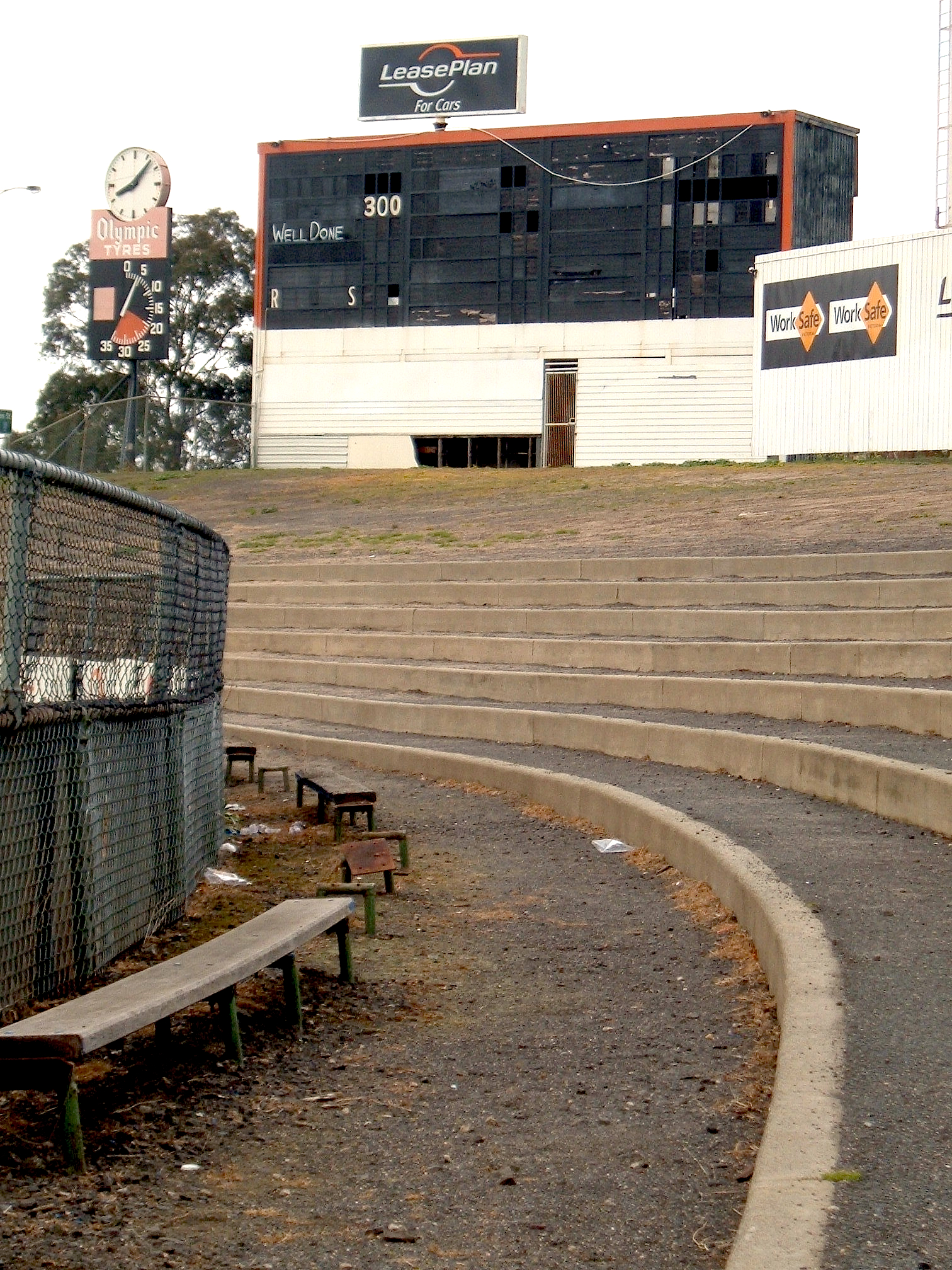
Scoreboard Pressure – Western Oval

Be sure to check out Vin Maskell’s piece on the Western/Whitten Oval for his sight Scoreboard Pressure, an in depth look at scoreboards from a scoreboard enthusiast! A big thanks to Vin for using some of my photos, much appreciated and glad they could be of use!

http://scoreboardpressure.com/2012/06/04/whitten-oval-footscray-victoria/


Happy Snap #14 – Punt Road panorama circa 1966

With the announcement that Richmond’s famous and fantastically located Punt Road Oval is set to undergo a significant redevelopment, I thought it appropriate to share with you some old pics that my dad took. He often bemoans his lack of forsight in taking a camera to the footy in the 50’s, 60’s and 70’s, but there were three significant occasions he thankfully documented.

One occasion was his photos post siren of the 1967 grand final, another from Kevin Barlett’s 400th match, both times taken from the middle deck of the old Northern Stand. The other is slightly more obscure, but none-the less significant. Dad, a teen at the time, had heard rave reports of the Tigers new signing from Tassie, Royce Hart. So he headed to Punt Road for the Richmond intra-club match, and was so excited that he brought his camera. Dad took several snaps from the recently demolished cricketers stand, and luckily he took enough that I was able to piece them together some years ago to form the below panoramic view of Punt Road circa 1966.

Apologies for my unfinished photoshop work…I haven’t had the time to do a better job of it! On my list of things to do! Pretty long list that!

Here are Tony Greenberg’s recollections of the following years intra-club, on richmondfc.com.au.

http://www.richmondfc.com.au/news/newsarticle/tabid/6301/newsid/108329/default.aspx

Adelaide v The Eagles


West Coast and Adelaide are often lumped together. Both teams represent their state’s local leagues, the WAFL and the SANFL, and are considered the ‘big brother’ of their respective cross town rivals, Fremantle and Port Adelaide. Both also enjoyed early success, prising away two flags each from a bitter Victorian landscape during the 1990’s.

Why is it then that I consider Adelaide a bona fide footy club, and the Eagles still as a franchise, a bit plastic? I was only 6 when they entered the competition so I’ve grown up with them, but there’s something not quite right for me.

So what’s in a name?

Let’s start with Adelaide. It is what it is, it represents the town of….Adelaide! The previous incarnation of the Adelaide Football Club disbanded in 1893 and is in no way connected to the current day club, which meant that upon entrance to the AFL in 1991, their was no hesitation in simply calling the club Adelaide.

West Coast on the other hand is to me a vague choice of name to represent a Perth based club. In their defence, the name Perth Football Club was already taken, the Perth Demons being a member of the WAFL. However, the ‘West Coast’ of Australia represents a landmass four to five times larger larger the United Kingdom, and as all landmasses possess a west coast, to me the name is generic and far from inspiring.

Think I’m being harsh? Consider the words of respected footy commentator and proud West Australian Dennis Cometti. He describes the “dumb name” as “American crapola!” The usually affable Cometti continued “It’s a real blight on the competition.”
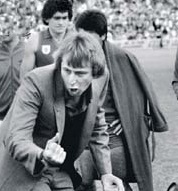
Cometti coaching WAFL side West Perth, who he also played with. Image from- http://www.theage.com.au/ffximage/2005/08/26/cometti.jpg

Part of Cometti’s reasoning is a lack of a geographical focus. “I have struck many people who I have met overseas who follow Australian rules who ask me where West Coast is located. They ask me how far from Melbourne is it.” The Perth Eagles is Cometti’s preferred choice.

While the name ‘Perth’ was out of reach, perhaps something such as ‘Greater Perth’ could have worked. That’s what marketing and branding people are out there for. ‘West Coast’ seems a poor choice.

Nicknames and Monikers

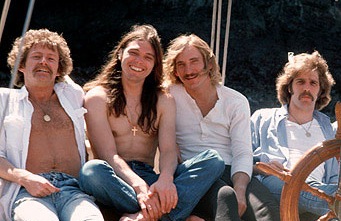
The Eagles. Easy listening pop-rock music, from the West Coast of the USA. That’s right, ‘West Coast Eagles’ conjures up images of harmonic pop melodies, sweetly sung by hairy, good natured ‘boy next door’ types. It hardly sounds befitting of a hard and tough football team, which is what West Coast have been for the majority of their existence.

The Eagles from the US West Coast. Perhaps Eagle Ben Cousins modelled his open shirt look from the bloke on the left? Image from-http://images.paraorkut.com/img/artists/images/t/the_eagles-1137.jpg

But what should a team from Perth have been called? Like the Perth name was taken, so was the obvious W.A football name of Swans; snatched by South Melbourne after an influx of West Australian recruits many years ago. The state team was also known as the ‘Sandgropers,’ a colloquial term for West Australians. However ‘Greater Perth Gropers’ would struggle to secure the sponsorship dollars needed to run a football club. I don’t have the answer, but ‘West Coast’ with ‘Eagles’ is too American.

Compare this with Adelaide’s moniker, the Crows. This is no throw-away nickname, instead it is steeped in more history than most. South Australia’s state football team has been long known as the Croweaters, a unique name which started out as a term of ridicule. It can be traced back to 1851, seven years before the recognised ‘beginnings’ of our national game began fragmenting themselves together.

As the South Australians rushed to the Victorian gold fields they began to run low on food, so out of necessity, “killed, cooked and ate some crows.” Arriving at the gold fields in a “very hard up state” and after relating their experiences, they were soon dubbed the ‘croweaters.’ The name stuck.

So whilst ‘Crow-eaters’ and ‘Crows’ confusingly brings up thoughts of cannibalism, this too adds to their footy club culture, as all the old clubs have the ability to ‘eat their own’ in times of trouble.

The Jumper

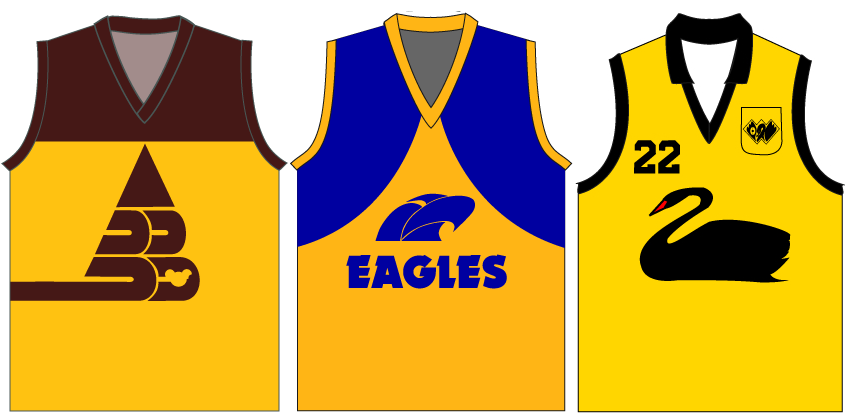
We now turn our attention the two teams guernsey designs. This is important to me. If the jumper is right, I can turn a blind eye to other aspects. When West Coast and the Brisbane Bears entered the VFL competition in 1987, they brought with them two jumpers which challenged the definition of a ‘footy jumper.’
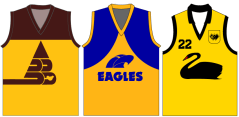
The original 1987 Brisbane and West Coast jumpers, along with the WA state jumper. Upon putting these together I noticed that perhaps a picture of a bird in the middle of the guernsey was possibly a shout out to tradition.

The first thing to notice is that there was far more yellow than had been used in the VFL to that point . But for me this worked, as yellow seemed a colour representative of far warmer climates than the Melbourne competition they were joining. West Australia’s state team had a predominately yellow jumper, and this provided a nice link.

Anthony Costa, whose site http://www.costasportslogos.com/ looks at sporting logos, branding and uniforms amongst other things, also prefers the “gold jumper, which for me is the club’s most distinctive onfield look. There’s a lot of blue and dark sombre colours in the AFL… reckon this jumper would really light things up.”

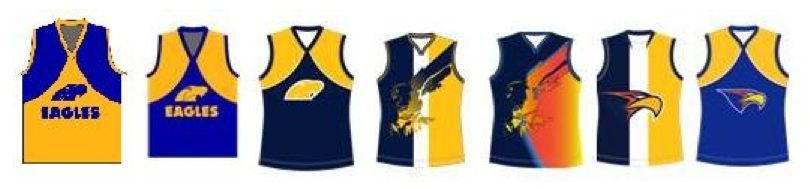
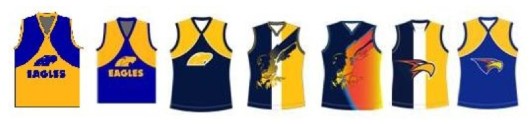
West Coast reversed the colours in 1988, the colour blue becoming the more dominant, though many shades of blue have since been used. I found and continue to find the Eagles jumper a tad fiddley, with both the writing and the picture being rather non-descript when viewed from any distance past ten metres, though the word Eagles is long gone. The guernsey has never felt settled and is often tinkered with. I am still unclear which is their ‘official’ jumper. 
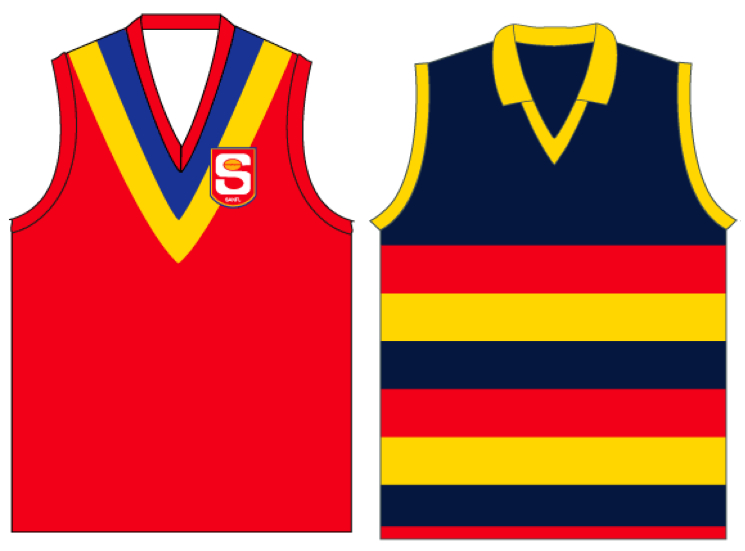
Adelaide on the other hand have ticked ‘all the boxes’ as the clichéd footy saying goes. Their colours, red, blue and yellow are those of their states football team. Their design is simple and striking, like a Geelong jumper on an acid trip.
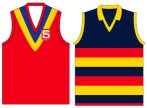
South Australia’s jumper left, Adelaide jumper right.

A look through Adelaide’s home jumpers from 1991 to today shows the most minor of tinkering, which would indicate that they have got it right. No fancy pictures, words or designs, which incidentally are impossible to see as a player is chasing the pigskin in the distance. Just simple, bold colours and patterns.

To illustrate my point, the past few years have seen Port Adelaide, Fremantle and Footscray all simplify their jumpers, removing all imagery, to near-universal praise. Port Adelaide’s current jumper was even designed by a 7 year old fan. Consider all the money wasted on professional advice from marketing and design companies!

Club Song

This is my final point. As a a musician, I can’t help but see this as integral to the fabric and culture of a club. I’ll kick this section off with a tweet I came across after West Coast’s recent thrilling victory over Hawthorn.

Simple statement. True statement. West Coast’s ‘modern’ rock-pop themesong severely lacks the punch and heart thumping pride found in old fashioned brass band music. It sounds corny, but it’s amazing what can happen when you mix a tuba, trombone and banjo with a barbershop quartet on heat! The rock beat which sits behind West Coast’s song also sucks the number dry of emotion and feeling.

*click* West Coast’s themesong (Warning! Contains mediocre footy song!)

While Adelaide’s song is far from the best in the league, again you get the sense that they have aimed for the type of song which blokes can sing together post-match, a cappella. They have the right idea, I’m just not sure about the execution. But it has the desired effect as the Adelaide players congregate post-victory. I think I can even hear the Coodabeens South Aussie representative Greg Champion’s voice in there!

*click* Adelaide’s themesong (Warning! Contains MIDI instruments)

Final thoughts

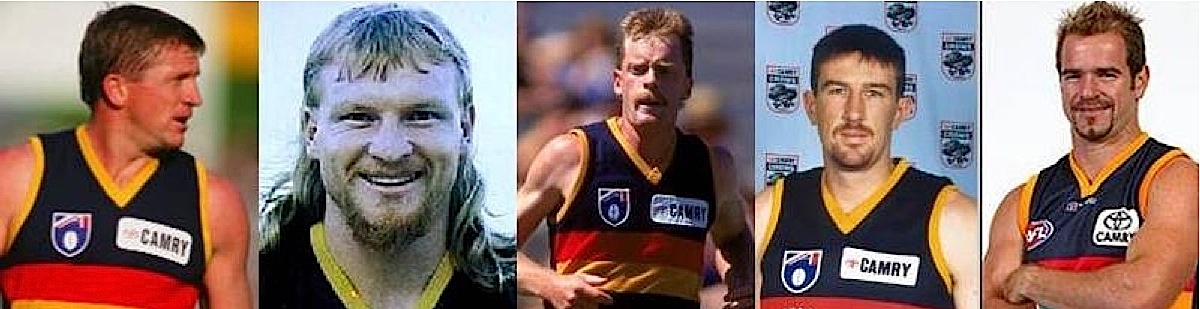
When it comes to club image, marketing and all that jargon, the Crows have just kept it simple and rooted in the past. And just think, anything fancy wouldn’t have matched the heads of McDermott, Weideman, Maynard, Rhenn or Riccoutiou!
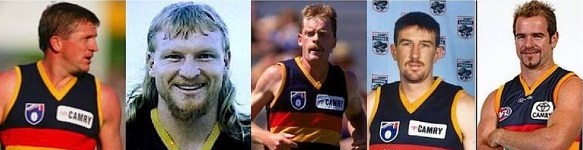
West Coast on other hand were and are a slick, professional outfit. Business like and clean cut, seemingly an emotionless machine. Much of that could have been due to coach Mick Malthouse’s approach and demeanor at the time. But just think of McKenna, Worsfold, Pyke and co…. they would have looked just as comfortable on the footy field as they would have in business suits.

Sure, West Coast had the rough heads of Gastev and Ishchenko run around, while the Crows had glamour boy Modra and the clean-cut Tyson Edwards, but these are the exceptions rather than the rule.

Perhaps the ‘American’ West Coast image suits this club? Perhaps it was what the Eagles founders saw as their aim? But I don’t think so. Think of Worsfold’s toughness, the skill of Matera, Dean Kemp and Guy McKenna’s courage, Ashley McIntosh throwing his light frame around with little regard for himself. What of the toughness of the pint-sized Daniel Kerr, the gut-running of Cousins and Judd, the fear Beau Waters instils in opponents. A team renowned for their miserly defence and toughness.

West Coast Eagle fans, you deserve better. Your club’s image does not match the reality of your club, whilst the Crows, love them or hate them, would appear to have done things well.

What’s your take? I would love to hear from Eagles and Crow fans alike!

With a little help from my friends…

-Click here for more of Anthony Costa’s thoughts on the West Coast logo

-All jumper images were found at footyjumper.com. For a comprehensive look at VFL-AFL and state jumpers, this website will not leave you disappointed! http://www.footyjumpers.com/

Cometti’s comments were courtesy of http://www.perthnow.com.au/sport/west-coast-name-is-dumb/story-e6frg1wu-1111113132067

And the Crow-eaters history lesson was found here- http://www.slsa.sa.gov.au/manning/sa/misc/crema.htm#croweaters
Where’s the Boot?

I’ve been a bit busy of late but rest assured, I have several pieces in the pipeline coming soon. In the meantime, consider this equation of sorts.

7 x 7 = 49

7 goals 7 pts is also 49.

Think about that. Yours in football, Boot

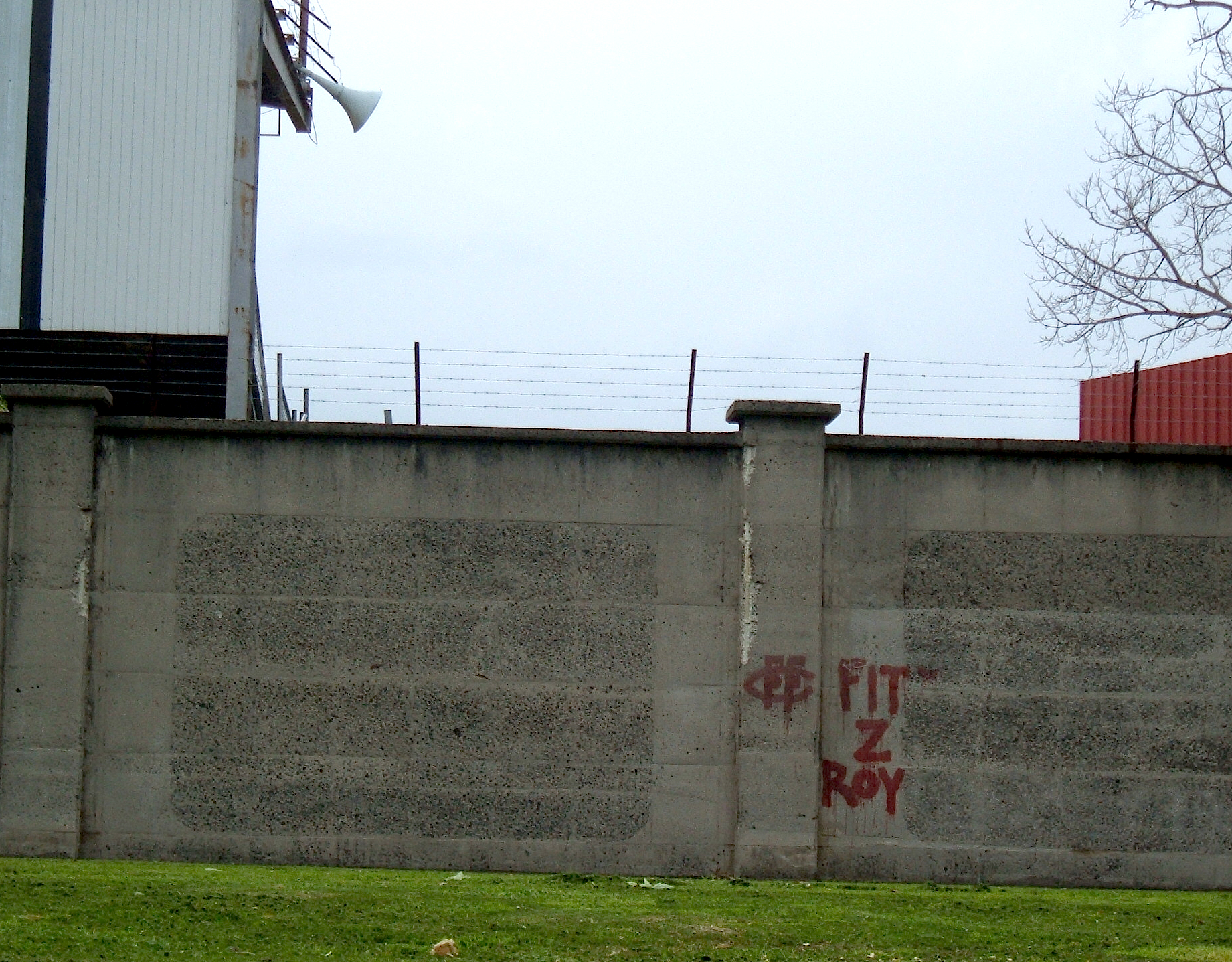
Happy Snap #13 Fit-Z-roy

I snapped this lovely little bit of graffiti on Collingwood’s Vic Park wall back in the mid 2000’s, the Roy Boys long gone and Victoria Park in a state of decay. Most of the wall is gone, and tag most certainly gone, yet Vic Park has been spruced up somewhat and I plan to feature it in a post soon. The photo just appeals to me, the industrial, near jail-like appearance of the ground with the word Fitzroy written in such a way as to suggest Franco Cozzo was pronouncing it.. “Fit-z-roy!”

Home & Away #4 Arden Street Oval

Arden Street: League venue: 1925-1985. League (VFL/AFL) matches: 529 . Record Attendance: 35,000-North Melbourne v Carlton, 1949.

Melbourne’s football grounds tend to reflect the suburb in which they are found. As I’ve already shown you, Glenferrie Oval, in the leafy, well to do suburb of Hawthorn boasted an art-deco stand, while Fitzroy, Melbourne’s first suburb, with somewhat a bohemian past boasted two elegant pavilions, one of which still stands.

North Melbourne’s Arden Street oval on the other hand mirrors it’s working class roots. Much like Footscray’s Western Oval and Collingwood’s Victoria Park, Arden Street was a no-frills football ground with plenty of concrete and grit. It was practical, yet still charming in it’s simplicity.

 To demonstrate Arden Street’s lack of outstanding features, it was an object separate to the ground itself which is still remembered as it’s most endearing feature; a gigantic gasometer which towered over the outer wing. 

The gasometer overlooking Arden St. Image from –http://www.footballinvective.com/2005/0508.html

The gasometer however is long gone, the humble little ground outlasting it’s neighbour. The old stand has made way for North Melbourne’s new training facility, with very little remaining to suggest league football was played at this ground. A few years back I made a few trips to Arden Street, and was able to capture the decaying ruins of a league venue. Being too young to have ever attended or been aware of a match at Arden St, it was with some level of mystery that I ventured to North Melbourne’s spiritual home. Here’s how the ground stood just 5 years ago.

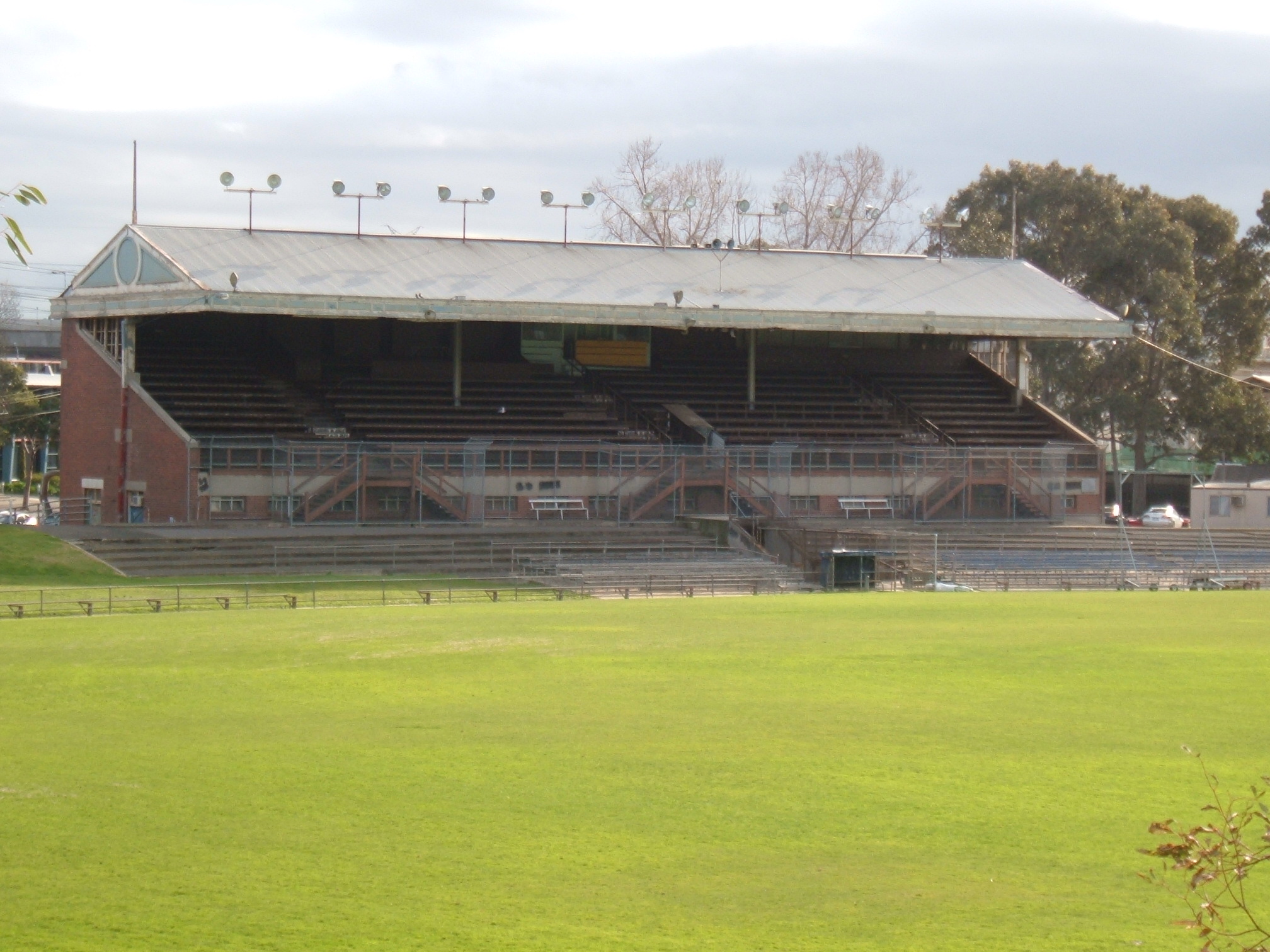
Firstly the old stand, what I would term a very ‘northern suburbs’ pavillion, much the same design as Carlton’s late Heatley Stand and what’s left of Coburg’s grandstand. Incidentally, North used Coburg City Oval as it’s home ground for season 1965, yet returned home the following year.

With the old grandstand still standing proud, though blocked off from the public, this is Arden Street looking much as it had as a league venue, complete with the old undercover betting ring behind the old stand which was in place for the greyhound races that used to grace the ground. It was destroyed by fire in 2006, though its days were numbered.

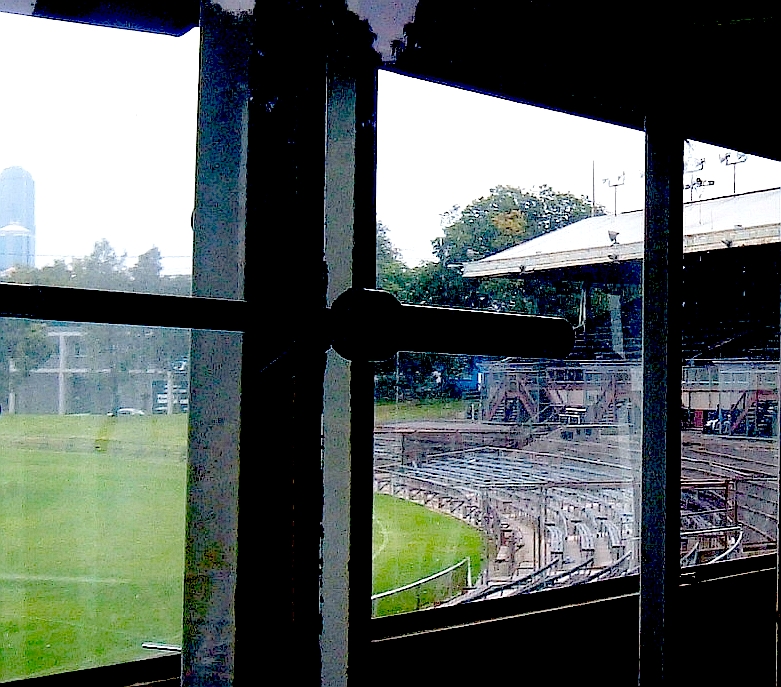
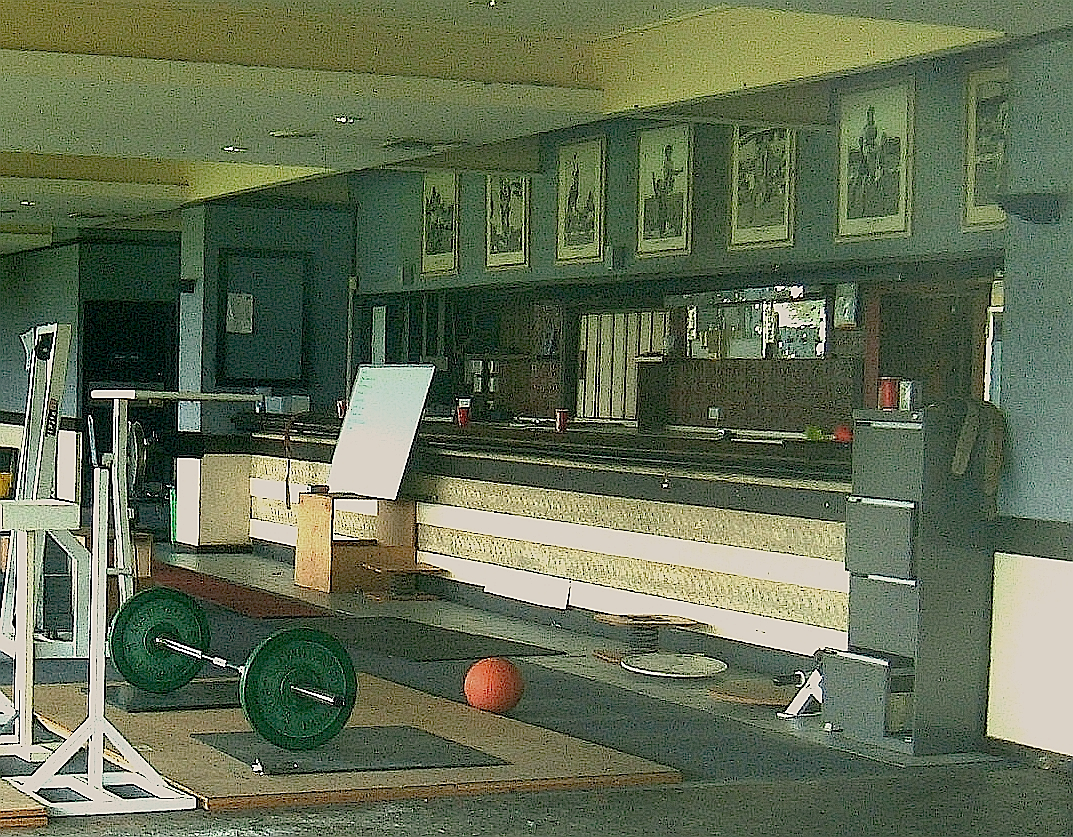
This is a snap taken through the old social club-come-gymnasium window. North Melbourne produced some amazing results in the 1990’s considering their facilities. As North players said throughout their successful era, the “weights are just as heavy as West Coast’s.”

North was renowned for playing hard both on and off the field, yet surely the gymnasium in the bar was taking it a step too far!

As you can see below, the old grandstand was in a state of decay, and though I never like to see a grandstand demolished, what’s more important to me is that North Melbourne is still based at Arden Street Oval. Bulldozing the existing facilities and building up to date ones were the only way that North could stay in it’s own suburb. In a nice touch however, many of the old bricks were used in the new structure.

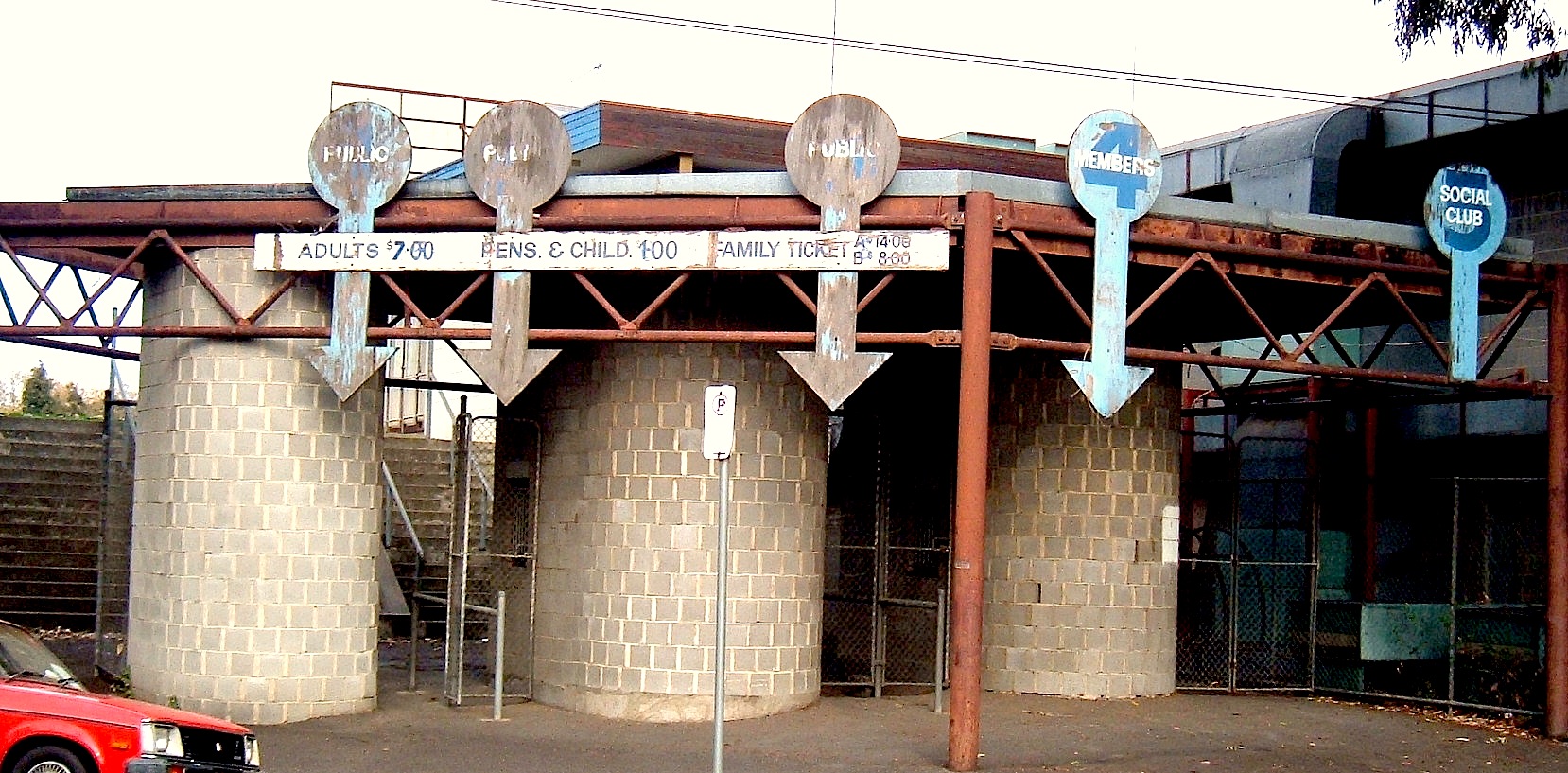
A feature of the ground which I loved was the old entrance next to the social club. It looks to me as though this was one of the last additions to Arden Street as a league venue, coming across as very ’70’s. And what I love here is the glimpse it gives us into 1985, the last year Arden Street was used as a league venue:

Adults $7, Pensioners/Children just $1.00!

Ah…the magic of entering the ground and heading up the stairs to be confronted by the vast field is displayed beautifully here, a feature at many old league and association grounds, and football grounds the world over.

The old players race is about the last remaining feature from days past, other than the oval itself and the grassy contours which once stood as gravelly terraces. The scoreboard and covered shelter areas are long gone and the ground itself has been opened to the public. The seating along the boundary fence also remains, and you can see by the below photo what I meant when I said that Arden Street was a ‘no-frills’ affair.

As I’ve already mentioned, little is left of the outer other than the grassy hills which have replaced the concrete wonderland, so I was surprised to find this little gem which has survived the passages of time. The old ‘Dry Area’ sign still remains at the top of the hill on the outer side, and I had to remove a small branch or two to make the sign visible. The standing room ‘sheds’ that stood on the wing and behind the goals were demolished after the Bradford City fire in England, deemed a fire hazard.

Lastly, I’ll leave you with the words of football great Ron Barassi. This is one of Ron’s quarter time speeches as coach of North Melbourne in the centre of Arden Street oval during the late 1970’s. Let’s just say that Ron did not hold back for the camera! As Ron rants, make sure you take in the footage of old Arden Street as a league venue, the life and colour that once adorned the old ground. Next time you drive past Arden Street, Victoria Park or Windy Hill, it’s worth remembering the contribution they made to football in Victoria. We outgrew them, but they shouldn’t be forgotten.

For more on Arden Street, in particular the scoreboard, check out scoreboard pressure

http://scoreboardpressure.com/2011/06/22/north-melbourne-victoria/

With a little help from my friends…

http://stats.rleague.com/afl/venues/arden_st.html

http://en.wikipedia.org


The Melbourne Jemons?

My friend and fellow football-devotee Gareth was listening to the West Coast v Melbourne match just a couple of weeks ago on the wireless, and couldn’t help but notice the immense number of players in red and blue whose name started with the letter ‘J’.

On closer inspection, he found that no less than eleven Melbourne players names began with the letter ‘J’ in the round 3 match, which may be some sort of record. I haven’t had the time to check as yet. Eleven, that’s 50% of the team.

They were as follows…

Jamie Bennell, James Frawley, Jack Grimes, Jeremy Howe, Joel Macdonald, James Magner, Jordie McKenzie, Jared Rivers, James Sellar, Jack Trengove, Jack Watts.

I’ve hear Gold Coast’s Karmichael Hunt referred to as ‘K’, but the Demons will need to be a little more creative with their nicknames. Perhaps that has been the problem these first few rounds.

‘J’ is for Jumper…Melbourne’s proposed 2012 guernsey

Happy Snap #12 My favourite Player

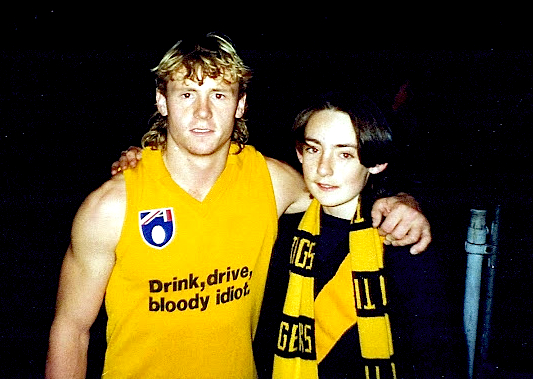
Stuart Maxfield and yours truly, circa 1994…as if the hair cuts didn’t give that away!

I think that this photograph speaks for itself. The year is 1994. It is my 13th birthday. As a gift of sorts, I was taken to Richmond training at Punt Road. Of course, training was still a Tuesday  and Thursday night affair hence all the darkness.

Richmond had just won four matches on the trot, in what was to that stage by far the most successful and exciting period I had encountered as a young Richmondite. The boys had just defeated Adelaide at Football Park, a year after being embarrassed at the same venue by 137 points. We went on to finish 9th….a joke now but a vast improvement at the time.

Stuart Maxfield. I have never had a player before or since I have loved as much. This may seem odd to some while others may relate. He was scruffy and a bit wild. He thumped the ball onto his boot in the strangest of fashions, and when it worked he could thump it 65 metres. At times it didn’t work but that didn’t bother me. I had his number 27 on my short sleeved guernsey. I bought the numbers and sewed them on myself. The 7 fell off.

I was heartbroken when, after season 1995, which had been a wild and heady time for this young Tiger, both he and coach John Northey departed Punt Road… Stu to Sydney and Northey to Brisbane. And so it came to be that in 1996, I ventured to Waverley Park to see Maxfield in red and white take the field against Richmond. A truly odd sensation. But the game is the game, and once the ball was bounced, it was only a Richmond victory that occupied my thought.

However I did smash my flag in two pieces at the games conclusion, perhaps a mixture of anguish that Chris Bond’s ‘winning’ goal had been disallowed and the subconscious stress of watching my favourite player running around for the opposition.

Seeing Stuart Maxfield named as captain of the Sydney Swans late in his career gave me a sense of pride. Although I’d far prefer that he’d stayed at Tigerland, he sensed that Sydney would provide him with more options, and it appeared to happen that way. It would have been lovely to see him lift the Swans 2005 premiership cup aloft, yet injury cruelled him at the wrong time. I still comfort myself with the fact that he was officially the captain of a club the year it won a premiership.

Stu Maxfield…a fine footballer.

Photo taken by mum…Joy Carr

Video #5 Richie’s Tips

My one year old son Richie joined our family footy tipping competition this year. My dad has been running it for 22 years, people have come and gone, but I can officially say that Richie is our youngest ever tipster. And what a start he made, tipping 8 out of 9 in round one of this season…beginners luck or does he just have the knack?

So here is how little Rich tips. Some use their heads, some their hearts. Rich uses his…..I don’t really know? Just watch!